Thank you for visiting SNEWPapers!
Sign up free
Story
March 23, 1922
The Glenwood Post
Glenwood Springs, Garfield County, Colorado
What is this article about?
Article by Edward G. Lowry discusses U.S. government expenditures for fiscal years 1921-1922, quoting Treasury Secretary Mellon and R.C. Leffingwell on the need for retrenchment and economy to reduce tax burdens, criticizing wasteful spending and calling for public involvement.
Clipping
OCR Quality
98%
Excellent
Full Text
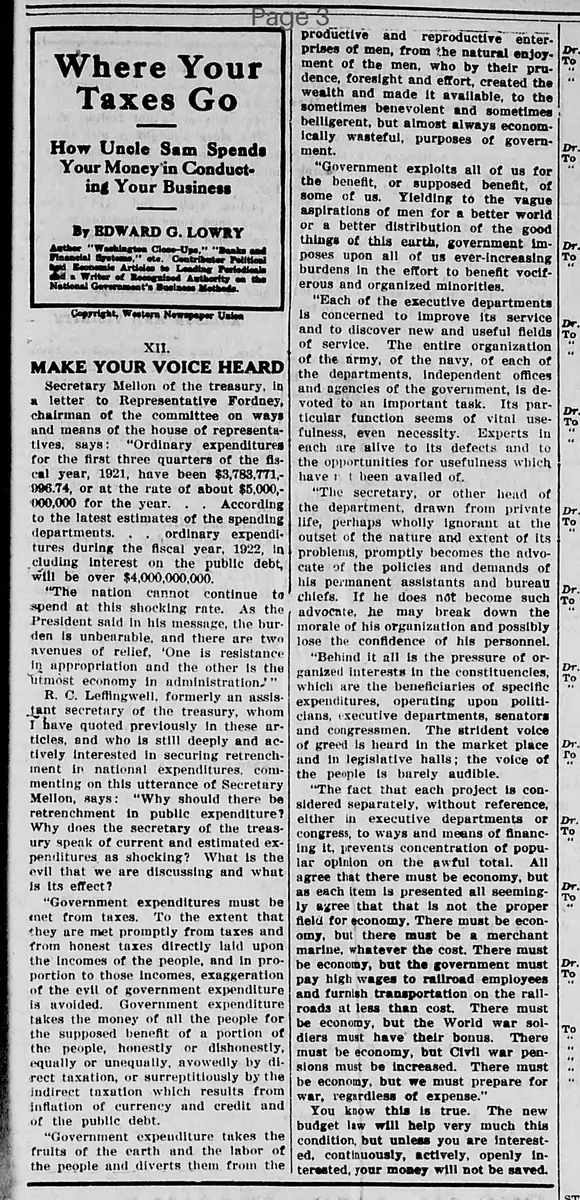
Where Your Taxes Go
How Uncle Sam Spends Your Money in Conducting Your Business
By EDWARD G. LOWRY
Copyright, Western Newspaper Union
XII
MAKE YOUR VOICE HEARD
Secretary Mellon of the treasury, in letter to Representative Fordney, chairman of the committee on ways and means of the house of representatives, says:
"Ordinary expenditures for the first three quarters of the fiscal year, 1921, have been $3,783,771,996.74, or at the rate of about $5,000,000,000 for the year. . . According to the latest estimates of the spending departments, ordinary expenditures during the fiscal year, 1922, including interest on the public debt, will be over $4,000,000,000.
"The nation cannot continue to spend at this shocking rate. As the President said in his message, the burden is unbearable, and there are two avenues of relief. One is resistance in appropriation and the other is the utmost economy in administration."
R. C. Leffingwell, formerly an assistant secretary of the treasury, whom I have quoted previously in these articles, and who is still deeply and actively interested in securing retrenchment in national expenditures, commenting on this utterance of Secretary Mellon, says: "Why should there be retrenchment in public expenditure?
Why does the secretary of the treasury speak of current and estimated expenditures as shocking? What is the evil that we are discussing and what is its effect?
"Government expenditures must be met from taxes. To the extent that they are met promptly from taxes and from honest taxes directly laid upon the incomes of the people, and in proportion to those incomes, exaggeration of the evil of government expenditure is avoided. Government expenditure takes the money of all the people for the supposed benefit of a portion of the people, honestly or dishonestly, equally or unequally, avowedly by direct taxation, or surreptitiously by the indirect taxation which results from inflation of currency and credit and of the public debt.
"Government expenditure takes the fruits of the earth and the labor of the people and diverts them from the productive and reproductive enterprises of men, from the natural enjoyment of the men, who by their prudence, foresight and effort, created the wealth and made it available, to the sometimes benevolent and sometimes belligerent, but almost always economically wasteful, purposes of government.
"Government exploits all of us for the benefit, or supposed benefit, of some of us. Yielding to the vague aspirations of men for a better world or a better distribution of the good things of this earth, government imposes upon all of us ever-increasing burdens in the effort to benefit vociferous and organized minorities.
"Each of the executive departments is concerned to improve its service and to discover new and useful fields of service. The entire organization of the army, of the navy, of each of the departments, independent offices and agencies of the government, is devoted to an important task. Its particular function seems of vital usefulness, even necessity. Experts in each are alive to its defects and to the opportunities for usefulness which have not been availed of.
"The secretary, or other head of the department, drawn from private life, perhaps wholly ignorant at the outset of the nature and extent of its problems, promptly becomes the advocate of the policies and demands of his permanent assistants and bureau chiefs. If he does not become such advocate, he may break down the morale of his organization and possibly lose the confidence of his personnel.
"Behind it all is the pressure of organized interests in the constituencies, which are the beneficiaries of specific expenditures, operating upon politicians, executive departments, senators and congressmen. The strident voice of greed is heard in the market place and in legislative halls: the voice of the people is barely audible.
"The fact that each project is considered separately, without reference, either in executive departments or congress, to ways and means of financing it, prevents concentration of popular opinion on the awful total. All agree that there must be economy, but as each item is presented all seemingly agree that that is not the proper field for economy. There must be economy, but there must be a merchant marine, whatever the cost. There must be economy, but the government must pay high wages to railroad employees and furnish transportation on the railroads at less than cost.
There must be economy, but the World war soldiers must have their bonus. There must be economy, but Civil war pensions must be increased. There must be economy, but we must prepare for war, regardless of expense.
You know this is true. The new budget law will help very much this condition, but unless you are interested, continuously, actively, openly interested, your money will not be saved.
How Uncle Sam Spends Your Money in Conducting Your Business
By EDWARD G. LOWRY
Copyright, Western Newspaper Union
XII
MAKE YOUR VOICE HEARD
Secretary Mellon of the treasury, in letter to Representative Fordney, chairman of the committee on ways and means of the house of representatives, says:
"Ordinary expenditures for the first three quarters of the fiscal year, 1921, have been $3,783,771,996.74, or at the rate of about $5,000,000,000 for the year. . . According to the latest estimates of the spending departments, ordinary expenditures during the fiscal year, 1922, including interest on the public debt, will be over $4,000,000,000.
"The nation cannot continue to spend at this shocking rate. As the President said in his message, the burden is unbearable, and there are two avenues of relief. One is resistance in appropriation and the other is the utmost economy in administration."
R. C. Leffingwell, formerly an assistant secretary of the treasury, whom I have quoted previously in these articles, and who is still deeply and actively interested in securing retrenchment in national expenditures, commenting on this utterance of Secretary Mellon, says: "Why should there be retrenchment in public expenditure?
Why does the secretary of the treasury speak of current and estimated expenditures as shocking? What is the evil that we are discussing and what is its effect?
"Government expenditures must be met from taxes. To the extent that they are met promptly from taxes and from honest taxes directly laid upon the incomes of the people, and in proportion to those incomes, exaggeration of the evil of government expenditure is avoided. Government expenditure takes the money of all the people for the supposed benefit of a portion of the people, honestly or dishonestly, equally or unequally, avowedly by direct taxation, or surreptitiously by the indirect taxation which results from inflation of currency and credit and of the public debt.
"Government expenditure takes the fruits of the earth and the labor of the people and diverts them from the productive and reproductive enterprises of men, from the natural enjoyment of the men, who by their prudence, foresight and effort, created the wealth and made it available, to the sometimes benevolent and sometimes belligerent, but almost always economically wasteful, purposes of government.
"Government exploits all of us for the benefit, or supposed benefit, of some of us. Yielding to the vague aspirations of men for a better world or a better distribution of the good things of this earth, government imposes upon all of us ever-increasing burdens in the effort to benefit vociferous and organized minorities.
"Each of the executive departments is concerned to improve its service and to discover new and useful fields of service. The entire organization of the army, of the navy, of each of the departments, independent offices and agencies of the government, is devoted to an important task. Its particular function seems of vital usefulness, even necessity. Experts in each are alive to its defects and to the opportunities for usefulness which have not been availed of.
"The secretary, or other head of the department, drawn from private life, perhaps wholly ignorant at the outset of the nature and extent of its problems, promptly becomes the advocate of the policies and demands of his permanent assistants and bureau chiefs. If he does not become such advocate, he may break down the morale of his organization and possibly lose the confidence of his personnel.
"Behind it all is the pressure of organized interests in the constituencies, which are the beneficiaries of specific expenditures, operating upon politicians, executive departments, senators and congressmen. The strident voice of greed is heard in the market place and in legislative halls: the voice of the people is barely audible.
"The fact that each project is considered separately, without reference, either in executive departments or congress, to ways and means of financing it, prevents concentration of popular opinion on the awful total. All agree that there must be economy, but as each item is presented all seemingly agree that that is not the proper field for economy. There must be economy, but there must be a merchant marine, whatever the cost. There must be economy, but the government must pay high wages to railroad employees and furnish transportation on the railroads at less than cost.
There must be economy, but the World war soldiers must have their bonus. There must be economy, but Civil war pensions must be increased. There must be economy, but we must prepare for war, regardless of expense.
You know this is true. The new budget law will help very much this condition, but unless you are interested, continuously, actively, openly interested, your money will not be saved.
What sub-type of article is it?
Editorial
Economic Commentary
What themes does it cover?
Misfortune
Moral Virtue
What keywords are associated?
Government Expenditures
Taxes
Retrenchment
Economy
Public Debt
Budget Law
What entities or persons were involved?
Edward G. Lowry
Secretary Mellon
Representative Fordney
R. C. Leffingwell
President
Where did it happen?
United States
Story Details
Key Persons
Edward G. Lowry
Secretary Mellon
Representative Fordney
R. C. Leffingwell
President
Location
United States
Event Date
1921 1922
Story Details
Article critiques high U.S. government expenditures in 1921-1922, quotes Mellon on shocking rates and need for economy, Leffingwell explains burdens of taxation and waste, urges public to demand retrenchment against special interests.