Thank you for visiting SNEWPapers!
Sign up free
The Prison Mirror
Stillwater, Washington County, Minnesota
What is this article about?
A London Daily News correspondent, posing as an antiquarian, gains rare access to the 'Kirschana' prison in Uskub, Macedonia, revealing horrific conditions: overcrowded, filthy cells with high mortality, starvation, torture methods like ant bites and sun exposure, affecting hundreds of prisoners under Ottoman rule.
Clipping
OCR Quality
Full Text
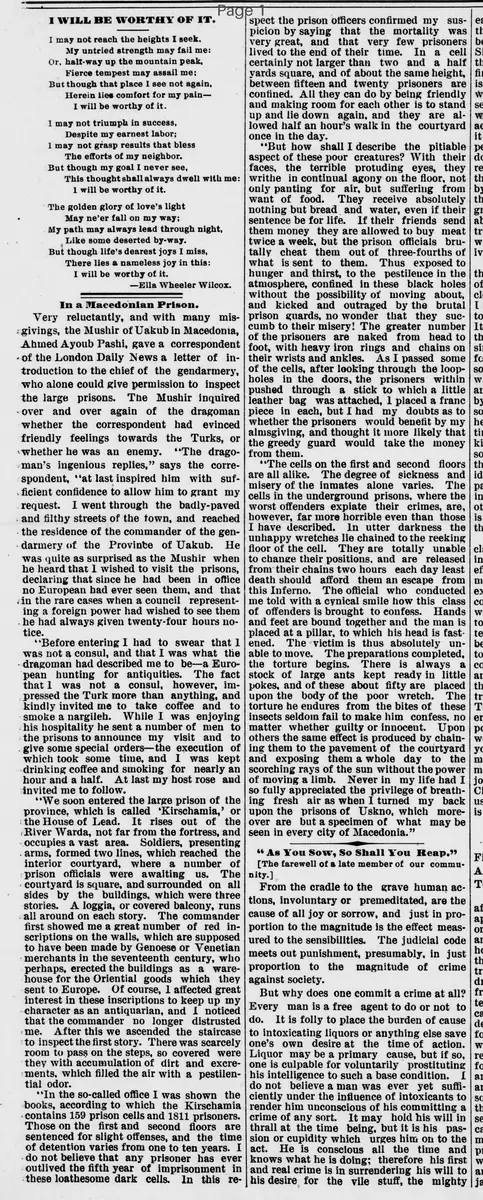
Very reluctantly, and with many misgivings, the Mushir of Uskub in Macedonia, Ahmed Ayoub Pashi, gave a correspondent of the London Daily News a letter of introduction to the chief of the gendarmery, who alone could give permission to inspect the large prisons. The Mushir inquired over and over again of the dragoman whether the correspondent had evinced friendly feelings towards the Turks, or whether he was an enemy. "The dragoman's ingenious replies," says the correspondent, "at last inspired him with sufficient confidence to allow him to grant my request. I went through the badly-paved and filthy streets of the town, and reached the residence of the commander of the gendarmery of the Province of Uskub. He was quite as surprised as the Mushir when he heard that I wished to visit the prisons, declaring that since he had been in office no European had ever seen them, and that in the rare cases when a council representing a foreign power had wished to see them he had always given twenty-four hours notice.
"Before entering I had to swear that I was not a consul, and that I was what the dragoman had described me to be-a European hunting for antiquities. The fact that I was not a consul, however, impressed the Turk more than anything, and kindly invited me to take coffee and to smoke a nargileh. While I was enjoying his hospitality he sent a number of men to the prisons to announce my visit and to give some special orders-the execution of which took some time, and I was kept drinking coffee and smoking for nearly an hour and a half. At last my host rose and invited me to follow.
"We soon entered the large prison of the province, which is called 'Kirschana,' or 'the House of Lead.' It rises out of the River Varda, not far from the fortress, and occupies a vast area. Soldiers, presenting arms, formed two lines, which reached the interior courtyard, where a number of prison officials were awaiting us. The courtyard is square, and surrounded on all sides by the buildings, which were three stories. A loggia, or covered balcony, runs all around on each story. The commander first showed me a great number of red inscriptions on the walls, which are supposed to have been made by Genoese or Venetian merchants in the seventeenth century, who perhaps erected the buildings as a warehouse for the Oriental goods which they sent to Europe. Of course, I affected great interest in these inscriptions to keep up my character as an antiquarian, and I noticed that the commander no longer distrusted me. After this we ascended the staircase to inspect the first story. There was scarcely room to pass on the steps, so covered were they with accumulation of dirt and excrement, which filled the air with a pestilential odor.
"In the so-called office I was shown the books, according to which the Kirschana contains 159 prison cells and 1811 prisoners. Those on the first and second floors are sentenced for slight offenses, and the time of detention varies from one to ten years. I do not believe that any prisoner has ever outlived the fifth year of imprisonment in these loathsome dark cells. In this respect the prison officers confirmed my suspicion by saying that the mortality was very great, and that very few prisoners lived to the end of their time. In a cell certainly not larger than two and a half yards square, and of about the same height between fifteen and twenty prisoners are confined. All they can do by being friendly and making room for each other is to stand up and lie down again, and they are allowed half an hour's walk in the courtyard once in the day.
"But how shall I describe the pitiable aspect of these poor creatures? With their faces, the terrible protruding eyes, they writhe in continual agony on the floor, not only panting for air, but suffering from want of food. They receive absolutely nothing but bread and water, even if their sentence be for life. If their friends send them money they are allowed to buy meat twice a week, but the prison officials brutally cheat them out of three-fourths of what is sent to them. Thus exposed to hunger and thirst, to the pestilence in the atmosphere, confined in these black holes without the possibility of moving about, and kicked and outraged by the brutal prison guards, no wonder that they succumb to their misery! The greater number of the prisoners are naked from head to foot, with heavy iron rings and chains on their wrists and ankles. As I passed some of the cells, after looking through the loop-holes in the doors, the prisoners within pushed through a stick to which a little leather bag was attached, I placed a franc piece in each, but I had my doubts as to whether the prisoners would benefit by my almsgiving, and thought it more likely that the greedy guard would take the money from them.
"The cells on the first and second floors are all alike. The degree of sickness and misery of the inmates alone varies. The cells in the underground prisons, where the worst offenders expiate their crimes, are, however, far more horrible even than those I have described. In utter darkness the unhappy wretches lie chained to the reeking floor of the cell. They are totally unable to change their positions, and are released from their chains two hours each day lest death should afford them an escape from this Inferno. The official who conducted me told with a cynical smile how this class of offenders is brought to confess. Hands and feet are bound together and the man is placed at a pillar, to which his head is fastened. The victim is thus absolutely unable to move. The preparations completed, the torture begins. There is always a stock of large ants kept ready in little pails, and of these about fifty are placed upon the body of the poor wretch. The torture he endures from the bites of these insects seldom fail to make him confess, no matter whether guilty or innocent. Upon others the same effect is produced by chaining them to the pavement of the courtyard and exposing them a whole day to the scorching rays of the sun without the power of moving a limb. Never in my life had I so fully appreciated the privilege of breathing fresh air as when I turned my back upon the prisons of Uskub, which moreover are but a specimen of what may be seen in every city of Macedonia."
What sub-type of article is it?
What keywords are associated?
What entities or persons were involved?
Where did it happen?
Foreign News Details
Primary Location
Uskub, Macedonia
Key Persons
Outcome
high mortality rate in prisons; very few prisoners survive to end of sentence; 1811 prisoners in 159 cells
Event Details
Correspondent visits Kirschana prison in Uskub after gaining permission from Mushir Ahmed Ayoub Pashi and gendarmery commander; describes overcrowded, filthy cells with 15-20 prisoners in small spaces, starvation on bread and water, cheating by officials, chaining, and tortures like ant bites and sun exposure for confessions; underground cells worse with total darkness and immobility.