Thank you for visiting SNEWPapers!
Sign up free
Literary
October 10, 1850
Western Union
Hannibal, Marion County, Missouri
What is this article about?
Arthur J. Stansbury recounts the 1788 Philadelphia procession celebrating the Federal Constitution's adoption by ten states, detailing preparations, vessels, floats like the eagle car and Indian chief, emblems of industry and peace, and a united clerical group, ending at Bush Hill.
Clipping
OCR Quality
98%
Excellent
Full Text
From Arthur's Home Gazette,
The National
CELEBRATION IN 1788,
In Honor of the Adoption of the Federal
CONSTITUTION.
BY ARTHUR J. STANSBURY.
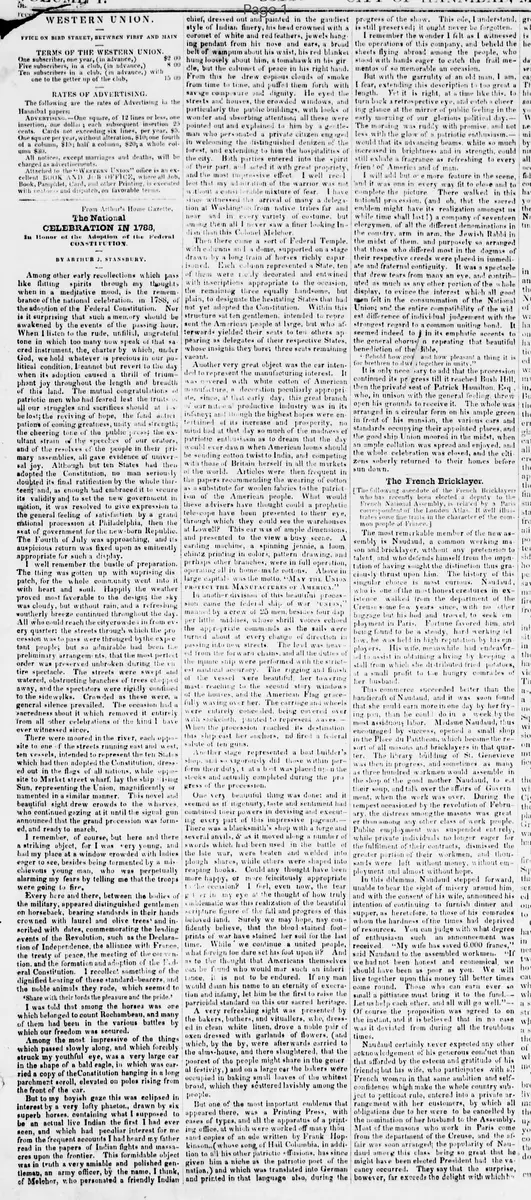
Among other early recollections which pass like flitting spirits through my thoughts when in a meditative mood, is the remembrance of the national celebration, in 1788, of the adoption of the Federal Constitution. Nor is it surprising that such a memory should be awakened by the events of the passing hour. When I listen to the rude, unfilial, ungrateful tone in which too many now speak of that sacred instrument, the charter by which, under God, we hold whatever is precious in our political condition, I cannot but revert to the day when its adoption caused a thrill of triumphant joy throughout the length and breadth of this land. The mutual congratulations of patriotic men who had feared lest the fruits of all our struggles and sacrifices should at last be lost; the reviving of hope, the fond anticipation of coming greatness, unity and strength; the cheering tone of the public press; the exultant strain of the speeches of our orators, and of the resolves of the people in their primary assemblies, all gave evidence of universal joy. Although but ten States had then adopted the Constitution, no man seriously doubted its final ratification by the whole thirteen; and, as enough had embraced it to secure its validity and to set the new government in motion, it was resolved to give expression to the general feeling of satisfaction by a grand national procession at Philadelphia, then the seat of government for the new-born Republic. The Fourth of July was approaching, and its auspicious return was fixed upon as eminently appropriate for such a display.
I well remember the bustle of preparation. The thing was gotten up with surprising dispatch, for the whole community went into it with heart and soul. Happily the weather proved most favorable to the design; the sky was cloudy, but without rain, and a refreshing westerly breeze continued throughout the day. All who could reach the city crowded in from every quarter: the streets through which the procession was to pass were thronged by the expectant people; but so admirable had been the preliminary arrangements, that the most perfect order was preserved unbroken during the entire spectacle. The streets were swept and watered, obstructing branches of trees chopped away, and the spectators were rigidly confined to the sidewalks. Crowded as these were, a general silence prevailed. The occasion had a sacredness about it which removed it entirely from all other celebrations of the kind I have ever witnessed since.
There were moored in the river, each opposite to one of the streets running east and west, ten vessels, intended to represent the ten States which had then adopted the Constitution, dressed out in the flags of all nations, while opposite to Market street wharf, lay the ship Rising Sun, representing the Union, magnificently ornamented in a similar manner. This novel and beautiful sight drew crowds to the wharves who continued gazing at it until the signal gun announced that the grand procession was formed, and ready to march.
I remember, of course, but here and there a striking object, for I was very young, and had my place at a window crowded with ladies eager to see, besides being tormented by a mischievous young man, who was perpetually alarming my fears by telling me that the troops were going to fire.
Every here and there, between the bodies of the military, appeared distinguished gentlemen on horseback, bearing standards in their hands crowned with laurel and olive wreaths, and inscribed with dates, commemorating the leading events of the Revolution, such as the Declaration of Independence, the alliance with France, the treaty of peace, the meeting of the convention, and the formation and adoption of the Federal Constitution. I recollect something of the dignified bearing of these standard-bearers, and the noble animals they rode, which seemed to share with their lords the pleasure and the pride.
I was told that among the horses was one which belonged to Count Rochambeau, and many of them had been in the various battles by which our freedom was secured.
Among the most impressive of the things which passed slowly along, and which forcibly struck my youthful eye, was a very large car in the shape of a bald eagle, in which was carried a copy of the Constitution hanging in a long parchment scroll, elevated on poles rising from the front of the car.
But to my boyish gaze this was eclipsed in interest by a very lofty phaeton, drawn by six superb horses, containing what I supposed to be an actual live Indian the first I had ever seen, and which had peculiar interest for me from the frequent accounts I had heard my father read in the papers of Indian fights and massacres upon the frontier. This formidable object was in truth a very amiable and polished gentleman, an army officer, by the name, I think, of Melchor, who personated a friendly Indian chief, dressed out and painted in the gaudiest style of Indian finery, his head crowned with a coronet of white and red feathers, jewels hanging pendant from his nose and ears, a broad belt of wampum about his waist, his red blanket hung loosely about him, a tomahawk in his girdle, but the calumet of peace in his right hand. From this he drew copious clouds of smoke from time to time, and puffed them forth with savage composure and dignity. He eyed the streets and houses, the crowded windows, and particularly the public buildings, with looks of wonder and absorbing attention; all these were pointed out and explained to him by a gentleman who personated a private citizen engaged in welcoming the distinguished denizen of the forest, and extending to him the hospitalities of the city. Both parties entered into the spirit of their part, and acted it with great propriety, and the most impressive effect I well recollect that my admiration of the warrior was not without a considerable mixture of fear. I have since witnessed the arrival of many a delegation at Washington's from native tribes far and near and in every variety of costume, but among them all I never saw a finer looking Indian than this Colonel Melchor.
Then there came a sort of Federal Temple with columns and a dome, supported on a stage drawn by a long train of horses richly caparisoned. Each column represented a State, ten of them were richly decorated and entwined with inscriptions appropriate to the occasion, the remaining three equally handsome, but plain, to designate the hesitating States that had not yet adopted the Constitution. Within this structure sat ten gentlemen, intended to represent the American people at large, but who afterwards yielded their seats to ten others appearing as delegates of their respective States, whose insignia they bore; three seats remaining vacant.
Another very great object was the car intended to represent the manufacturing interest. It was covered with white cotton of American manufacture, a decoration peculiarly appropriate, since, at that early day, this great branch of our national productive industry was in its infancy; and though the highest hopes were entertained of its increase and prosperity, no mind had at that day so much of the madness of patriotic enthusiasm as to dream that the day would ever dawn when American looms should be sending cotton twist to India, and competing with those of Britain herself in all the markets of the world. Articles were then frequent in the papers recommending the wearing of cotton as a substitute for woolen fabrics to the patriotism of the American people. What would these advisers have thought could a prophetic telescope have been presented to their eye, through which they could see the warehouses at Lowell? This car was of ample dimensions, and presented to the view a busy scene. A carding machine, a spinning jenny, a loom, chintz printing in colors, pattern drawing, and perhaps other branches, were in full operation, operating all in home-made cottons. Above in large capitals, was the motto, "May The Union PROTECT THE MANUFACTURES OF AMERICA."
In another division of this beautiful procession came the federal ship of war 'Union,' manned by a crew of 25 men, besides four dapper little middies, whose shrill voices echoed the appropriate commands as the sails were turned about at every change of direction in passing into new streets. The lead was heaved from the forward chains, and all the duties of the minute ship were performed with the strictest nautical accuracy. The rigging and finish of the vessel were beautiful, her towering mast, reaching to the second story windows of the houses, and the American Flag gracefully waving over her. The carriage and wheels were entirely concealed, being covered over with sackcloth, painted to represent sails. When the procession reached its destination this ship cast her anchors, and fired a federal salute of ten guns.
Another stage represented a boat builder's shop, and so vigorously did those within perform their duty, that a boat was placed upon the stocks and actually completed during the progress of the procession.
One very beautiful thing was done: and it seemed as if ingenuity, taste and sentiment had combined their powers in devising and executing every part of this impressive pageant. There was a blacksmith's shop with a forge and several anvils, and as it moved along a number of swords which had been used in the battle of the late war, were beaten and welded into plough shares, while others were shaped into reaping hooks. Could any thought have been more happy, or more felicitously appropriate to the occasion? I feel, even now, the tear gathering in my eye at the thought of how truly emblematic was this realization of the beautiful scripture figure of the full and progress of this beloved land. Surely we may hope, nay confidently believe, that the blood stained footprints of war have stained her soil for the last time. While we continue a united people, what foreign foe dare set his foot upon it? And as to the thought that Americans themselves can be found who would mar such an inheritance, it is not to be endured. If any man would damn his name to an eternity of execration and infamy, let him be the first to raise the parricidal standard on this our sacred heritage.
A very refreshing sight was presented by the bakers, butchers, and victuallers, who, dressed in clean white linen, drove a noble pair of oxen dressed with garlands of flowers, (and which, by the by, were afterwards carried to the alms-house, and there slaughtered, that the poorest of the people might share in the general festivity,) and on a large car the bakers were occupied in baking small loaves of the whitest bread, which they scattered lavishly among the people.
But one of the most important emblems that appeared there, was a Printing Press, with cases of types, and all the apparatus of a printing office, at which were worked off many thousand copies of an ode written by Francis Hopkinson, (whose song of Hail Columbia, in addition to all his other patriotic effusions, has since given him a niche as the patriotic poet of the nation,) and which was translated into German and printed in that language also, during the progress of the show. This ode, I understand, is still preserved; it ought never be forgotten.
I remember the wonder I felt as I witnessed the operations of this company, and beheld the sheets flying abroad among the people, who stood with hands eager to catch the frail mementos of so memorable an occasion.
But with the garrulity of an old man, I am, I fear, extending this description to too great a length. Yet it is right, at a time like this, to turn back a retrospective eye, and catch a clearing glance at the mirror of public feeling in the early morning of our glorious political day. The morning was ruddy with promise, and not less with the glow of a patriotic enthusiasm. Would that its advancing beams, while so much increased in brightness and in strength, could still exhale a fragrance as refreshing to every friend of America and of man.
I will add but one more feature in the scene, and it was one in every way fit to close and to complete the picture. There walked in this national procession, (and oh, that the sacred emblem might have its realization amongst us while time shall last!) a company of seventeen clergymen, of all the different denominations in the country, arm in arm, the Jewish Rabbi in the midst of them, and purposely so arranged that those who differed most in the dogmas of their respective creeds were placed in immediate and fraternal contiguity. It was a spectacle that drew tears from many an eye, and contributed as much as any other portion of the whole display, to evince the interest which all good men felt in the consummation of the National Union; and the entire compatibility of the widest difference of individual judgment with the strongest regard to a common uniting bond. It seemed indeed to join in its emphatic accents to the general chorus in repeating that beautiful benediction of the Bible,
"Behold how good and how pleasant a thing it is for brethren to dwell together in unity."
It is only necessary to add that the procession continued its progress till it reached Bush Hill, then the private seat of Patrick Hamilton, Esq., who, in unison with the general feeling, threw open his grounds to receive it. The whole was arranged in a circular form on his ample green in front of his mansion, the various cars and standards occupying their appointed places, and the good ship Union moored in the midst, when an ample collation was spread and enjoyed, and the whole celebration was closed, and the citizens soberly returned to their homes before sundown.
The National
CELEBRATION IN 1788,
In Honor of the Adoption of the Federal
CONSTITUTION.
BY ARTHUR J. STANSBURY.
Among other early recollections which pass like flitting spirits through my thoughts when in a meditative mood, is the remembrance of the national celebration, in 1788, of the adoption of the Federal Constitution. Nor is it surprising that such a memory should be awakened by the events of the passing hour. When I listen to the rude, unfilial, ungrateful tone in which too many now speak of that sacred instrument, the charter by which, under God, we hold whatever is precious in our political condition, I cannot but revert to the day when its adoption caused a thrill of triumphant joy throughout the length and breadth of this land. The mutual congratulations of patriotic men who had feared lest the fruits of all our struggles and sacrifices should at last be lost; the reviving of hope, the fond anticipation of coming greatness, unity and strength; the cheering tone of the public press; the exultant strain of the speeches of our orators, and of the resolves of the people in their primary assemblies, all gave evidence of universal joy. Although but ten States had then adopted the Constitution, no man seriously doubted its final ratification by the whole thirteen; and, as enough had embraced it to secure its validity and to set the new government in motion, it was resolved to give expression to the general feeling of satisfaction by a grand national procession at Philadelphia, then the seat of government for the new-born Republic. The Fourth of July was approaching, and its auspicious return was fixed upon as eminently appropriate for such a display.
I well remember the bustle of preparation. The thing was gotten up with surprising dispatch, for the whole community went into it with heart and soul. Happily the weather proved most favorable to the design; the sky was cloudy, but without rain, and a refreshing westerly breeze continued throughout the day. All who could reach the city crowded in from every quarter: the streets through which the procession was to pass were thronged by the expectant people; but so admirable had been the preliminary arrangements, that the most perfect order was preserved unbroken during the entire spectacle. The streets were swept and watered, obstructing branches of trees chopped away, and the spectators were rigidly confined to the sidewalks. Crowded as these were, a general silence prevailed. The occasion had a sacredness about it which removed it entirely from all other celebrations of the kind I have ever witnessed since.
There were moored in the river, each opposite to one of the streets running east and west, ten vessels, intended to represent the ten States which had then adopted the Constitution, dressed out in the flags of all nations, while opposite to Market street wharf, lay the ship Rising Sun, representing the Union, magnificently ornamented in a similar manner. This novel and beautiful sight drew crowds to the wharves who continued gazing at it until the signal gun announced that the grand procession was formed, and ready to march.
I remember, of course, but here and there a striking object, for I was very young, and had my place at a window crowded with ladies eager to see, besides being tormented by a mischievous young man, who was perpetually alarming my fears by telling me that the troops were going to fire.
Every here and there, between the bodies of the military, appeared distinguished gentlemen on horseback, bearing standards in their hands crowned with laurel and olive wreaths, and inscribed with dates, commemorating the leading events of the Revolution, such as the Declaration of Independence, the alliance with France, the treaty of peace, the meeting of the convention, and the formation and adoption of the Federal Constitution. I recollect something of the dignified bearing of these standard-bearers, and the noble animals they rode, which seemed to share with their lords the pleasure and the pride.
I was told that among the horses was one which belonged to Count Rochambeau, and many of them had been in the various battles by which our freedom was secured.
Among the most impressive of the things which passed slowly along, and which forcibly struck my youthful eye, was a very large car in the shape of a bald eagle, in which was carried a copy of the Constitution hanging in a long parchment scroll, elevated on poles rising from the front of the car.
But to my boyish gaze this was eclipsed in interest by a very lofty phaeton, drawn by six superb horses, containing what I supposed to be an actual live Indian the first I had ever seen, and which had peculiar interest for me from the frequent accounts I had heard my father read in the papers of Indian fights and massacres upon the frontier. This formidable object was in truth a very amiable and polished gentleman, an army officer, by the name, I think, of Melchor, who personated a friendly Indian chief, dressed out and painted in the gaudiest style of Indian finery, his head crowned with a coronet of white and red feathers, jewels hanging pendant from his nose and ears, a broad belt of wampum about his waist, his red blanket hung loosely about him, a tomahawk in his girdle, but the calumet of peace in his right hand. From this he drew copious clouds of smoke from time to time, and puffed them forth with savage composure and dignity. He eyed the streets and houses, the crowded windows, and particularly the public buildings, with looks of wonder and absorbing attention; all these were pointed out and explained to him by a gentleman who personated a private citizen engaged in welcoming the distinguished denizen of the forest, and extending to him the hospitalities of the city. Both parties entered into the spirit of their part, and acted it with great propriety, and the most impressive effect I well recollect that my admiration of the warrior was not without a considerable mixture of fear. I have since witnessed the arrival of many a delegation at Washington's from native tribes far and near and in every variety of costume, but among them all I never saw a finer looking Indian than this Colonel Melchor.
Then there came a sort of Federal Temple with columns and a dome, supported on a stage drawn by a long train of horses richly caparisoned. Each column represented a State, ten of them were richly decorated and entwined with inscriptions appropriate to the occasion, the remaining three equally handsome, but plain, to designate the hesitating States that had not yet adopted the Constitution. Within this structure sat ten gentlemen, intended to represent the American people at large, but who afterwards yielded their seats to ten others appearing as delegates of their respective States, whose insignia they bore; three seats remaining vacant.
Another very great object was the car intended to represent the manufacturing interest. It was covered with white cotton of American manufacture, a decoration peculiarly appropriate, since, at that early day, this great branch of our national productive industry was in its infancy; and though the highest hopes were entertained of its increase and prosperity, no mind had at that day so much of the madness of patriotic enthusiasm as to dream that the day would ever dawn when American looms should be sending cotton twist to India, and competing with those of Britain herself in all the markets of the world. Articles were then frequent in the papers recommending the wearing of cotton as a substitute for woolen fabrics to the patriotism of the American people. What would these advisers have thought could a prophetic telescope have been presented to their eye, through which they could see the warehouses at Lowell? This car was of ample dimensions, and presented to the view a busy scene. A carding machine, a spinning jenny, a loom, chintz printing in colors, pattern drawing, and perhaps other branches, were in full operation, operating all in home-made cottons. Above in large capitals, was the motto, "May The Union PROTECT THE MANUFACTURES OF AMERICA."
In another division of this beautiful procession came the federal ship of war 'Union,' manned by a crew of 25 men, besides four dapper little middies, whose shrill voices echoed the appropriate commands as the sails were turned about at every change of direction in passing into new streets. The lead was heaved from the forward chains, and all the duties of the minute ship were performed with the strictest nautical accuracy. The rigging and finish of the vessel were beautiful, her towering mast, reaching to the second story windows of the houses, and the American Flag gracefully waving over her. The carriage and wheels were entirely concealed, being covered over with sackcloth, painted to represent sails. When the procession reached its destination this ship cast her anchors, and fired a federal salute of ten guns.
Another stage represented a boat builder's shop, and so vigorously did those within perform their duty, that a boat was placed upon the stocks and actually completed during the progress of the procession.
One very beautiful thing was done: and it seemed as if ingenuity, taste and sentiment had combined their powers in devising and executing every part of this impressive pageant. There was a blacksmith's shop with a forge and several anvils, and as it moved along a number of swords which had been used in the battle of the late war, were beaten and welded into plough shares, while others were shaped into reaping hooks. Could any thought have been more happy, or more felicitously appropriate to the occasion? I feel, even now, the tear gathering in my eye at the thought of how truly emblematic was this realization of the beautiful scripture figure of the full and progress of this beloved land. Surely we may hope, nay confidently believe, that the blood stained footprints of war have stained her soil for the last time. While we continue a united people, what foreign foe dare set his foot upon it? And as to the thought that Americans themselves can be found who would mar such an inheritance, it is not to be endured. If any man would damn his name to an eternity of execration and infamy, let him be the first to raise the parricidal standard on this our sacred heritage.
A very refreshing sight was presented by the bakers, butchers, and victuallers, who, dressed in clean white linen, drove a noble pair of oxen dressed with garlands of flowers, (and which, by the by, were afterwards carried to the alms-house, and there slaughtered, that the poorest of the people might share in the general festivity,) and on a large car the bakers were occupied in baking small loaves of the whitest bread, which they scattered lavishly among the people.
But one of the most important emblems that appeared there, was a Printing Press, with cases of types, and all the apparatus of a printing office, at which were worked off many thousand copies of an ode written by Francis Hopkinson, (whose song of Hail Columbia, in addition to all his other patriotic effusions, has since given him a niche as the patriotic poet of the nation,) and which was translated into German and printed in that language also, during the progress of the show. This ode, I understand, is still preserved; it ought never be forgotten.
I remember the wonder I felt as I witnessed the operations of this company, and beheld the sheets flying abroad among the people, who stood with hands eager to catch the frail mementos of so memorable an occasion.
But with the garrulity of an old man, I am, I fear, extending this description to too great a length. Yet it is right, at a time like this, to turn back a retrospective eye, and catch a clearing glance at the mirror of public feeling in the early morning of our glorious political day. The morning was ruddy with promise, and not less with the glow of a patriotic enthusiasm. Would that its advancing beams, while so much increased in brightness and in strength, could still exhale a fragrance as refreshing to every friend of America and of man.
I will add but one more feature in the scene, and it was one in every way fit to close and to complete the picture. There walked in this national procession, (and oh, that the sacred emblem might have its realization amongst us while time shall last!) a company of seventeen clergymen, of all the different denominations in the country, arm in arm, the Jewish Rabbi in the midst of them, and purposely so arranged that those who differed most in the dogmas of their respective creeds were placed in immediate and fraternal contiguity. It was a spectacle that drew tears from many an eye, and contributed as much as any other portion of the whole display, to evince the interest which all good men felt in the consummation of the National Union; and the entire compatibility of the widest difference of individual judgment with the strongest regard to a common uniting bond. It seemed indeed to join in its emphatic accents to the general chorus in repeating that beautiful benediction of the Bible,
"Behold how good and how pleasant a thing it is for brethren to dwell together in unity."
It is only necessary to add that the procession continued its progress till it reached Bush Hill, then the private seat of Patrick Hamilton, Esq., who, in unison with the general feeling, threw open his grounds to receive it. The whole was arranged in a circular form on his ample green in front of his mansion, the various cars and standards occupying their appointed places, and the good ship Union moored in the midst, when an ample collation was spread and enjoyed, and the whole celebration was closed, and the citizens soberly returned to their homes before sundown.
What sub-type of article is it?
Essay
What themes does it cover?
Patriotism
Political
Liberty Freedom
What keywords are associated?
Federal Constitution
National Procession
Philadelphia Celebration
1788
Patriotism
Unity
Manufacturing Emblem
Clergymen Unity
What entities or persons were involved?
By Arthur J. Stansbury.
Literary Details
Title
The National Celebration In 1788, In Honor Of The Adoption Of The Federal Constitution.
Author
By Arthur J. Stansbury.
Subject
Remembrance Of The National Celebration In Philadelphia On July 4, 1788, Honoring The Adoption Of The Federal Constitution.
Key Lines
Among Other Early Recollections Which Pass Like Flitting Spirits Through My Thoughts When In A Meditative Mood, Is The Remembrance Of The National Celebration, In 1788, Of The Adoption Of The Federal Constitution.
There Was A Blacksmith's Shop With A Forge And Several Anvils, And As It Moved Along A Number Of Swords Which Had Been Used In The Battle Of The Late War, Were Beaten And Welded Into Plough Shares, While Others Were Shaped Into Reaping Hooks.
But One Of The Most Important Emblems That Appeared There, Was A Printing Press, With Cases Of Types, And All The Apparatus Of A Printing Office, At Which Were Worked Off Many Thousand Copies Of An Ode Written By Francis Hopkinson...
There Walked In This National Procession... A Company Of Seventeen Clergymen, Of All The Different Denominations In The Country, Arm In Arm, The Jewish Rabbi In The Midst Of Them...
"Behold How Good And How Pleasant A Thing It Is For Brethren To Dwell Together In Unity."