Thank you for visiting SNEWPapers!
Sign up free
Rhode Island Republican
Newport, Newport County, Rhode Island
What is this article about?
Biographical account of William Eaton, American soldier and consul who led a daring expedition against Tripoli in 1804-1805, highlighting his revolutionary service, education, diplomatic defiance, and heroic character through anecdotes.
Clipping
OCR Quality
Full Text
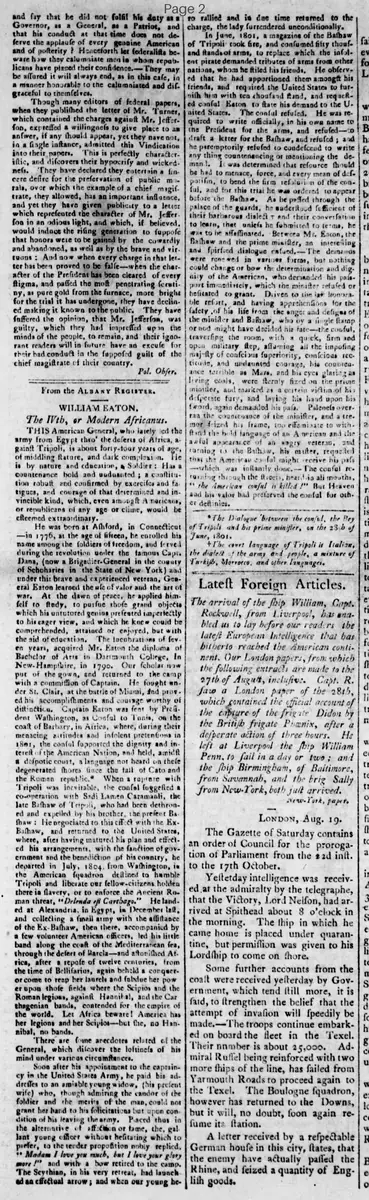
WILLIAM EATON.
The IVth, or Modern Africanus.
THIS American General, who lately led the army from Egypt through the deserts of Africa, against Tripoli, is about forty-four years of age. Of middling stature, and dark complexion. He is by nature and education, a Soldier: Has a countenance bold and undaunted; a constitution robust and confirmed by exercises and fatigues, and courage of that determined and invincible kind, which, even amongst Americans, or republicans of any age or clime, would be esteemed extraordinary.
He was born at Ashford, in Connecticut—in 176, at the age of fifteen, he enrolled his name among the soldiers of freedom, and served during the revolution under the famous Capt. Dana, (now a Brigadier-General in the county of Schoharies in the State of New York) and under this brave and experienced veteran, General Eaton learned the use of valor and the art of war. At the dawn of peace, he applied himself to study, to pursue those grand objects which his untutored genius presented imperfectly to his eager view, and which he knew could be comprehended, attained or enjoyed, but with the aid of education. The lucubrations of seven years, acquired Mr. Eaton the diploma of Bachelor of Arts in Dartmouth College, in New-Hampshire, in 1790. Our scholar now put off the gown, and returned to the camp with a commission of Captain. He fought under St. Clair, at the battle of Miami, and proved his accomplishments and courage worthy of distinction. Captain Eaton was sent by President Washington, as Consul to Tunis, on the coast of Barbary, in Africa, where, during their menacing attitudes and insolent pretensions in 1801, the consul supported the dignity and interest of the American Nation, and held, amidst a despotic court, a language not heard on these degenerated shores since the fall of Cato and the Roman republic.* When a rupture with Tripoli was inevitable, the consul suggested a co-operation with Sadi Lamen Caramaalli, the late Bashaw of Tripoli, who had been dethroned and expelled by his brother, the present Bashaw: He negotiated to this effect with the Ex-Bashaw, and returned to the United States, where, after having matured his plan and effected his arrangements, with the sanction of government and the benediction of his country, he departed in July, 1804, from Washington, in the American squadron destined to humble Tripoli and liberate our fellow-citizens holden there in slavery, or to enforce the Ancient Roman threat, "Delenda est Carthago." He landed at Alexandria, in Egypt, in December last, and collecting a small army with the assistance of the Ex-Bashaw, then there, accompanied by a few volunteer American officers, led his little band along the coast of the Mediterranean sea, through the desert of Barca and astonished Africa, after a repose of twelve centuries, from the time of Belisarius, again beheld a conqueror come to reap her laurels and subdue her power upon those fields where the Scipios and the Roman legions, against Hannibal, and the Carthagenian bands, contended for the empire of the world. Let Africa beware! America has her legions and her Scipios—but She, no Hannibal, "no bands."
There are some anecdotes related of the General, which discover the loftiness of his mind under various circumstances.
Soon after his appointment to the captaincy in the United States Army, he paid his address to an amiable young widow, (his present wife) who, though admiring the candor of the soldier and the merit of the man, could not grant her hand to his solicitations but upon condition of his leaving the army. Placed thus in the alternative of affection or fame, the gallant young officer without hesitating which to prefer, to the tender proposition nobly replied. "Madam I love you much, but I love your glory more!" and with a bow retired to the camp.
The Scythian, in his very retreat, had launched an effectual arrow; and when our young beau rallied and in due time returned to the charge, the lady surrendered unconditionally.
In June, 1801, a magazine of the Bashaw of Tripoli—took fire, and consumed fifty thousand stand of arms, to replace which the insolent pirate demanded tributes of arms from other nations, whom he styled his friends. He observed that he had apportioned them amongst his friends, and required the United States to furnish him with ten thousand stand, and requested consul Eaton to state his demand to the United States. The consul refused. He was required to write officially, in his own name to the President for the arms, and refused to draft a letter for the Bashaw, and refused; and he peremptorily refused to condescend to write any thing countenancing or mentioning the demand. It was determined that recourse should be had to menace, force, and every means of despotism, to bend the firm resolution of the consul, and for this trial he was ordered to appear before the Bashaw. As he passed through the palace of the guards, he understood sufficient of their barbarous dialect and their conversation to learn, that unless he submitted to terms, he was to be assassinated. Between Mr. Eaton, the Bashaw and the prime minister, an interesting and spirited dialogue ensued.—The demands were renewed in various forms, but nothing could change or bow the determination and dignity of the American, who demanded his passport immediately, which the minister refused or hesitated to grant. Driven to the last honorable resort, and having apprehensions for the safety of his life from the anger and designs of the minister and Bashaw, who by a single stamp or nod might have decided his fate—the consul, traversing the room, with a quick, firm and open military step, assuming all the imposing majesty of conscious superiority, conscious security, and undaunted courage, his countenance terrible as Mars, and his eyes glaring as living coals, were sternly fixed on the prime minister, and marked as a certain victim of his desperate fury, and laying his hand upon his sword, again demanded his pass. Paleness overran the countenance of the minister, and a tremor seized his frame, too effeminate to withstand the bold language of an American and the awful appearance of an angry veteran, and running to the Bashaw, his master, requested that the American consul might receive his pass—which was instantly done.—The consul returning through the streets, heard in all mouths, "the American consul is killed!" But Heaven and his valor had preserved the consul for other destinies.
"The Dialogue between the consul, the Bey of Tripoli and his prime minister, on the 28th of June, 1801."
*The court language of Tripoli is Italian, the dialect of the army and people, a mixture of Turkish, Morocco, and other languages.
What sub-type of article is it?
What themes does it cover?
What keywords are associated?
What entities or persons were involved?
Where did it happen?
Story Details
Key Persons
Location
Ashford Connecticut; Tunis Barbary; Tripoli; Alexandria Egypt; Deserts Of Africa
Event Date
176 To 1805
Story Details
Biographical sketch of American General William Eaton, detailing his early life, military service in the Revolution, education, consulship in Tunis, defiance of the Bashaw of Tripoli, and leadership of an expedition from Egypt against Tripoli to restore the ex-Bashaw, including anecdotes of his courtship and confrontation with the Bashaw.