Thank you for visiting SNEWPapers!
Sign up free
The Virginia Gazette
Richmond, Williamsburg, Richmond County, Virginia
What is this article about?
An essay exploring the principle of mediocrity as key to happiness and virtue, advising avoidance of extremes in natural gifts like beauty, health, and especially riches, which lead to ruin. Illustrated by a fable of shepherds Hamet and Rachid requesting water from the Genius of Distribution, where moderation succeeds and excess causes destruction.
Merged-components note: Merged image into literary component due to spatial overlap in bboxes and adjacent reading orders (1 and 2); the image appears to be an illustration or vignette associated with the essay.
Clipping
OCR Quality
Full Text
Deligit, tutus caret obsoleti
Sordibus tecti, caret invidenda
Sobrius aula.
HOR.
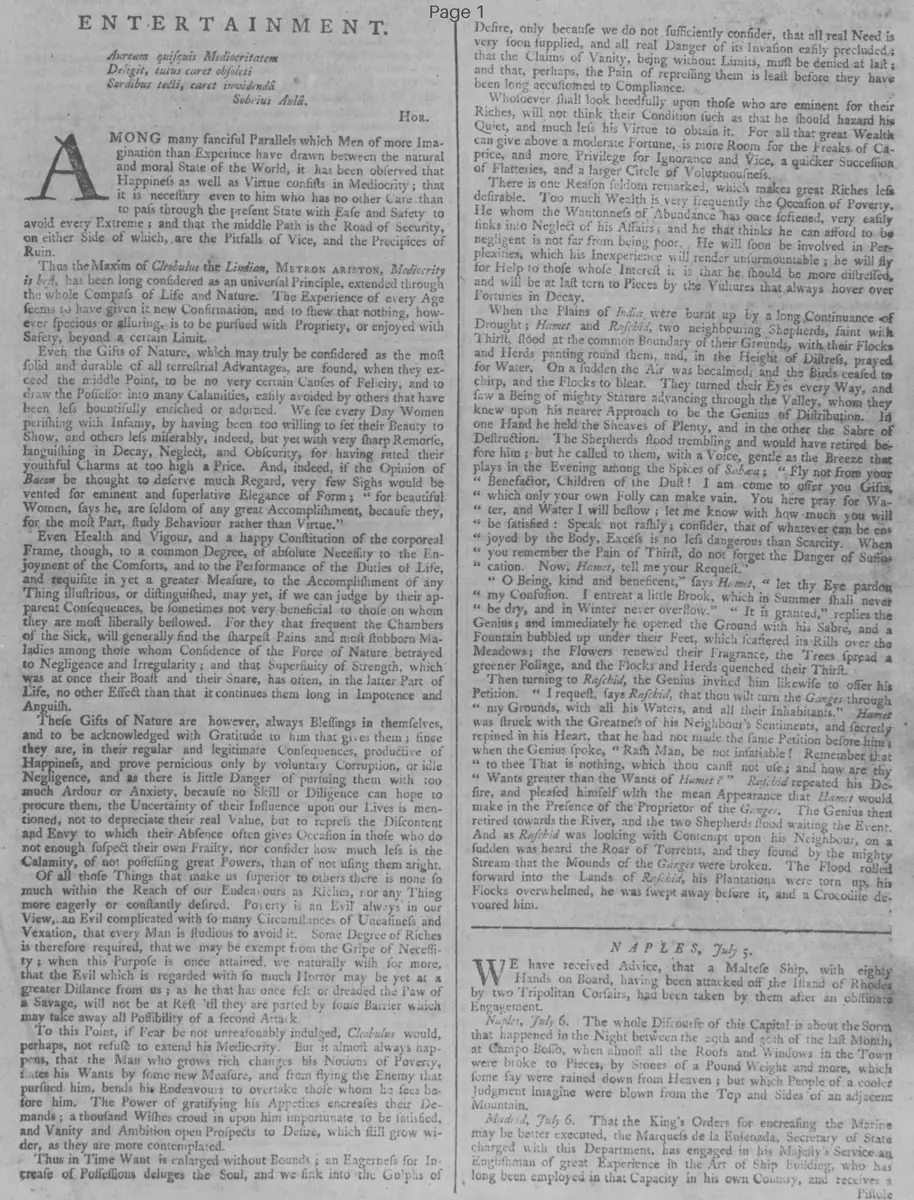
Among many fanciful Parallels which Men of more Imagination than Experience have drawn between the natural and moral State of the World, it has been observed that Happiness as well as Virtue consists in Mediocrity; that it is necessary even to him who has no other Care than to pass through the present State with Ease and Safety to avoid every Extreme; and that the middle Path is the Road of Security, on either Side of which, are the Pitfalls of Vice, and the Precipices of Ruin.
Thus the Maxim of Cleobulus the Lindian, Metron Ariston, Mediocrity is best, has been long considered as an universal Principle, extended through the whole Compass of Life and Nature. The Experience of every Age seems to have given it new Confirmation, and to shew that nothing, however precious or alluring, is to be pursued with Propriety, or enjoyed with Safety, beyond a certain Limit.
Even the Gifts of Nature, which may truly be considered as the most solid and durable of all terrestrial Advantages, are found, when they exceed the middle Point, to be no very certain Causes of Felicity, and to draw the Possessor into many Calamities, easily avoided by others that have been less bountifully enriched or adorned. We see every Day Women perishing with Infamy, by having been too willing to set their Beauty to Show, and others less miserably, indeed, but yet with very sharp Remorse, languishing in Decay, Neglect, and Obscurity, for having rated their youthful Charms at too high a Price. And, indeed, if the Opinion of Bacon be thought to deserve much Regard, very few Sighs would be vented for eminent and superlative Elegance of Form; "for beautiful Women, says he, are seldom of any great Accomplishment, because they, for the most Part, study Behaviour rather than Virtue."
Even Health and Vigour, and a happy Constitution of the corporeal Frame, though, to a common Degree, of absolute Necessity to the Enjoyment of the Comforts, and to the Performance of the Duties of Life, and requisite in yet a greater Measure, to the Accomplishment of any Thing illustrious, or distinguished, may yet, if we can judge by their apparent Consequences, be sometimes not very beneficial to those on whom they are most liberally bestowed. For they that frequent the Chambers of the Sick, will generally find the sharpest Pains and most stubborn Maladies among those whom Confidence of the Force of Nature betrayed to Negligence and Irregularity; and that Superfluity of Strength, which was at once their Boast and their Snare, has often, in the latter Part of Life, no other Effect than that it continues them long in Impotence and Anguish.
These Gifts of Nature are however, always Blessings in themselves, and to be acknowledged with Gratitude to him that gives them; since they are, in their regular and legitimate Consequences, productive of Happiness, and prove pernicious only by voluntary Corruption, or idle Negligence, and as there is little Danger of pursuing them with too much Ardour or Anxiety, because no Skill or Diligence can hope to procure them, the Uncertainty of their Influence upon our Lives is mentioned, not to depreciate their real Value, but to repress the Discontent and Envy to which their Absence often gives Occasion in those who do not enough suspect their own Frailty, nor consider how much less is the Calamity, of not possessing great Powers, than of not using them aright.
Of all those Things that make us superior to others there is none so much within the Reach of our Endeavours as Riches, nor any Thing more eagerly or constantly desired. Poverty is an Evil always in our View, an Evil complicated with so many Circumstances of Uneasiness and Vexation, that every Man is studious to avoid it. Some Degree of Riches is therefore required, that we may be exempt from the Gripe of Necessity; when this Purpose is once attained, we naturally wish for more, that the Evil which is regarded with so much Horror may be yet at a greater Distance from us; as he that has once felt or dreaded the Paw of a Savage, will not be at Rest 'til they are parted by some Barrier which may take away all Possibility of a second Attack.
To this Point, if Fear be not unreasonably indulged, Cleobulus would, perhaps, not refuse to extend his Mediocrity. But it almost always happens, that the Man who grows rich changes his Notions of Poverty, states his Wants by some new Measure, and from flying the Enemy that pursued him, bends his Endeavours to overtake those whom he sees before him. The Power of gratifying his Appetites increases their Demands; a thousand Wishes crowd in upon him importunate to be satisfied, and Vanity and Ambition open Prospects to Desire, which still grow wider, as they are more contemplated.
Thus in Time Want is enlarged without Bounds; an Eagerness for Increase of Possessions deluges the Soul, and we sink into the Gulphs of Desire, only because we do not sufficiently consider that all real Need is very soon supplied, and all real Danger of its Invasion easily precluded; that the Claims of Vanity, being without Limits, must be denied at last; and that, perhaps, the Pain of repressing them is least before they have been long accustomed to Compliance.
Whosoever shall look heedfully upon those who are eminent for their Riches, will not think their Condition such as that he should hazard his Quiet, and much less his Virtue to obtain it. For all that great Wealth can give above a moderate Fortune, is more Room for the Freaks of Caprice, and more Privilege for Ignorance and Vice, a quicker Succession of Flatteries, and a larger Circle of Voluptuousness.
There is one Reason seldom remarked, which makes great Riches less desirable. Too much Wealth is very frequently the Occasion of Poverty. He whom the Wantonness of Abundance has once softened, very easily sinks into Neglect of his Affairs; and he that thinks he can afford to be negligent is not far from being poor. He will soon be involved in Perplexities, which his Inexperience will render insurmountable; he will fly for Help to those whose Interest it is that he should be more distressed, and will be at last torn to Pieces by the Vultures that always hover over Fortunes in Decay.
When the Plains of India were burnt up by a long Continuance of Drought; Hamet and Rachid, two neighbouring Shepherds, faint with Thirst, stood at the common Boundary of their Grounds, with their Flocks and Herds panting round them, and, in the Height of Distress, prayed for Water. On a sudden the Air was becalmed, and the Birds ceased to chirp, and the Flocks to bleat. They turned their Eyes every Way, and saw a Being of mighty Stature advancing through the Valley, whom they knew upon his nearer Approach to be the Genius of Distribution. In one Hand he held the Sheaves of Plenty, and in the other the Sabre of Destruction. The Shepherds stood trembling and would have retired before him; but he called to them, with a Voice, gentle as the Breeze that plays in the Evening among the Spices of Sabaea; "Fly not from your Benefactor, Children of the Dust! I am come to offer you Gifts, which only your own Folly can make vain. You here pray for Water, and Water I will bestow; let me know with how much you will be satisfied: Speak not rashly; consider, that of whatever can be enjoyed by the Body, Excess is no less dangerous than Scarcity. When you remember the Pain of Thirst, do not forget the Danger of Suffocation. Now, Hamet, tell me your Request."
"O Being, kind and beneficent," says Hamet, "let thy Eye pardon my Confusion. I entreat a little Brook, which in Summer shall never be dry, and in Winter never overflow." "It is granted," replies the Genius; and immediately he opened the Ground with his Sabre, and a Fountain bubbled up under their Feet, which scattered its Rills over the Meadows; the Flowers renewed their Fragrance, the Trees spread a greener Foliage, and the Flocks and Herds quenched their Thirst.
Then turning to Rachid, the Genius invited him likewise to offer his Petition. "I request," says Rachid, "that thou wilt turn the Ganges through my Grounds, with all his Waters, and all their Inhabitants." Hamet was struck with the Greatness of his Neighbour's Sentiments, and secretly repined in his Heart, that he had not made the same Petition before him when the Genius spoke, "Rash Man, be not insatiate! Remember that to thee That is nothing, which thou canst not use; and how are thy Wants greater than the Wants of Hamet?" Rachid repeated his Desire, and pleased himself with the mean Appearance that Hamet would make in the Presence of the Proprietor of the Ganges. The Genius then retired towards the River, and the two Shepherds stood waiting the Event. And as Rachid was looking with Contempt upon his Neighbour, on a sudden was heard the Roar of Torrents, and they found by the mighty Stream that the Mounds of the Ganges were broken. The Flood rolled forward into the Lands of Rachid, his Plantations were torn up, his Flocks overwhelmed, he was swept away before it, and a Crocodile devoured him.
What sub-type of article is it?
What themes does it cover?
What keywords are associated?
What entities or persons were involved?
Literary Details
Author
Hor.
Subject
Mediocrity Is Best
Form / Style
Philosophical Essay With Embedded Moral Fable
Key Lines