Thank you for visiting SNEWPapers!
Sign up free
Letter to Editor
January 23, 1856
Morning Star
Limerick, York County, Maine
What is this article about?
A letter to the Morning Star argues against abandoning religious revivals, highlighting their essential role in conversions, church sustainability, and spiritual vitality. It cites historical examples like Noah Webster's conversion and biblical precedents, urging churches to hold them regularly for personal and communal benefit.
Clipping
OCR Quality
95%
Excellent
Full Text
MORNING STAR.
For the Morning Star.
REVIVALS OF RELIGION
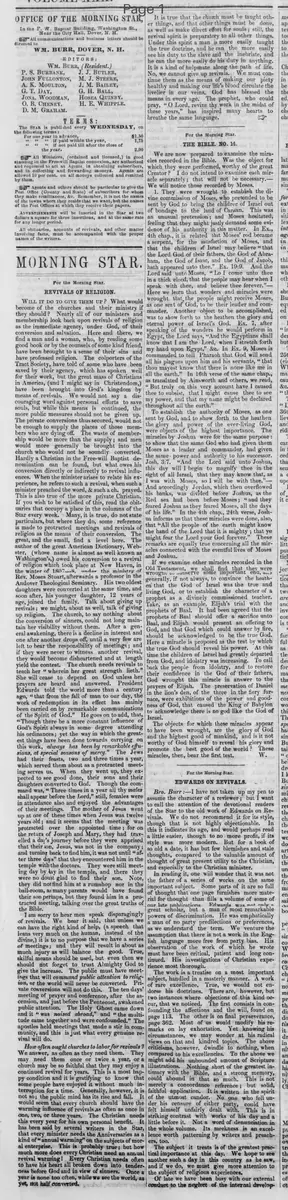
WILL IT DO TO GIVE THEM UP? What would become of the churches and their ministry if they should? Nearly all of our ministers and membership look back upon revivals of religion as the immediate agency, under God, of their conversion and salvation. Here and there, we find a man and a woman, who, by reading some good book or by the counsels of some kind friend, have been brought to a sense of their sins and have professed religion. The colporters of the Tract Society, have told of some who have been saved by their agency, which has spoken well for their work, but the great mass of Christians in America, (and I might say in Christendom,) have been brought into God's kingdom by means of revivals. We would not say a discouraging word against personal efforts to save souls, but while this means is continued, the more public measures should not be given up. The private conversions thus secured, would not be enough to supply the places of those members who are dying off. The waste of membership would be more than the supply; and men would more generally be brought into the church who would not be soundly converted. Hardly a Christian in the Free-will Baptist denomination can be found, but what owes his conversion directly or indirectly to revival influences. When the minister arises to relate his experience, he refers to such a revival. when such a minister preached the word, & such a ch. prayed. This is also true of the more private Christian. If you wish to be satisfied of this, read the obituaries that occupy a place in the columns of the Star every week. Many, it is true, do not state particulars, but where they do, some reference is made to protracted meetings and revivals of religion as the means of their conversion. The great, and the small, find a level here. The author of the great American Dictionary, Webster, (whose name is almost as well known as Washington's,) owed his conversion to a revival of religion which took place at New Haven, in the winter of 1807-8, under the ministry of Rev. Moses Stuart, afterwards a professor in the Andover Theological Seminary. His two oldest daughters were converted at the same time, and soon after, his younger daughter, 12 years of age, joined the family. Talk about giving up revivals; we might, about as well, talk of giving up religion. The church, to say nothing about the conversion of sinners, could not long maintain her visibility without them. After a general awakening, there is a decline in interest and one after another drops off, until a very few are left to bear the responsibility of meetings; and if they were never to witness another revival, they would become disheartened and at length yield the contest. The church needs revivals to teach her "wherein her great strength lieth." She will cease to depend on God unless her prayers are heard and answered. President Edwards told the world more than a century ago, "that from the fall of man to our day, the work of redemption in its effect has mainly been carried on by remarkable communications of the Spirit of God." He goes on to add. that, "Though there be a more constant influence of God's Spirit always in some degree attending his ordinances; yet the way in which the greatest things have been done towards carrying on this work, always has been by remarkable effusions, at special seasons of mercy." The Jews had their feasts, two and three times a year, which served them about as a protracted meeting serves us. When they went up, they expected to see good done, their sons and their daughters converted to God. Though the command was, "Three times in a year all thy males shall appear before the Lord," still, females were in attendance also and enjoyed the advantages of their meetings. The mother of Jesus went up at one of these times when Jesus was twelve years old; and it seems that the meeting was protracted over the appointed time; for on the return of Joseph and Mary, they had travelled a day's journey before they were apprised that their son, Jesus, was not in the company; and turning back to find him, it was not until "after three days" that they encountered him in the temple with the doctors. They were still meeting day by day in the temple, and there they were no doubt glad to find their son. Note, they did not find him at a rumshop nor in the ball-room, as many parents would have found their son perhaps, but they found him in a protracted meeting, talking over the great truths of the Bible.
I am sorry to hear men speak disparagingly of revivals, We hear it said, that unless we can have the right kind of help, (a speech that leans very much on the human, instead of the divine,) it is to no purpose that we have a series of meetings; and they will result in about as much injury as will balance the good. 'True, skillful means should be used, but even then we should not forget to trust Almighty God to give the increase. The public must have meetings that will command public attention to religion, or the world will never be converted. Private conversions will not do this. The ten days meeting of prayer and conference, after the ascension, and just before the Pentecost, awakened public attention. The Holy Ghost came down and it "was noised abroad," and "the multitude came together and were confounded." The apostles held meetings that made a stir in community, and this is just what every genuine revival will do.
How often ought churches to labor for revivals? We answer, as often as they need them. They may need them once or twice a year, or a church may be so faithful that they may enjoy a continued revival for years. This is a most happy condition and it is gratifying to know that some people have enjoyed it without much interruption for a time. Generally, however, it is not so; the public mind has its rise and fall. It would seem that every church should have the warming influence of revivals as often as once in one, two, or three years. The Christian needs this every year for his own personal benefit. It has been said by several writers in the Star, that every minister needs the Anniversaries as a kind of "annual warming" on the subjects of moral enterprise. This is probably true; but how much more does every Christian need an annual revival warming! Every Christian needs often to have his heart all broken down into tenderness before God and in view of sinners. Once a year is none too often, while we see the world, as yet, not half converted.
It is true that the church must be taught other things, and that other things must be done, as well as make direct effort for souls; still, the revival spirit is preparatory to all other things. Under this spirit a man is more easily taught the true doctrine, and he can the more easily see his duty to the slave and the inebriate, and he can the more easily do his duty in anything. It is a kind of helpmate along the path of life. No, we cannot give up revivals. We must continue them as the means of making our piety healthy and making our life's blood circulate the livelier in our veins. God has blessed the means in every age. The prophet, who could pray, "O Lord, revive thy work in the midst of these years," has inspired many hearts to breathe the same language.
For the Morning Star.
REVIVALS OF RELIGION
WILL IT DO TO GIVE THEM UP? What would become of the churches and their ministry if they should? Nearly all of our ministers and membership look back upon revivals of religion as the immediate agency, under God, of their conversion and salvation. Here and there, we find a man and a woman, who, by reading some good book or by the counsels of some kind friend, have been brought to a sense of their sins and have professed religion. The colporters of the Tract Society, have told of some who have been saved by their agency, which has spoken well for their work, but the great mass of Christians in America, (and I might say in Christendom,) have been brought into God's kingdom by means of revivals. We would not say a discouraging word against personal efforts to save souls, but while this means is continued, the more public measures should not be given up. The private conversions thus secured, would not be enough to supply the places of those members who are dying off. The waste of membership would be more than the supply; and men would more generally be brought into the church who would not be soundly converted. Hardly a Christian in the Free-will Baptist denomination can be found, but what owes his conversion directly or indirectly to revival influences. When the minister arises to relate his experience, he refers to such a revival. when such a minister preached the word, & such a ch. prayed. This is also true of the more private Christian. If you wish to be satisfied of this, read the obituaries that occupy a place in the columns of the Star every week. Many, it is true, do not state particulars, but where they do, some reference is made to protracted meetings and revivals of religion as the means of their conversion. The great, and the small, find a level here. The author of the great American Dictionary, Webster, (whose name is almost as well known as Washington's,) owed his conversion to a revival of religion which took place at New Haven, in the winter of 1807-8, under the ministry of Rev. Moses Stuart, afterwards a professor in the Andover Theological Seminary. His two oldest daughters were converted at the same time, and soon after, his younger daughter, 12 years of age, joined the family. Talk about giving up revivals; we might, about as well, talk of giving up religion. The church, to say nothing about the conversion of sinners, could not long maintain her visibility without them. After a general awakening, there is a decline in interest and one after another drops off, until a very few are left to bear the responsibility of meetings; and if they were never to witness another revival, they would become disheartened and at length yield the contest. The church needs revivals to teach her "wherein her great strength lieth." She will cease to depend on God unless her prayers are heard and answered. President Edwards told the world more than a century ago, "that from the fall of man to our day, the work of redemption in its effect has mainly been carried on by remarkable communications of the Spirit of God." He goes on to add. that, "Though there be a more constant influence of God's Spirit always in some degree attending his ordinances; yet the way in which the greatest things have been done towards carrying on this work, always has been by remarkable effusions, at special seasons of mercy." The Jews had their feasts, two and three times a year, which served them about as a protracted meeting serves us. When they went up, they expected to see good done, their sons and their daughters converted to God. Though the command was, "Three times in a year all thy males shall appear before the Lord," still, females were in attendance also and enjoyed the advantages of their meetings. The mother of Jesus went up at one of these times when Jesus was twelve years old; and it seems that the meeting was protracted over the appointed time; for on the return of Joseph and Mary, they had travelled a day's journey before they were apprised that their son, Jesus, was not in the company; and turning back to find him, it was not until "after three days" that they encountered him in the temple with the doctors. They were still meeting day by day in the temple, and there they were no doubt glad to find their son. Note, they did not find him at a rumshop nor in the ball-room, as many parents would have found their son perhaps, but they found him in a protracted meeting, talking over the great truths of the Bible.
I am sorry to hear men speak disparagingly of revivals, We hear it said, that unless we can have the right kind of help, (a speech that leans very much on the human, instead of the divine,) it is to no purpose that we have a series of meetings; and they will result in about as much injury as will balance the good. 'True, skillful means should be used, but even then we should not forget to trust Almighty God to give the increase. The public must have meetings that will command public attention to religion, or the world will never be converted. Private conversions will not do this. The ten days meeting of prayer and conference, after the ascension, and just before the Pentecost, awakened public attention. The Holy Ghost came down and it "was noised abroad," and "the multitude came together and were confounded." The apostles held meetings that made a stir in community, and this is just what every genuine revival will do.
How often ought churches to labor for revivals? We answer, as often as they need them. They may need them once or twice a year, or a church may be so faithful that they may enjoy a continued revival for years. This is a most happy condition and it is gratifying to know that some people have enjoyed it without much interruption for a time. Generally, however, it is not so; the public mind has its rise and fall. It would seem that every church should have the warming influence of revivals as often as once in one, two, or three years. The Christian needs this every year for his own personal benefit. It has been said by several writers in the Star, that every minister needs the Anniversaries as a kind of "annual warming" on the subjects of moral enterprise. This is probably true; but how much more does every Christian need an annual revival warming! Every Christian needs often to have his heart all broken down into tenderness before God and in view of sinners. Once a year is none too often, while we see the world, as yet, not half converted.
It is true that the church must be taught other things, and that other things must be done, as well as make direct effort for souls; still, the revival spirit is preparatory to all other things. Under this spirit a man is more easily taught the true doctrine, and he can the more easily see his duty to the slave and the inebriate, and he can the more easily do his duty in anything. It is a kind of helpmate along the path of life. No, we cannot give up revivals. We must continue them as the means of making our piety healthy and making our life's blood circulate the livelier in our veins. God has blessed the means in every age. The prophet, who could pray, "O Lord, revive thy work in the midst of these years," has inspired many hearts to breathe the same language.
What sub-type of article is it?
Religious
Persuasive
Reflective
What themes does it cover?
Religion
Morality
What keywords are associated?
Revivals Of Religion
Church Conversions
Spiritual Vitality
Historical Conversions
Biblical Precedents
Protracted Meetings
What entities or persons were involved?
Morning Star
Letter to Editor Details
Recipient
Morning Star
Main Argument
revivals of religion should not be abandoned, as they are crucial for conversions, maintaining church membership, spiritual health, and dependence on god; churches need them regularly to counteract decline and inspire piety.
Notable Details
References Noah Webster's Conversion In 1807 8 At New Haven
Cites President Edwards On The Spirit's Role In Redemption
Biblical Examples: Jewish Feasts, Jesus In The Temple At Age 12
Mentions Free Will Baptist Denomination And Obituaries In The Star