Thank you for visiting SNEWPapers!
Sign up free
The Daily Herald
New Haven, New Haven County, Connecticut
What is this article about?
This editorial letter (No. IV) from the Boston Courier argues against immediate abolition by critiquing popular excitement and combination as ineffective for reform, using the temperance movement as an example. It warns against involving women in political matters and shares an anecdote illustrating negative effects of such agitation.
Merged-components note: These components form a single continuous editorial article titled 'Letters against immediate Abolition' spanning multiple columns and pages.
Clippings
1 of 2
OCR Quality
Full Text
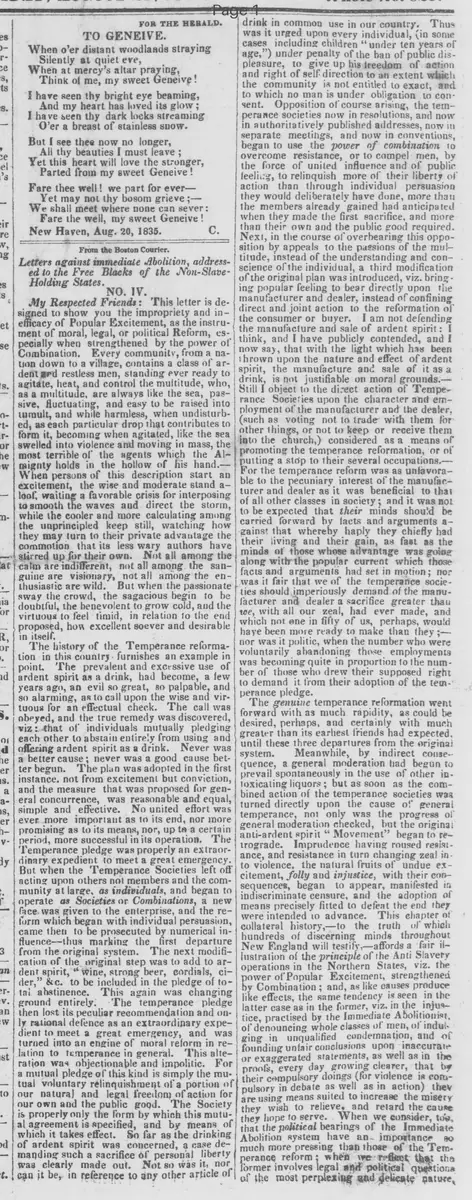
Letters against immediate Abolition, addressed to the Free Blacks of the Non-Slave-Holding States.
NO. IV.
My Respected Friends: This letter is designed to show you the impropriety and inefficacy of Popular Excitement, as the instrument of moral, legal, or political Reform, especially when strengthened by the power of Combination. Every community, from a nation down to a village, contains a class of ardent and restless men, standing ever ready to agitate, heat, and control the multitude, who, as a multitude, are always like the sea, passive, fluctuating, and easy to be raised into tumult, and while harmless, when undisturbed, as each particular drop that contributes to form it, becoming when agitated, like the sea swelled into violence and moving in mass, the most terrible of the agents which the Almighty holds in the hollow of his hand.
When persons of this description start an excitement, the wise and moderate stand aloof, waiting a favorable crisis for interposing to smooth the waves and direct the storm, while the cooler and more calculating among the unprincipled keep still, watching how they may turn to their private advantage the commotion that its less wary authors have stirred up for their own. Not all among the calm are indifferent, not all among the sanguine are visionary, not all among the enthusiastic are wild. But when the passionate sway the crowd, the sagacious begin to be doubtful, the benevolent to grow cold, and the virtuous to feel timid, in relation to the end proposed, how excellent soever and desirable in itself.
The history of the Temperance reformation in this country furnishes an example in point. The prevalent and excessive use of ardent spirit as a drink, had become, a few years ago, an evil so great, so palpable, and so alarming, as to call upon the wise and virtuous for an effectual check. The call was obeyed, and the true remedy was discovered, viz: that of individuals mutually pledging each other to abstain entirely from using and offering ardent spirit as a drink. Never was a better cause; never was a good cause better begun. The plan was adopted in the first instance, not from excitement but conviction, and the measure that was proposed for general concurrence, was reasonable and equal, simple and effective. No united effort was ever more important as to its end, nor more promising as to its means, nor, up to a certain period, more successful in its operation. The Temperance pledge was properly an extraordinary expedient to meet a great emergency.
But when the Temperance Societies left off acting upon others not members and the community at large, as individuals, and began to operate as Societies or Combinations, a new face was given to the enterprise, and the reform which began with individual persuasion, came then to be prosecuted by numerical influence--thus marking the first departure from the original system. The next modification of the original step was to add to ardent spirit, "wine, strong beer, cordials, cider," &c. to be included in the pledge of total abstinence. This again was changing ground entirely: The temperance pledge then lost its peculiar recommendation and only rational defence as an extraordinary expedient to meet a great emergency, and was turned into an engine of moral reform in relation to temperance in general. This alteration was objectionable and impolitic. For a mutual pledge of this kind is simply the mutual voluntary relinquishment of a portion of our natural and legal freedom of action for our own and the public good. The Society is properly only the form by which this mutual agreement is specified, and by means of which it takes effect. So far as the drinking of ardent spirit was concerned, a case demanding such a sacrifice of personal liberty was clearly made out. Not so was it, nor can it be, in reference to any other article of drink in common use in our country. Thus was it urged upon every individual, (in some cases including children under ten years of age,) under penalty of the ban of public displeasure, to give up his freedom of action and right of self-direction to an extent which the community is not entitled to exact, and to which no man is under obligation to consent. Opposition of course arising, the temperance societies now in resolutions, and now in authoritatively published addresses, now in separate meetings, and now in conventions, began to use the power of combination to overcome resistance, or to compel men, by the force of united influence and of public feeling, to relinquish more of their liberty of action than through individual persuasion they would deliberately have done, more than the members already gained had anticipated when they made the first sacrifice, and more than their own and the public good required.
Next, in the course of overbearing this opposition by appeals to the passions of the multitude, instead of the understanding and conscience of the individual, a third modification of the original plan was introduced, viz. bringing popular feeling to bear directly upon the manufacturer and dealer, instead of confining direct and joint action to the reformation of the consumer or buyer. I am not defending the manufacture and sale of ardent spirit: I think, and I have publicly contended, and I now say, that with the light which has been thrown upon the nature and effect of ardent spirit, the manufacture and sale of it as a drink, is not justifiable on moral grounds. Still I object to the direct action of Temperance Societies upon the character and employment of the manufacturer and the dealer. (such as voting not to trade with them for other things, or not to keep or receive them into the church,) considered as a means of promoting the temperance reformation, or of putting a stop to their several occupations.—
For the temperance reform was as unfavorable to the pecuniary interest of the manufacturer and dealer as it was beneficial to that of all other classes in society; and it was not to be expected that their minds should be carried forward by facts and arguments against that whereby haply they chiefly had their living and their gain, as fast as the minds of those whose advantage was going along with the popular current which those facts and arguments had set in motion; nor was it fair that we of the temperance societies should imperiously demand of the manufacturer and dealer a sacrifice greater than we, with all our zeal, had ever made, and which not one in fifty of us, perhaps, would have been more ready to make than they ; nor was it politic, when the number who were voluntarily abandoning those employments was becoming quite in proportion to the number of those who drew their supposed right to demand it from their adoption of the temperance pledge.
The genuine temperance reformation went forward with as much rapidity, as could be desired, perhaps, and certainly with much greater than its earliest friends had expected, until these three departures from the original system.
Meanwhile, by indirect consequence, a general moderation had begun to prevail spontaneously in the use of other intoxicating liquors; but as soon as the combined action of the temperance societies was turned directly upon the cause of general temperance, not only was the progress of general moderation checked, but the original anti-ardent spirit "Movement" began to retrograde. Imprudence having roused resistance, and resistance in turn changing zeal into violence, the natural fruits of undue excitement, folly and injustice, with their consequences, began to appear, manifested in indiscriminate censure, and the adoption of means precisely fitted to defeat the end they were intended to advance. This chapter of collateral history, to the truth of which hundreds of discerning minds throughout New England will testify, affords a fair illustration of the principle of the Anti Slavery operations in the Northern States, viz. the power of Popular Excitement, strengthened by Combination ; and, as like causes produce like effects, the same tendency is seen in the latter case as in the former, viz. in the injustice, practised by the Immediate Abolitionists, of denouncing whole classes of men, of indulging in unqualified condemnation, and of founding unfair conclusions upon inaccurate or exaggerated statements, as well as in the proofs, every day, growing clearer, that by their compulsory doings (for violence is compulsory in debate as well as in action) they are using means suited to increase the misery they wish to relieve, and retard the cause they hope to serve. When we consider, too, that the political bearings of the Immediate Abolition system have an importance so much more pressing than those of the Temperance reform; when we reflect that the former involves legal and political questions of the most perplexing and delicate nature. The impropriety and danger of that system will be seen in a plainer view, since unjustifiable violence and aggression are sure to produce passion, and passion, "when it is finished," brings forth madness, "confusion, and every evil work." This use of Popular Excitement, aided by combination, is the more objectionable and alarming, on account of the extent of the field on which its power has been tried; especially regarded as including the intermixture of Female influence in legal and political concerns. Woman, moving regularly and calmly in her own sphere, is as lovely as the evening star, and at once serviceable and delightful, like the planet at night. It is as unbecoming to her to appear in the world disrobed, as unattyred. But something more than the violation of decorum is here involved. When woman leaves her place, and with combined voice and action, mingles with men in the struggles of ambition and power, nothing that poet ever dreamed of the disastrous shock of comets, striking our trembling globe, out-measures the evil that might follow from her political interference in times which try men's souls, when fear of change perplexes the wise, and the hearts of the boldest fail at that which may come upon the earth. Men everywhere, but, so far as my observation has reached, particularly in this free land, are too much inclined to yield to the direction of intelligent and virtuous woman. Female influence, rightly understood, is as valuable, as female interference is mischievous. It is, however, still and meek, soothing and never irritating, seeking to draw and never to drive, and "keeping at home;" and it oversteps the modesty of nature when it begins to strive and to rule. "Let the woman," says St. Paul, "learn in silence and subjection." "I suffer not a woman to teach, nor to usurp authority over the man, but to be in silence."
The right of private judgement implies a solemn responsibility; and that freeman is unworthy of his country who dares not think and act freely to serve it. No man can attain true mental independence who permits domestic entreaty or dictation to deter him from forming his mind, or exerting his influence in the manner that unbiased examination and a deliberate conscience would prescribe. And it is wrong and reprehensible, accordingly, to make use of combined female influence to work upon the feelings of men, when legal and political changes are proposed. Women, from their natural excitability and domestic training, are as unfit to take part in the stern and stormy scenes of legislation and politics, as, from their physical delicacy, to wield the axe in the woods, or the hammer at the forge. That in stating these principles I am fully sustained by nature and by fact, and do my respected country-women no injustice, is shown by the following illustration from real New England life, furnished by an esteemed friend, to whom I read letter No. 2, of this series, before publication, and who says, in reference to the transaction which he relates—"Of the facts there is no doubt, and I am ready to vouch for them, and to bring hundreds of others to do the like."
* * * "I can give you an example of the manner of carrying on and the effect of an excitement raised by 'addressing women and children.' The anecdote I will relate occurred within my own observation; and I have no doubt there are fifty others who could testify to similar cases. A gentleman from College was engaged to teach the school in a district of -- for the winter of 18-. Now it happened that a majority of the inhabitants of this district of the town of -- were of a different sect from the rest of -- and from that of the college from which the teacher came. Consequently they were pre-disposed to make him trouble. The children were taught to watch the motions of their master, and encouraged to report their observations to their mothers. As it always will happen, (for who can live without making some enemies; above all, who can teach a school and satisfy all his pupils?) opportunity was soon found for making complaint. The children carried home marvellous stories to their mothers of the various wickednesses and misdeeds of their master. The good dames were inflamed with rage. It is not necessary to recount the various stories which flew from one angry woman to another, till there was scarcely a crime forbidden by law or gospel that the schoolmaster had not committed. The wives discussed between meetings and over their tea, the momentous question, and all were determined that 'something must be done, and that speedily.' But by the foolishness and tyranny of the law makers the master making power was vested in a committee of men. This was a sad thing for the conspirators—for by this time the excitement and determination had taken the form of a conspiracy—but as 'something must be done,' they consented to waive their dignity, and submit to the method which the law had prescribed. Each wife attacked her lord, while sundry maiden ladies, who had no families to take care of but their neighbor's, kindly volunteered to fan the flame, and at last, as the phrase goes, 'raised considerable of a breeze.' The men themselves began to think 'there was something in it after all' and the fever raged among them at last. One dark, stormy Saturday night, a meeting of the discontented was held at the school house, and a statement of their grievances was drawn up and signed by all present, including a childless widower and one or two old bachelors, who firmly and unanimously resolved 'that they would not send their children to the school any more, so long as it was kept by Mr. --. This paper was handed to the School Committee of the town next day, Sunday, and they immediately called a meeting for Monday night of the whole district—master and all—to take the subject into consideration. By the good sense of the Committee the excitement was thus stopped; for on investigation, the whole affair was found to be utterly groundless, and before leaving the meeting, every man, but one, recalled his previous promise, acknowledged himself satisfied that the children and not the master were in fault, and agreed that they should attend school as before. The one malcontent thought better of it before morning, and his children returned with the rest. Thus was settled the difficulty which at one time threatened the peace and quietness of -- but did the effect of the 'excitement' cease here? Far from it. The 'nullification act' which the men had passed by the command or entreaty of their wives, was indeed recalled. But the children never forgot it. From that period to the end of the term for which Mr. -- kept the school, he had to contend with those who had been taught by their parents to hate and despise their master. Of little value were his instructions to those children from the day the excitement began. Had the parents punished their children for 'telling tales out of school,' made their own complaints to the master himself, and if he refused redress, to the Committee, no injustice would have been done, and his services would not have been rendered useless to those for whom they were intended. But this would not do. This was the method prescribed by law, and must all be carried on by the intervention of the men. The agitators preferred to 'excite the women and children, and thus to influence public opinion.' Would any sensible man, who loves truth and reason, follow their example?
In my next letter I shall take up the question of the right to originate at the North, public measures designed to lead to the removal of slavery in the United States.
What sub-type of article is it?
What keywords are associated?
What entities or persons were involved?
Editorial Details
Primary Topic
Critique Of Immediate Abolition Through Analogy To Temperance Reform And Warnings Against Popular Excitement And Female Involvement
Stance / Tone
Opposition To Immediate Abolition Methods, Cautionary Against Agitation And Combination
Key Figures
Key Arguments