Thank you for visiting SNEWPapers!
Sign up free
The New Hampshire Gazette And General Advertiser
Portsmouth, Rockingham County, New Hampshire
What is this article about?
Report on the US army's defeat by Indians on November 4, 1791, near the Miami River in the Western Territory. The Kentucky militia was attacked at dawn, leading to a three-hour battle with heavy casualties. The army retreated to Fort Jefferson. Additional updates on reinforcements, garrison safety, and Major Butler's bravery despite injury.
Merged-components note: Merged related components detailing the St. Clair defeat in the Western Territory (November 4, 1791), including battle narrative, casualties table, post-battle updates from Fort Washington, and an anecdote on Major Butler's bravery; all focus on the same event and aftermath.
Clippings
1 of 2
OCR Quality
Full Text
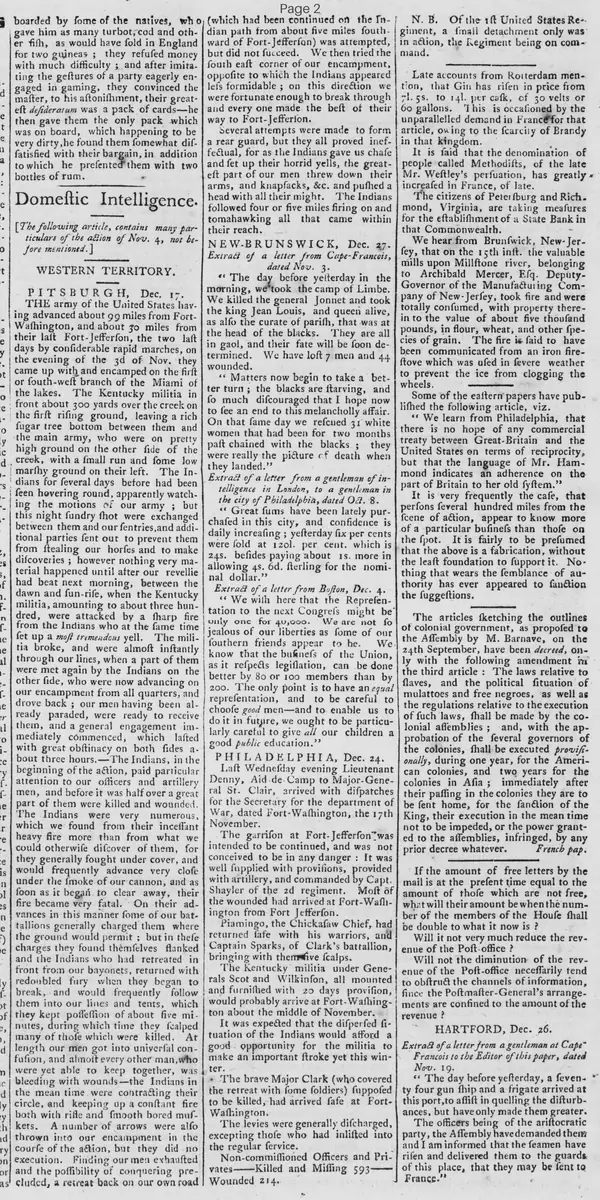
WESTERN TERRITORY.
PITTSBURGH, Dec. 17.
THE army of the United States having advanced about 90 miles from Fort-Washington, and about 30 miles from their last Fort-Jefferson, the two last days by considerable rapid marches, on the evening of the 3d of Nov. they came up with and encamped on the first or south-west branch of the Miami of the lakes. The Kentucky militia in front about 300 yards over the creek on the first rising ground, leaving a rich sugar tree bottom between them and the main army, who were on pretty high ground on the other side of the creek, with a small run and some low marshy ground on their left. The Indians for several days before had been seen hovering round, apparently watching the motions of our army; but this night sundry shot were exchanged between them and our sentries, and additional parties sent out to prevent them from stealing our horses and to make discoveries; however nothing very material happened until after our reveille had beat next morning, between the dawn and sun-rise, when the Kentucky militia, amounting to about three hundred, were attacked by a sharp fire from the Indians who at the same time set up a most tremendous yell. The militia broke, and were almost instantly through our lines, when a part of them were met again by the Indians on the other side, who were now advancing on our encampment from all quarters, and drove back; our men having been already paraded, were ready to receive them, and a general engagement immediately commenced, which lasted with great obstinacy on both sides about three hours.—The Indians, in the beginning of the action, paid particular attention to our officers and artillery men, and before it was half over a great part of them were killed and wounded. The Indians were very numerous, which we found from their incessant heavy fire more than from what we could otherwise discover of them, for they generally fought under cover, and would frequently advance very close under the smoke of our cannon, and as soon as it began to clear away, their fire became very fatal. On their advances in this manner some of our battalions generally charged them where the ground would permit; but in these charges they found themselves flanked and the Indians who had retreated in front from our bayonets, returned with redoubled fury when they began to break, and would frequently follow them into our lines and tents, which they kept possession of about five minutes, during which time they scalped many of those which were killed. At length our men got into universal confusion, and almost every other man, who were yet able to keep together, was bleeding with wounds—the Indians in the mean time were contracting their circle, and keeping up a constant fire both with rifle and smooth bored muskets. A number of arrows were also thrown into our encampment in the course of the action, but they did no execution. Finding our men exhausted and the possibility of conquering precluded, a retreat back on our own road (which had been continued on the Indian path from about five miles south-ward of Fort-Jefferson) was attempted, but did not succeed. We then tried the south east corner of our encampment, opposite to which the Indians appeared less formidable; on this direction we were fortunate enough to break through and every one made the best of their way to Fort-Jefferson. Several attempts were made to form a rear guard, but they all proved ineffectual, for as the Indians gave us chase and set up their horrid yells, the greatest part of our men threw down their arms, and knapsacks, &c. and pushed ahead with all their might. The Indians followed four or five miles firing on and tomahawking all that came within their reach.
N. B. Of the 1st United States Regiment, a small detachment only was in action, the Regiment being on command.
Non-commissioned Officers and Privates—Killed and Missing 593
Wounded 214.
PHILADELPHIA, Dec. 24.
Last Wednesday evening Lieutenant Denny, Aid-de-Camp to Major-General St. Clair, arrived with dispatches for the Secretary for the department of War, dated Fort-Washington, the 17th November.
The garrison at Fort-Jefferson was intended to be continued, and was not conceived to be in any danger: It was well supplied with provisions, provided with artillery, and commanded by Capt. Shaylor of the 2d regiment. Most of the wounded had arrived at Fort-Washington from Fort Jefferson.
Piamingo, the Chickasaw Chief, had returned safe with his warriors, and Captain Sparks, of Clark's battalion, bringing with them five scalps.
The Kentucky militia under Generals Scott and Wilkinson, all mounted and furnished with 20 days provision, would probably arrive at Fort-Washington about the middle of November.
It was expected that the dispersion of the Indians would afford a good opportunity for the militia to make an important stroke yet this winter.
The brave Major Clark (who covered the retreat with some soldiers) supposed to be killed, —had arrived safe at Fort-Washington.
The levies were generally discharged, excepting those who had enlisted into the regular service.
FORTITUDE.
To narrate the bravery of the brave is a very pleasing, grateful task. Of a genuine fortitude, perhaps very few examples in history, exceed the following:
Major Butler, brother to the gallant General of that name, commanded one of the battalions of levies from Pennsylvania, in the unfortunate action of the 4th November—In the commencement of the action he had his leg broke, and much shattered by a ball—he retired to be dressed; and the moment the surgeon had tied the bandages, he requested to be put upon his horse; rode immediately to the front of his battalion: and continued thereon during the whole action.
What sub-type of article is it?
What keywords are associated?
What entities or persons were involved?
Where did it happen?
Domestic News Details
Primary Location
Western Territory
Event Date
Nov. 4
Key Persons
Outcome
non-commissioned officers and privates of 1st united states regiment—killed and missing 593, wounded 214. army retreated to fort-jefferson. garrison at fort-jefferson safe. major clark arrived safe. levies discharged except enlistees.
Event Details
US army encamped near Miami of the lakes on Nov. 3. Kentucky militia attacked by Indians at dawn on Nov. 4, leading to general engagement lasting three hours. Indians targeted officers and artillery, fought under cover, flanked charges. Army in confusion, retreated southeast to Fort-Jefferson pursued by Indians. Major Butler continued commanding after leg injury.