Thank you for visiting SNEWPapers!
Sign up free
Literary
December 17, 1842
The Cecil Whig
Elkton, Cecil County, Maryland
What is this article about?
In 'The Bridal Eve,' Isabel Benton is pressured by her mother to marry wealthy Mr. Wallingford at Saratoga Springs, despite loving young painter Henry. On the eve of her wedding, Henry arrives, revealing intercepted letters. A confrontation discloses Henry is Wallingford's son, leading to the father yielding the bride to his son.
Clipping
OCR Quality
95%
Excellent
Full Text
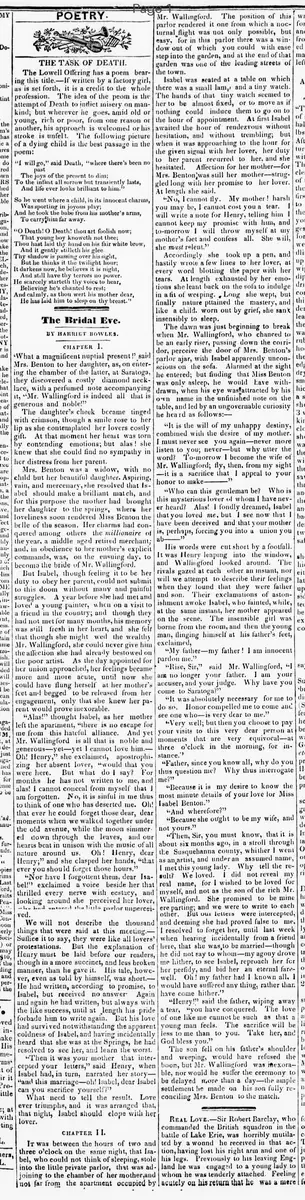
The Bridal Eve.
BY HARRIET BOWLES.
CHAPTER I.
'What a magnificent nuptial present!' said Mrs. Benton to her daughter, as, on entering the chamber of the latter, at Saratoga, they discovered a costly diamond necklace, with a perfumed note accompanying it, 'Mr. Wallingford is indeed all that is generous and noble!'
The daughter's cheek became tinged with crimson, though a smile rose to her lip as she contemplated her lover's costly gift. At that moment her heart was torn by contending emotions; but alas! she knew that she could find no sympathy in her distress from her parent.
Mrs. Benton was a widow, with no child but her beautiful daughter. Aspiring, vain, and mercenary, she resolved that Isabel should make a brilliant match, and for this purpose the mother had brought her daughter to the springs, where her loveliness soon rendered Miss Benton the belle of the season. Her charms had conquered among others the millionaire of the year, a middle aged retired merchant; and, in obedience to her mother's explicit commands, was, on the ensuing day, to become the bride of Mr. Wallingford.
But Isabel, though feeling it to be her duty to obey her parent, could not submit to this doom without many and painful struggles. A year before she had met and loved a young painter, when on a visit to a friend in the country; and though they had not met for many months, his memory was still fresh in her heart, and she felt that though she might wed the wealthy Mr. Wallingford, she could never give him the affection she had already bestowed on the poor artist. As the day appointed for her union approached, her feelings became more and more acute, until now she could have flung herself at her mother's feet and begged to be released from her engagement, only that she knew her parent would prove inexorable.
'Alas!' thought Isabel, as her mother left the apartment, 'there is no escape for me from this hateful alliance. And yet Mr. Wallingford is all that is noble and generous--yet--yet I cannot love him. Oh! Henry,' she exclaimed, apostrophizing her absent lover, 'would that you were here. But what do I say? For months he has not written to me, and alas! I cannot conceal from myself that I am forgotten. No, it is sinful in me thus to think of one who has deserted me. Oh! that ever he could forget those dear, dear moments when we walked together under the old avenue, while the moon shimmered down through the leaves, and our hearts beat in unison with the music of all nature around us. Oh! Henry, dear Henry;' and she clasped her hands, 'that ever you should forget those hours.'
'Nor have I forgotten them, dear Isabel!' exclaimed a voice beside her that thrilled every nerve with ecstasy, and looking around she perceived her lover, who had entered the little parlor unperceived.
We will not describe the thousand things that were said at this meeting. Suffice it to say, they were like all lovers' protestations. But the explanation of Henry must be laid before our readers, though in a more succinct, and less broken manner, than he gave it. His tale, however, even as told by himself, was short.
He had written, according to promise, to Isabel, but received no answer Again and again he had written, but always with the like success, until at length his pride forbade him to write again. But his love had survived notwithstanding the apparent coldness of Isabel, and having incidentally heard that she was at the Springs, he had resolved to see her, and learn the worst.
'Then it was your mother that intercepted your letters,' said Henry, when Isabel had, in turn, narrated her story 'and this marriage--oh! Isabel, dear Isabel can you sacrifice yourself?'
What need to tell the result. Love ever triumphs, and it was arranged that, that night, Isabel should elope with her lover.
CHAPTER II.
It was between the hours of two and three o'clock on the same night, that Isabel, who could not think of sleeping, stole into the little private parlor, that was adjoining to the chamber of her mother, and not far from the apartment occupied by Mr. Wallingford.
The position of this parlor rendered it one from which a nocturnal flight was not only possible, but easy, for in this parlor there was a window out of which you could with ease step into the garden, and at the end of that garden was one of the leading streets of the town.
Isabel was seated at a table on which there was a small lamp, and a tiny watch. The hands of that tiny watch seemed to her to be almost fixed, or to move as if nothing could induce them to go on to the hour of appointment. At first Isabel awaited the hour of rendezvous without hesitation, and without trembling; but when it was approaching to the hour for the given signal with her lover, her duty to her parent recurred to her, and she hesitated.
Affection for her mother--for Mrs. Benton was still her mother--struggled long with her promise to her lover. At length she said.
'No, I cannot fly. My mother! harsh you may be, I cannot cost you a tear. I will write a note for Henry, telling him I cannot keep my promise with him, and to-morrow I will throw myself at my mother's feet and confess all. She will, she must relent.'
Accordingly she took up a pen, and hastily wrote a few lines to her lover, at every word blotting the paper with her tears. At length exhausted by her emotions she leant back on the sofa to indulge in a fit of weeping. Long she wept, but finally nature attained the mastery, and like a child, worn out by grief, she sank insensibly to sleep.
The dawn was just beginning to break when Mr. Wallingford, who chanced to be an early riser, passing down the corridor, perceived the door of Mrs. Benton's parlor ajar, with Isabel apparently unconscious on the sofa. Alarmed at the sight he entered; but finding that Miss Benton was only asleep, he would have withdrawn, when his eye was attracted by his own name in the unfinished note on the table, and led by an ungovernable curiosity he read as follows:-
'It is the will of my unhappy destiny, combined with the desire of my mother. I must never see you again--never more listen to you; never--but why utter the word? To-morrow I become the wife of Mr. Wallingford; fly, then, from my sight --it is a sacrifice that I appeal to your honor to make
'Who can this gentleman be? Who is this mysterious lover of whom I have never heard? Alas! I fondly dreamed, Isabel that you loved me. but I see now that I have been deceived and that your mother is, perhaps, forcing you into a union you abhor.'
His words were cut short by a footfall. It was Henry leaping into the window, and Wallingford looked around. The rivals gazed at each other an instant, nor will we attempt to describe their feelings when they found that they were father and son.
Their exclamations of astonishment awoke Isabel, who fainted, while, at the same instant, her mother appeared on the scene.
The insensible girl was borne from the room, and then the young man, flinging himself at his father's feet, exclaimed,
'My father--my father! I am innocent pardon me.'
'Rise, Sir,' said Mr. Wallingford, 'I am no longer your father. I am your accuser, and your judge. Why have you come to Saratoga?'
'It was absolutely necessary for me to do so. Honor compelled me to come and see one who is very dear to me.'
'Very well; but then you choose to pay your visits to this very dear person at moments that are very equivocal--at three o'clock in the morning, for instance.'
'Father, since you know all, why do you thus question me? Why thus interrogate me?'
'Because it is my desire to know the most minute details of your love for Miss Isabel Benton.'
'And wherefore?'
'Because she ought to be my wife, and not yours.'
'Then, Sir, you must know, that it is about six months ago, in a stroll through the Susquehanna county, whither I went as an artist, and under an assumed name, I met this young lady. Why tell the result? We loved. I did not reveal my real name, for I wished to be loved for myself, and not as the son of the rich Mr. Wallingford. She promised to be mine ere parting; and we were to write to each other. But our letters were intercepted. and deeming she had proved false to me, I resolved to forget her, until last week when hearing incidentally from a friend here, that she was to be married--though he did not say to whom--my agony drove me hither, to see Isabel, reproach her for her perfidy, and bid her an eternal farewell. Oh! my father had I known all, I would have suffered any thing, rather than have come hither.'
'Henry!' said the father, wiping away a tear, 'you have conquered. The love of one like me cannot be such as that a young man feels. The sacrifice will be less to me than to you. Take her, and God bless you.'
The son fell on his father's shoulder and weeping, would have refused the boon, but Mr. Wallingford was inexorable, nor would he suffer the ceremony to be delayed more than a day--the ample settlement he made on his son fully reconciling Mrs. Benton to the match.
BY HARRIET BOWLES.
CHAPTER I.
'What a magnificent nuptial present!' said Mrs. Benton to her daughter, as, on entering the chamber of the latter, at Saratoga, they discovered a costly diamond necklace, with a perfumed note accompanying it, 'Mr. Wallingford is indeed all that is generous and noble!'
The daughter's cheek became tinged with crimson, though a smile rose to her lip as she contemplated her lover's costly gift. At that moment her heart was torn by contending emotions; but alas! she knew that she could find no sympathy in her distress from her parent.
Mrs. Benton was a widow, with no child but her beautiful daughter. Aspiring, vain, and mercenary, she resolved that Isabel should make a brilliant match, and for this purpose the mother had brought her daughter to the springs, where her loveliness soon rendered Miss Benton the belle of the season. Her charms had conquered among others the millionaire of the year, a middle aged retired merchant; and, in obedience to her mother's explicit commands, was, on the ensuing day, to become the bride of Mr. Wallingford.
But Isabel, though feeling it to be her duty to obey her parent, could not submit to this doom without many and painful struggles. A year before she had met and loved a young painter, when on a visit to a friend in the country; and though they had not met for many months, his memory was still fresh in her heart, and she felt that though she might wed the wealthy Mr. Wallingford, she could never give him the affection she had already bestowed on the poor artist. As the day appointed for her union approached, her feelings became more and more acute, until now she could have flung herself at her mother's feet and begged to be released from her engagement, only that she knew her parent would prove inexorable.
'Alas!' thought Isabel, as her mother left the apartment, 'there is no escape for me from this hateful alliance. And yet Mr. Wallingford is all that is noble and generous--yet--yet I cannot love him. Oh! Henry,' she exclaimed, apostrophizing her absent lover, 'would that you were here. But what do I say? For months he has not written to me, and alas! I cannot conceal from myself that I am forgotten. No, it is sinful in me thus to think of one who has deserted me. Oh! that ever he could forget those dear, dear moments when we walked together under the old avenue, while the moon shimmered down through the leaves, and our hearts beat in unison with the music of all nature around us. Oh! Henry, dear Henry;' and she clasped her hands, 'that ever you should forget those hours.'
'Nor have I forgotten them, dear Isabel!' exclaimed a voice beside her that thrilled every nerve with ecstasy, and looking around she perceived her lover, who had entered the little parlor unperceived.
We will not describe the thousand things that were said at this meeting. Suffice it to say, they were like all lovers' protestations. But the explanation of Henry must be laid before our readers, though in a more succinct, and less broken manner, than he gave it. His tale, however, even as told by himself, was short.
He had written, according to promise, to Isabel, but received no answer Again and again he had written, but always with the like success, until at length his pride forbade him to write again. But his love had survived notwithstanding the apparent coldness of Isabel, and having incidentally heard that she was at the Springs, he had resolved to see her, and learn the worst.
'Then it was your mother that intercepted your letters,' said Henry, when Isabel had, in turn, narrated her story 'and this marriage--oh! Isabel, dear Isabel can you sacrifice yourself?'
What need to tell the result. Love ever triumphs, and it was arranged that, that night, Isabel should elope with her lover.
CHAPTER II.
It was between the hours of two and three o'clock on the same night, that Isabel, who could not think of sleeping, stole into the little private parlor, that was adjoining to the chamber of her mother, and not far from the apartment occupied by Mr. Wallingford.
The position of this parlor rendered it one from which a nocturnal flight was not only possible, but easy, for in this parlor there was a window out of which you could with ease step into the garden, and at the end of that garden was one of the leading streets of the town.
Isabel was seated at a table on which there was a small lamp, and a tiny watch. The hands of that tiny watch seemed to her to be almost fixed, or to move as if nothing could induce them to go on to the hour of appointment. At first Isabel awaited the hour of rendezvous without hesitation, and without trembling; but when it was approaching to the hour for the given signal with her lover, her duty to her parent recurred to her, and she hesitated.
Affection for her mother--for Mrs. Benton was still her mother--struggled long with her promise to her lover. At length she said.
'No, I cannot fly. My mother! harsh you may be, I cannot cost you a tear. I will write a note for Henry, telling him I cannot keep my promise with him, and to-morrow I will throw myself at my mother's feet and confess all. She will, she must relent.'
Accordingly she took up a pen, and hastily wrote a few lines to her lover, at every word blotting the paper with her tears. At length exhausted by her emotions she leant back on the sofa to indulge in a fit of weeping. Long she wept, but finally nature attained the mastery, and like a child, worn out by grief, she sank insensibly to sleep.
The dawn was just beginning to break when Mr. Wallingford, who chanced to be an early riser, passing down the corridor, perceived the door of Mrs. Benton's parlor ajar, with Isabel apparently unconscious on the sofa. Alarmed at the sight he entered; but finding that Miss Benton was only asleep, he would have withdrawn, when his eye was attracted by his own name in the unfinished note on the table, and led by an ungovernable curiosity he read as follows:-
'It is the will of my unhappy destiny, combined with the desire of my mother. I must never see you again--never more listen to you; never--but why utter the word? To-morrow I become the wife of Mr. Wallingford; fly, then, from my sight --it is a sacrifice that I appeal to your honor to make
'Who can this gentleman be? Who is this mysterious lover of whom I have never heard? Alas! I fondly dreamed, Isabel that you loved me. but I see now that I have been deceived and that your mother is, perhaps, forcing you into a union you abhor.'
His words were cut short by a footfall. It was Henry leaping into the window, and Wallingford looked around. The rivals gazed at each other an instant, nor will we attempt to describe their feelings when they found that they were father and son.
Their exclamations of astonishment awoke Isabel, who fainted, while, at the same instant, her mother appeared on the scene.
The insensible girl was borne from the room, and then the young man, flinging himself at his father's feet, exclaimed,
'My father--my father! I am innocent pardon me.'
'Rise, Sir,' said Mr. Wallingford, 'I am no longer your father. I am your accuser, and your judge. Why have you come to Saratoga?'
'It was absolutely necessary for me to do so. Honor compelled me to come and see one who is very dear to me.'
'Very well; but then you choose to pay your visits to this very dear person at moments that are very equivocal--at three o'clock in the morning, for instance.'
'Father, since you know all, why do you thus question me? Why thus interrogate me?'
'Because it is my desire to know the most minute details of your love for Miss Isabel Benton.'
'And wherefore?'
'Because she ought to be my wife, and not yours.'
'Then, Sir, you must know, that it is about six months ago, in a stroll through the Susquehanna county, whither I went as an artist, and under an assumed name, I met this young lady. Why tell the result? We loved. I did not reveal my real name, for I wished to be loved for myself, and not as the son of the rich Mr. Wallingford. She promised to be mine ere parting; and we were to write to each other. But our letters were intercepted. and deeming she had proved false to me, I resolved to forget her, until last week when hearing incidentally from a friend here, that she was to be married--though he did not say to whom--my agony drove me hither, to see Isabel, reproach her for her perfidy, and bid her an eternal farewell. Oh! my father had I known all, I would have suffered any thing, rather than have come hither.'
'Henry!' said the father, wiping away a tear, 'you have conquered. The love of one like me cannot be such as that a young man feels. The sacrifice will be less to me than to you. Take her, and God bless you.'
The son fell on his father's shoulder and weeping, would have refused the boon, but Mr. Wallingford was inexorable, nor would he suffer the ceremony to be delayed more than a day--the ample settlement he made on his son fully reconciling Mrs. Benton to the match.
What sub-type of article is it?
Prose Fiction
What themes does it cover?
Love Romance
Moral Virtue
Social Manners
What keywords are associated?
Bridal Eve
Elopement
Intercepted Letters
Father Son Revelation
Saratoga Springs
Romantic Sacrifice
What entities or persons were involved?
By Harriet Bowles.
Literary Details
Title
The Bridal Eve
Author
By Harriet Bowles.
Key Lines
'Nor Have I Forgotten Them, Dear Isabel!' Exclaimed A Voice Beside Her That Thrilled Every Nerve With Ecstasy
'It Is The Will Of My Unhappy Destiny, Combined With The Desire Of My Mother. I Must Never See You Again Never More Listen To You; Never But Why Utter The Word? To Morrow I Become The Wife Of Mr. Wallingford; Fly, Then, From My Sight It Is A Sacrifice That I Appeal To Your Honor To Make
The Rivals Gazed At Each Other An Instant, Nor Will We Attempt To Describe Their Feelings When They Found That They Were Father And Son.
'Henry!' Said The Father, Wiping Away A Tear, 'You Have Conquered. The Love Of One Like Me Cannot Be Such As That A Young Man Feels. The Sacrifice Will Be Less To Me Than To You. Take Her, And God Bless You.'