Thank you for visiting SNEWPapers!
Sign up free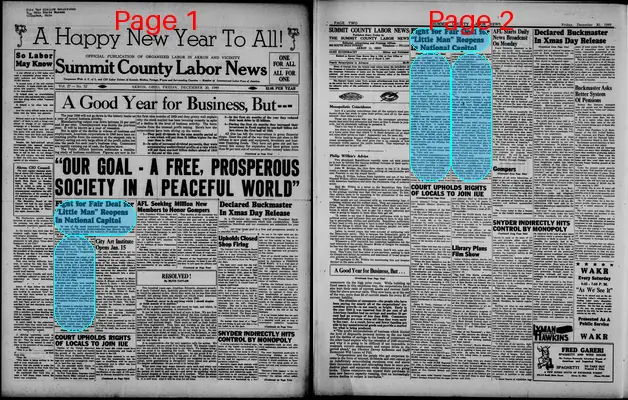
Summit County Labor News
Akron, Summit County, Ohio
What is this article about?
In Washington, D.C., the Truman Administration's officials testified before a congressional subcommittee on aiding 10 million low-income families through economic expansion, unemployment insurance, health legislation, and education aid as part of the Fair Deal program, sparking debate on deficit financing.
Merged-components note: Merged continuation from page 1 to page 2.
Clippings
1 of 2
OCR Quality
Full Text
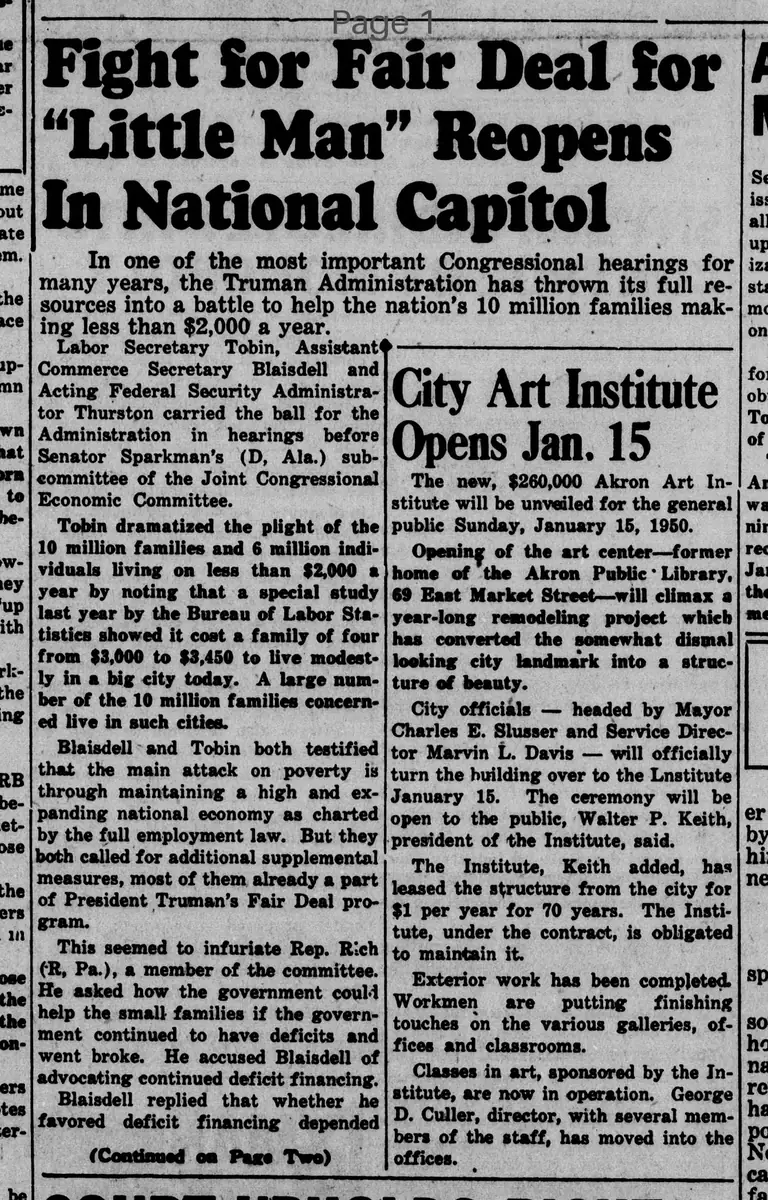
In one of the most important Congressional hearings for many years, the Truman Administration has thrown its full resources into a battle to help the nation's 10 million families making less than $2,000 a year.
Labor Secretary Tobin, Assistant Commerce Secretary Blaisdell and Acting Federal Security Administrator Thurston carried the ball for the Administration in hearings before Senator Sparkman's (D, Ala.) sub-committee of the Joint Congressional Economic Committee.
Tobin dramatized the plight of the 10 million families and 6 million individuals living on less than $2,000 a year by noting that a special study last year by the Bureau of Labor Statistics showed it cost a family of four from $3,000 to $3,450 to live modestly in a big city today. A large number of the 10 million families concerned live in such cities.
Blaisdell-and Tobin both testified that the main attack on poverty is through maintaining a high and expanding national economy as charted by the full employment law. But they both called for additional supplemental measures, most of them already a part of President Truman's Fair Deal program.
This seemed to infuriate Rep. Rich (R, Pa.), a member of the committee.
He asked how the government could help the small families if the government continued to have deficits and went broke. He accused Blaisdell of advocating continued deficit financing.
Blaisdell replied that whether he favored deficit financing 'depended
(Continued on Page Two)
Fight for Fair Deal for "Little Man" Reopens In National Capitol
(Continued from Page One)
upon the conditions. He noted that Congress (the Republican 80th) had created the deficit by cutting taxes at a time when he opposed such action.
Now, he said, he would prefer a balanced budget, but, whether it could be achieved in the light of the demands on government here and abroad he could not say.
Sparkman denied Blaisdell had advocated continued deficit spending. Rich insisted he had. Blaisdell flatly contradicted the Congressman asserting: "I have not."
Senator Flanders (R, N. H.), a more moderate Republican, noted that Senator Sawyer had been quoted as being on Rich's side of the fence on deficit-financing. Rich asked whether the Administration would carry out Sawyer's views. Sparkman reminded him that was up to Congress, not the President.
Tobin presented the committee with statistics-on the estimated cost of modest living for families of various sizes in big cities. It varied from $1500 to $1800 for one person to $3700 to $4400 for a family of six persons. Only the single person could live decently on $2,000, which left all the city families among the 10 million below par. He called the figure $2,000 a conservative one for defining low-income families.
Among the additional steps necessary to protect the low-income families, Tobin said, are: More adequate unemployment insurance with additional allowances for children; more adequate old age insurance benefits for older workers; national health legislation to strengthen unions and collective bargaining.
Blaisdell outlined a program not only for government, but for business. He said business could make a real contribution to the problem of low incomes by passing on the gains from
technological advance through higher wages and lower prices, and by regularizing employment, particularly in the seasonal industries.
The Commerce Department's greatest contribution, Blaisdell said, was in promoting regional developments like TVA, which he noted has shown more economic progress than the rest of the country.
Thurston said Federal aid to education (approved by the Senate, still pending in House), "would be a long step toward wiping out the inequities which are still a blot upon our principle of equal educational opportunity."
The nation's investment in child health and welfare services is too little and too late. Thurston argued, adding that more funds should be made available for basic research into why some children develop serious emotional and behavior problems which will affect their earning power and social adjustments all through their lives.
Some estimates which shocked the Congressmen, are that out of every classroom of 30 children, "three are destined to spend part of their lives in a mental hospital," Thurston said.
Many public health services programs, operating with federal and state funds, are doing a good job, but the performance varies from place to place, Thurston continued. Bills to extend public health programs, and to aid more workers to enter medical and nursing schools are now before Congress, Thurston said.
"A national health insurance plan," he told the subcommittee, "by bringing medical care within reach, in conjunction with rehabilitation services, should substantially cut down the loss of earning capacity because of ill health and disability. And this in turn would reduce the number of families whose low income is attributable to this cause."
What sub-type of article is it?
What keywords are associated?
What entities or persons were involved?
Where did it happen?
Domestic News Details
Primary Location
National Capitol
Key Persons
Outcome
administration officials advocated for supplemental measures including unemployment insurance, old age benefits, national health legislation, federal aid to education, and business contributions to higher wages; debate arose over deficit financing with no resolution noted.
Event Details
Truman Administration officials testified before Senator Sparkman's subcommittee on aiding 10 million low-income families through economic policies, health, education, and Fair Deal programs; Tobin highlighted living costs exceeding $2,000; Blaisdell discussed deficit financing and regional developments like TVA; Thurston emphasized child health, education aid, and national health insurance.