Thank you for visiting SNEWPapers!
Sign up free
Editorial
January 4, 1917
The Daily Progressive Miner
Ketchikan, Alaska
What is this article about?
Editorial by Mr. Hunt supports the halibut bill to shift the U.S. fish market from British Columbia's Prince Rupert to Alaska's Ketchikan, arguing it benefits fishermen, boosts local economy, and promotes patriotic community growth over foreign dependency.
Clipping
OCR Quality
95%
Excellent
Full Text
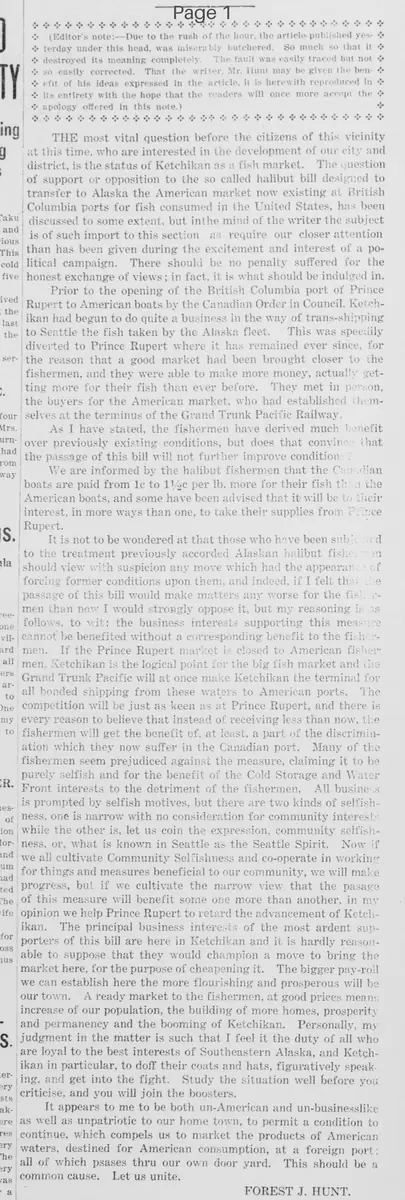
(Editor's note:—Due to the rush of the hour, the article published yesterday under this head, was miserably butchered. So much so that it destroyed its meaning completely. The fault was easily traced but not so easily corrected. That the writer, Mr. Hunt may be given the benefit of his ideas expressed in the article, it is herewith reproduced in its entirety with the hope that the readers will once more accept the apology offered in this note.)
THE most vital question before the citizens of this vicinity at this time, who are interested in the development of our city and district, is the status of Ketchikan as a fish market. The question of support or opposition to the so called halibut bill designed to transfer to Alaska the American market now existing at British Columbia ports for fish consumed in the United States, has been discussed to some extent, but in the mind of the writer the subject is of such import to this section as require our closer attention than has been given during the excitement and interest of a political campaign. There should be no penalty suffered for the honest exchange of views: in fact, it is what should be indulged in.
Prior to the opening of the British Columbia port of Prince Rupert to American boats by the Canadian Order in Council, Ketchikan had begun to do quite a business in the way of trans-shipping to Seattle the fish taken by the Alaska fleet. This was speedily diverted to Prince Rupert where it has remained ever since, for the reason that a good market had been brought closer to the fishermen, and they were able to make more money, actually getting more for their fish than ever before. They met in person, the buyers for the American market, who had established themselves at the terminus of the Grand Trunk Pacific Railway.
As I have stated, the fishermen have derived much benefit over previously existing conditions, but does that convince that the passage of this bill will not further improve conditions?
We are informed by the halibut fishermen that the Canadian boats are paid from 1c to 1½c per lb. more for their fish than the American boats, and some have been advised that it will be to their interest, in more ways than one, to take their supplies from Prince Rupert.
It is not to be wondered at that those who have been subjected to the treatment previously accorded Alaskan halibut fishermen should view with suspicion any move which had the appearance of forcing former conditions upon them, and indeed, if I felt that the passage of this bill would make matters any worse for the fishermen than now I would strongly oppose it, but my reasoning is as follows, to wit: the business interests supporting this measure cannot be benefited without a corresponding benefit to the fishermen.
If the Prince Rupert market is closed to American fishermen, Ketchikan is the logical point for the big fish market and this Grand Trunk Pacific will at once make Ketchikan the terminal for all bonded shipping from these waters to American ports. The competition will be just as keen as at Prince Rupert, and there is every reason to believe that instead of receiving less than now, the fishermen will get the benefit of, at least, a part of the discrimination which they now suffer in the Canadian port. Many of the fishermen seem prejudiced against the measure, claiming it to be purely selfish and for the benefit of the Cold Storage and Water Front interests to the detriment of the fishermen. All business is prompted by selfish motives, but there are two kinds of selfishness, one is narrow with no consideration for community interest while the other is, let us coin the expression, community selfishness, or, what is known in Seattle as the Seattle Spirit. Now if we all cultivate Community Selfishness and co-operate in working for things and measures beneficial to our community, we will make progress, but if we cultivate the narrow view that the passage of this measure will benefit some one more than another, in my opinion we help Prince Rupert to retard the advancement of Ketchikan. The principal business interests of the most ardent supporters of this bill are here in Ketchikan and it is hardly reasonable to suppose that they would champion a move to bring the market here, for the purpose of cheapening it. The bigger pay-roll we can establish here the more flourishing and prosperous will be our town. A ready market to the fishermen, at good prices means: increase of our population, the building of more homes, prosperity and permanency and the booming of Ketchikan. Personally, my judgment in the matter is such that I feel it the duty of all who are loyal to the best interests of Southeastern Alaska, and Ketchikan in particular, to doff their coats and hats, figuratively speaking, and get into the fight. Study the situation well before you criticise, and you will join the boosters.
It appears to me to be both un-American and un-businesslike as well as unpatriotic to our home town, to permit a condition to continue, which compels us to market the products of American waters, destined for American consumption, at a foreign port: all of which passes thru our own door yard. This should be a common cause. Let us unite.
THE most vital question before the citizens of this vicinity at this time, who are interested in the development of our city and district, is the status of Ketchikan as a fish market. The question of support or opposition to the so called halibut bill designed to transfer to Alaska the American market now existing at British Columbia ports for fish consumed in the United States, has been discussed to some extent, but in the mind of the writer the subject is of such import to this section as require our closer attention than has been given during the excitement and interest of a political campaign. There should be no penalty suffered for the honest exchange of views: in fact, it is what should be indulged in.
Prior to the opening of the British Columbia port of Prince Rupert to American boats by the Canadian Order in Council, Ketchikan had begun to do quite a business in the way of trans-shipping to Seattle the fish taken by the Alaska fleet. This was speedily diverted to Prince Rupert where it has remained ever since, for the reason that a good market had been brought closer to the fishermen, and they were able to make more money, actually getting more for their fish than ever before. They met in person, the buyers for the American market, who had established themselves at the terminus of the Grand Trunk Pacific Railway.
As I have stated, the fishermen have derived much benefit over previously existing conditions, but does that convince that the passage of this bill will not further improve conditions?
We are informed by the halibut fishermen that the Canadian boats are paid from 1c to 1½c per lb. more for their fish than the American boats, and some have been advised that it will be to their interest, in more ways than one, to take their supplies from Prince Rupert.
It is not to be wondered at that those who have been subjected to the treatment previously accorded Alaskan halibut fishermen should view with suspicion any move which had the appearance of forcing former conditions upon them, and indeed, if I felt that the passage of this bill would make matters any worse for the fishermen than now I would strongly oppose it, but my reasoning is as follows, to wit: the business interests supporting this measure cannot be benefited without a corresponding benefit to the fishermen.
If the Prince Rupert market is closed to American fishermen, Ketchikan is the logical point for the big fish market and this Grand Trunk Pacific will at once make Ketchikan the terminal for all bonded shipping from these waters to American ports. The competition will be just as keen as at Prince Rupert, and there is every reason to believe that instead of receiving less than now, the fishermen will get the benefit of, at least, a part of the discrimination which they now suffer in the Canadian port. Many of the fishermen seem prejudiced against the measure, claiming it to be purely selfish and for the benefit of the Cold Storage and Water Front interests to the detriment of the fishermen. All business is prompted by selfish motives, but there are two kinds of selfishness, one is narrow with no consideration for community interest while the other is, let us coin the expression, community selfishness, or, what is known in Seattle as the Seattle Spirit. Now if we all cultivate Community Selfishness and co-operate in working for things and measures beneficial to our community, we will make progress, but if we cultivate the narrow view that the passage of this measure will benefit some one more than another, in my opinion we help Prince Rupert to retard the advancement of Ketchikan. The principal business interests of the most ardent supporters of this bill are here in Ketchikan and it is hardly reasonable to suppose that they would champion a move to bring the market here, for the purpose of cheapening it. The bigger pay-roll we can establish here the more flourishing and prosperous will be our town. A ready market to the fishermen, at good prices means: increase of our population, the building of more homes, prosperity and permanency and the booming of Ketchikan. Personally, my judgment in the matter is such that I feel it the duty of all who are loyal to the best interests of Southeastern Alaska, and Ketchikan in particular, to doff their coats and hats, figuratively speaking, and get into the fight. Study the situation well before you criticise, and you will join the boosters.
It appears to me to be both un-American and un-businesslike as well as unpatriotic to our home town, to permit a condition to continue, which compels us to market the products of American waters, destined for American consumption, at a foreign port: all of which passes thru our own door yard. This should be a common cause. Let us unite.
What sub-type of article is it?
Trade Or Commerce
Economic Policy
What keywords are associated?
Halibut Bill
Ketchikan Market
Prince Rupert
American Fishermen
Fish Trans Shipping
Community Selfishness
Southeastern Alaska Development
What entities or persons were involved?
Ketchikan
Prince Rupert
Grand Trunk Pacific Railway
Halibut Fishermen
Mr. Hunt
Editorial Details
Primary Topic
Support For Halibut Bill To Establish Ketchikan As American Fish Market
Stance / Tone
Strongly Supportive, Urging Community Cooperation And Boosterism
Key Figures
Ketchikan
Prince Rupert
Grand Trunk Pacific Railway
Halibut Fishermen
Mr. Hunt
Key Arguments
Prior Diversion Of Fish Business To Prince Rupert Benefited Fishermen But Discriminated Against Americans
Canadian Boats Receive Higher Prices Than American Ones
Closing Prince Rupert To American Fishermen Would Make Ketchikan The Logical Market Point
Competition In Ketchikan Would Benefit Fishermen By Reducing Discrimination
Business Interests Supporting The Bill Align With Community Prosperity
Opposition Helps Prince Rupert And Retards Ketchikan's Advancement
Passage Of Bill Promotes Population Growth, Homes, Prosperity In Ketchikan
Uniting Against Foreign Port Marketing Of American Fish Is Patriotic