Thank you for visiting SNEWPapers!
Sign up free
Story
November 5, 1899
San Antonio Daily Light
San Antonio, Bexar County, Texas
What is this article about?
General Manager Chamberlain of the New York, New Haven and Hartford Railroad issues a strict dress code order for uniformed employees, banning gaudy shirts, cravats, and accessories in favor of neat, polished black-and-white attire to promote cleanliness and uniformity across the system.
Clipping
OCR Quality
98%
Excellent
Full Text
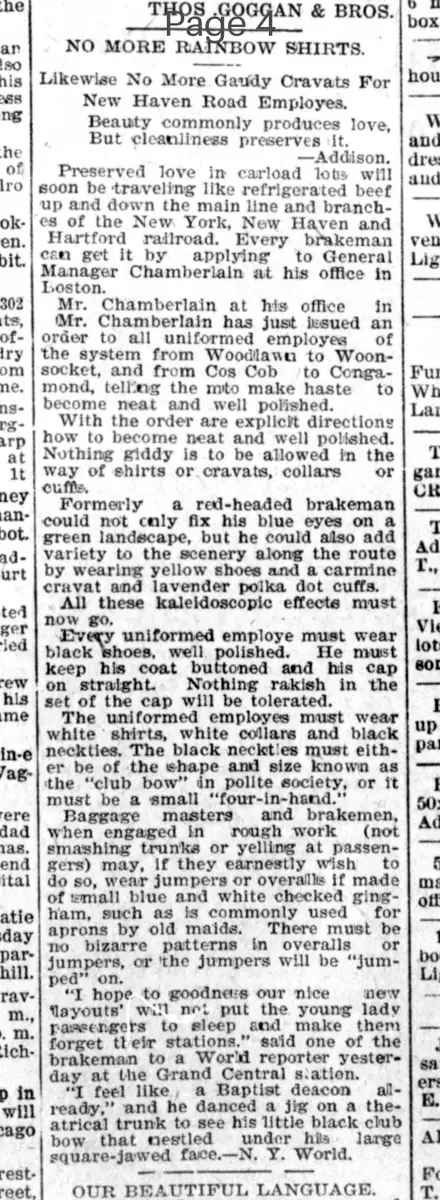
NO MORE RAINBOW SHIRTS.
Likewise No More Gaudy Cravats For New Haven Road Employes.
Beauty commonly produces love,
But cleanliness preserves it.
-Addison.
Preserved love in carload lots will soon be traveling like refrigerated beef up and down the main line and branches of the New York, New Haven and Hartford railroad. Every brakeman can get it by applying to General Manager Chamberlain at his office in Boston.
Mr. Chamberlain has just issued an order to all uniformed employes of the system from Woodlawn to Woonsocket, and from Cos Cob to Congamond, telling them to make haste to become neat and well polished.
With the order are explicit directions how to become neat and well polished.
Nothing giddy is to be allowed in the way of shirts or cravats, collars or cuffs.
Formerly a red-headed brakeman could not only fix his blue eyes on a green landscape, but he could also add variety to the scenery along the route by wearing yellow shoes and a carmine cravat and lavender polka dot cuffs.
All these kaleidoscopic effects must now go.
Every uniformed employee must wear black shoes, well polished. He must keep his coat buttoned and his cap on straight. Nothing rakish in the set of the cap will be tolerated.
The uniformed employes must wear white shirts, white collars and black neckties. The black neckties must either be of the shape and size known as the "club bow" in polite society, or it must be a small "four-in-hand."
Baggage masters and brakemen when engaged in rough work (not smashing trunks or yelling at passengers) may, if they earnestly wish to do so, wear jumpers or overalls if made of small blue and white checked gingham, such as is commonly used for aprons by old maids. There must be no bizarre patterns in overalls or jumpers, or the jumpers will be "jumped" on.
"I hope to goodness our nice new layouts' will not put the young lady passengers to sleep and make them forget their stations," said one of the brakemen to a World reporter yesterday at the Grand Central station.
"I feel like a Baptist deacon already," and he danced a jig on a theatrical trunk to see his little black club bow that nestled under his large square-jawed face.-N. Y. World.
Likewise No More Gaudy Cravats For New Haven Road Employes.
Beauty commonly produces love,
But cleanliness preserves it.
-Addison.
Preserved love in carload lots will soon be traveling like refrigerated beef up and down the main line and branches of the New York, New Haven and Hartford railroad. Every brakeman can get it by applying to General Manager Chamberlain at his office in Boston.
Mr. Chamberlain has just issued an order to all uniformed employes of the system from Woodlawn to Woonsocket, and from Cos Cob to Congamond, telling them to make haste to become neat and well polished.
With the order are explicit directions how to become neat and well polished.
Nothing giddy is to be allowed in the way of shirts or cravats, collars or cuffs.
Formerly a red-headed brakeman could not only fix his blue eyes on a green landscape, but he could also add variety to the scenery along the route by wearing yellow shoes and a carmine cravat and lavender polka dot cuffs.
All these kaleidoscopic effects must now go.
Every uniformed employee must wear black shoes, well polished. He must keep his coat buttoned and his cap on straight. Nothing rakish in the set of the cap will be tolerated.
The uniformed employes must wear white shirts, white collars and black neckties. The black neckties must either be of the shape and size known as the "club bow" in polite society, or it must be a small "four-in-hand."
Baggage masters and brakemen when engaged in rough work (not smashing trunks or yelling at passengers) may, if they earnestly wish to do so, wear jumpers or overalls if made of small blue and white checked gingham, such as is commonly used for aprons by old maids. There must be no bizarre patterns in overalls or jumpers, or the jumpers will be "jumped" on.
"I hope to goodness our nice new layouts' will not put the young lady passengers to sleep and make them forget their stations," said one of the brakemen to a World reporter yesterday at the Grand Central station.
"I feel like a Baptist deacon already," and he danced a jig on a theatrical trunk to see his little black club bow that nestled under his large square-jawed face.-N. Y. World.
What sub-type of article is it?
Curiosity
What themes does it cover?
Social Manners
What keywords are associated?
Railroad Dress Code
Uniformed Employees
Neatness Policy
New Haven Railroad
Gaudy Attire Ban
What entities or persons were involved?
Mr. Chamberlain
Where did it happen?
New York, New Haven And Hartford Railroad
Story Details
Key Persons
Mr. Chamberlain
Location
New York, New Haven And Hartford Railroad
Story Details
General Manager Chamberlain orders uniformed railroad employees to adopt a neat dress code: black polished shoes, buttoned coats, straight caps, white shirts and collars, black club bow or four-in-hand ties, and plain blue-and-white checked jumpers for rough work, banning all gaudy colors and patterns.