Thank you for visiting SNEWPapers!
Sign up free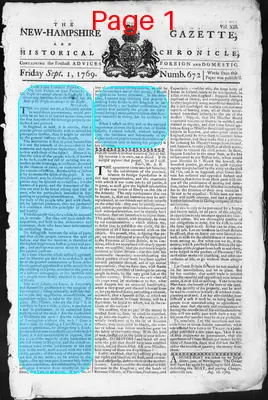
Letter to Editor
September 1, 1769
The New Hampshire Gazette And Historical Chronicle
Portsmouth, Greenland, Rockingham County, New Hampshire
What is this article about?
Reprinted from a London paper, this piece argues that the body of the people is always right, distinguishing their voice from factional clamor. It critiques how princely interests and poor representation threaten liberty, questioning who constitutes the 'mob' and decrying class insolence in Britain.
Clipping
OCR Quality
98%
Excellent
Full Text
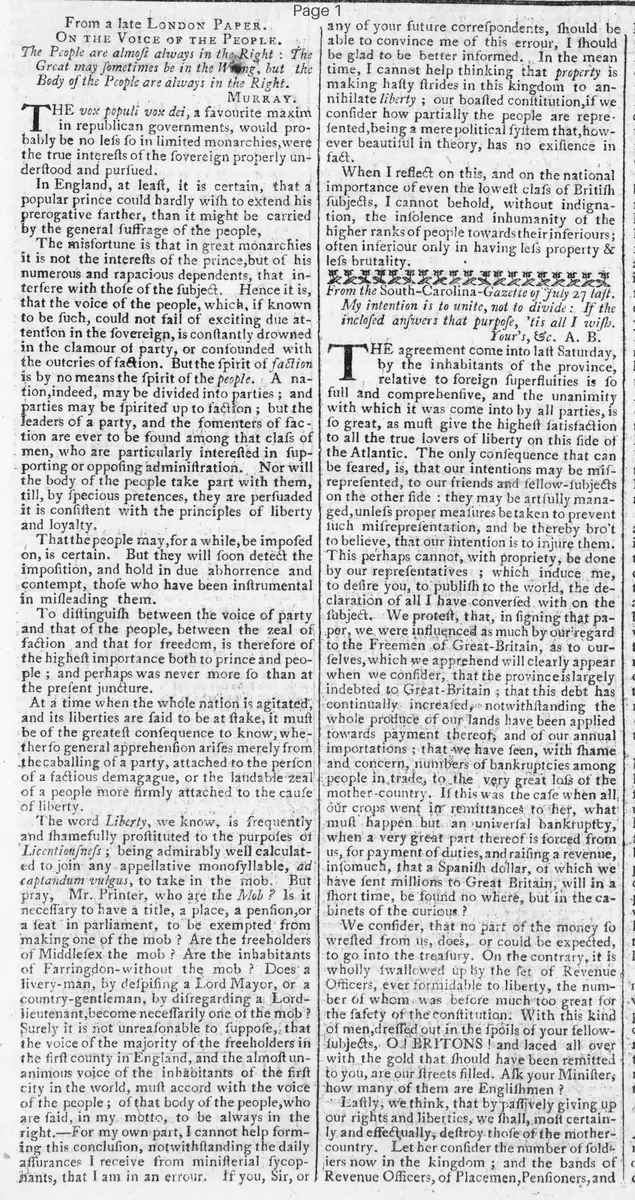
From a late London Paper.
On the Voice of the People.
The People are almost always in the Right: The Great may sometimes be in the Wrong, but the Body of the People are always in the Right.
MURRAY.
The very despotic maxim probably be no less so in limited monarchies, were the true interests of the sovereign properly understood and pursued.
In England, at least, it is certain, that a popular prince could hardly wish to extend his prerogative farther than it might be carried by the general suffrage of the people.
The misfortune is that in great monarchies it is not the interests of the prince, but of his numerous and rapacious dependents, that interfere with those of the subject. Hence it is, that the voice of the people, which, if known to be such, could not fail of exciting due attention in the sovereign, is constantly drowned in the clamour of party, or confounded with the outcries of faction. But the spirit of faction is by no means the spirit of the people. A nation, indeed, may be divided into parties; and parties may be spirited up to faction: but the leaders of a party, and the fomenters of faction are ever to be found among that class of men, who are particularly interested in supporting or opposing administration. Nor will the body of the people take part with them, till, by specious pretences, they are persuaded it is consistent with the principles of liberty and loyalty.
That the people may, for a while, be imposed on, is certain. But they will soon detect the imposition, and hold in due abhorrence and contempt, those who have been instrumental in misleading them.
To distinguish between the voice of party and that of the people, between the zeal of faction and that for freedom, is therefore of the highest importance both to prince and people; and perhaps was never more so than at the present juncture.
At a time when the whole nation is agitated, and its liberties are said to be at stake, it must be of the greatest consequence to know, whether so general apprehension arises merely from the caballing of a party, attached to the person of a factious demagogue, or the laudable zeal of a people more firmly attached to the cause of liberty.
The word Liberty, we know, is frequently and shamefully prostituted to the purposes of Licentiousness; being admirably well calculated to join any appellative monosyllable, ad captandum vulgus, to take in the mob. But pray, Mr. Printer, who are the Mob? Is it necessary to have a title, a place, a pension, or a seat in parliament, to be exempted from making one of the mob? Are the freeholders of Middlesex the mob? Are the inhabitants of Farringdon-without the mob? Does a livery-man, by despising a Lord Mayor, or a country-gentleman, by disregarding a Lord-Lieutenant, become necessarily one of the mob?
Surely it is not unreasonable to suppose, that the voice of the majority of the freeholders in the first county in England, and the almost unanimous voice of the inhabitants of the first city in the world, must accord with the voice of the people; of that body of the people, who are said, in my motto, to be always in the right. For my own part, I cannot help forming this conclusion, notwithstanding the daily assurances I receive from ministerial sycophants, that I am in an error. If you, Sir, or any of your future correspondents, should be able to convince me of this error, I should be glad to be better informed. In the mean time, I cannot help thinking that property is making hasty strides in this kingdom to annihilate liberty; our boasted constitution, if we consider how partially the people are represented, being a mere political system that, however beautiful in theory, has no existence in fact.
When I reflect on this, and on the national importance of even the lowest class of British subjects, I cannot behold, without indignation, the insolence and inhumanity of the higher ranks of people towards their inferiors; often inferior only in having less property & less brutality.
On the Voice of the People.
The People are almost always in the Right: The Great may sometimes be in the Wrong, but the Body of the People are always in the Right.
MURRAY.
The very despotic maxim probably be no less so in limited monarchies, were the true interests of the sovereign properly understood and pursued.
In England, at least, it is certain, that a popular prince could hardly wish to extend his prerogative farther than it might be carried by the general suffrage of the people.
The misfortune is that in great monarchies it is not the interests of the prince, but of his numerous and rapacious dependents, that interfere with those of the subject. Hence it is, that the voice of the people, which, if known to be such, could not fail of exciting due attention in the sovereign, is constantly drowned in the clamour of party, or confounded with the outcries of faction. But the spirit of faction is by no means the spirit of the people. A nation, indeed, may be divided into parties; and parties may be spirited up to faction: but the leaders of a party, and the fomenters of faction are ever to be found among that class of men, who are particularly interested in supporting or opposing administration. Nor will the body of the people take part with them, till, by specious pretences, they are persuaded it is consistent with the principles of liberty and loyalty.
That the people may, for a while, be imposed on, is certain. But they will soon detect the imposition, and hold in due abhorrence and contempt, those who have been instrumental in misleading them.
To distinguish between the voice of party and that of the people, between the zeal of faction and that for freedom, is therefore of the highest importance both to prince and people; and perhaps was never more so than at the present juncture.
At a time when the whole nation is agitated, and its liberties are said to be at stake, it must be of the greatest consequence to know, whether so general apprehension arises merely from the caballing of a party, attached to the person of a factious demagogue, or the laudable zeal of a people more firmly attached to the cause of liberty.
The word Liberty, we know, is frequently and shamefully prostituted to the purposes of Licentiousness; being admirably well calculated to join any appellative monosyllable, ad captandum vulgus, to take in the mob. But pray, Mr. Printer, who are the Mob? Is it necessary to have a title, a place, a pension, or a seat in parliament, to be exempted from making one of the mob? Are the freeholders of Middlesex the mob? Are the inhabitants of Farringdon-without the mob? Does a livery-man, by despising a Lord Mayor, or a country-gentleman, by disregarding a Lord-Lieutenant, become necessarily one of the mob?
Surely it is not unreasonable to suppose, that the voice of the majority of the freeholders in the first county in England, and the almost unanimous voice of the inhabitants of the first city in the world, must accord with the voice of the people; of that body of the people, who are said, in my motto, to be always in the right. For my own part, I cannot help forming this conclusion, notwithstanding the daily assurances I receive from ministerial sycophants, that I am in an error. If you, Sir, or any of your future correspondents, should be able to convince me of this error, I should be glad to be better informed. In the mean time, I cannot help thinking that property is making hasty strides in this kingdom to annihilate liberty; our boasted constitution, if we consider how partially the people are represented, being a mere political system that, however beautiful in theory, has no existence in fact.
When I reflect on this, and on the national importance of even the lowest class of British subjects, I cannot behold, without indignation, the insolence and inhumanity of the higher ranks of people towards their inferiors; often inferior only in having less property & less brutality.
What sub-type of article is it?
Persuasive
Political
Social Critique
What themes does it cover?
Politics
Constitutional Rights
Social Issues
What keywords are associated?
Voice Of The People
Faction
Liberty
Mob
Representation
British Constitution
Class Insolence
What entities or persons were involved?
Mr. Printer
Letter to Editor Details
Recipient
Mr. Printer
Main Argument
the body of the people is always in the right, and their voice must be distinguished from factional interests; poor representation and class divisions threaten british liberty, with property encroaching on constitutional rights.
Notable Details
Motto From Murray: 'The People Are Almost Always In The Right'
References To Middlesex Freeholders, Farringdon Without Inhabitants, Livery Men, Country Gentlemen
Critique Of 'Ministerial Sycophants' And 'Specious Pretences'