Thank you for visiting SNEWPapers!
Sign up free
Concord Register
Concord, Merrimack County, New Hampshire
What is this article about?
Philadelphia committee's address endorsing Henry Clay for U.S. Presidency, highlighting his consistent political career, patriotism, advocacy for liberty, war support, internal improvements, and South American independence recognition.
Clipping
OCR Quality
Full Text
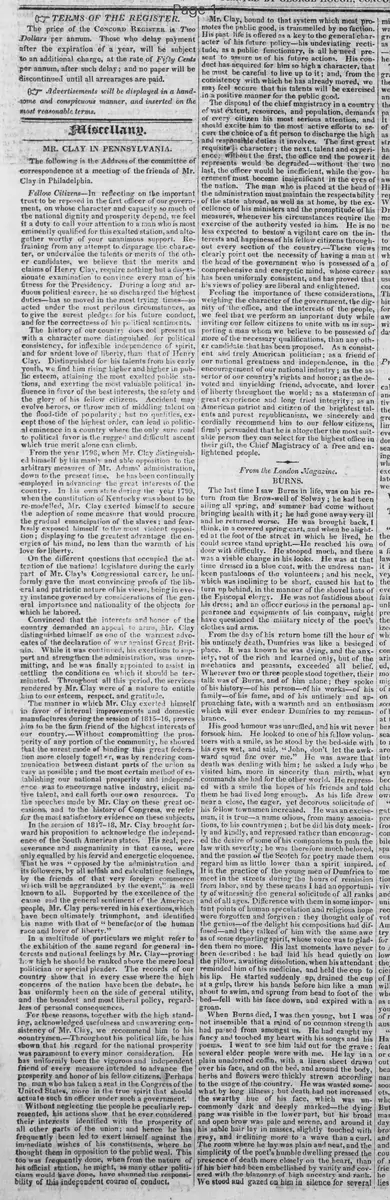
The following is the Address of the committee of correspondence at a meeting of the friends of Mr. Clay in Philadelphia.
Fellow Citizens—In reflecting on the important trust to be reposed in the first officer of our government, on whose character and capacity so much of the national dignity and prosperity depend, we feel it a duty to call your attention to a man who is most eminently qualified for this exalted station, and altogether worthy of your unanimous support. Refraining from any attempt to disparage the character, or undervalue the talents or merits of the other candidates, we believe that the merits and claims of Henry Clay, require nothing but a dispassionate examination to convince every man of his fitness for the Presidency. During a long and arduous political career, he so discharged the highest duties—has so moved in the most trying times—so acted under the most perilous circumstances, as to give the surest pledges for his future conduct, and for the correctness of his political sentiments. The history of our country does not present us with a character more distinguished for political consistency, for inflexible independence of spirit, and for ardent love of liberty, than that of Henry Clay. Distinguished for his talents from his early youth, we find him rising higher and higher in public esteem, attaining the most exalted public stations, and exerting the most valuable political influence in favor of the best interests, the safety and the glory of his fellow citizens. Accident may evolve heroes, or throw men of middling talent on the flood-tide of popularity; but no qualities, except those of the highest order, can lead to political eminence in a country where the only sure road to political favor is the rugged and difficult ascent which true merit alone can climb.
From the year 1798, when Mr. Clay distinguished himself by his manly and able opposition to the arbitrary measures of Mr. Adams' administration, down to the present time, he has been continually employed in advancing the great interests of the country. In his own state during the year 1799, when the constitution of Kentucky was about to be re-modelled, Mr. Clay exerted himself to secure the adoption of some measure that would procure the gradual emancipation of the slaves; and fearlessly exposed himself to the most violent opposition; displaying to the greatest advantage the energies of his mind, no less than the warmth of his love for liberty.
On the different questions that occupied the attention of the national legislature during the early part of Mr. Clay's Congressional career, he uniformly gave the most convincing proofs of the liberal and patriotic nature of his views, being in every instance governed by considerations of the general importance and nationality of the objects for which he labored. Convinced that the interests and honor of the country demanded an appeal to arms, Mr. Clay distinguished himself as one of the warmest advocates of the declaration of war against Great Britain. While it was continued, his exertions to support and strengthen the administration, was unremitting, and he was finally appointed to assist in settling the conditions on which it should be terminated. Throughout all this period, the services rendered by Mr. Clay were of a nature to entitle him to our esteem, respect, and gratitude.
The manner in which Mr. Clay exerted himself in favor of internal improvements and domestic manufactures during the session of 1815-16, proves him to be the firm friend of the highest interests of our country.—Without compromising the prosperity of any portion of the community, he showed that the surest mode of binding this great federation more closely together, was by rendering communication between distant parts of the union as easy as possible; and the most certain method of establishing our national prosperity and independence was to encourage native industry, elicit native talent, and call forth our own resources. To the speeches made by Mr. Clay on these great occasions, and to the history of Congress, we refer for the most satisfactory evidence on these subjects.
In the session of 1817-18, Mr. Clay brought forward his proposition to acknowledge the independence of the South American states. His zeal, perseverance and magnanimity in that cause, were only equalled by his fervid and energetic eloquence. That he was "opposed by the administration and its followers, by all selfish and calculating feelings, by the friends of that very foreign commerce which will be aggrandized by the event," is well known to all. Supported by the excellence of the cause and the general sentiment of the American people, Mr. Clay persevered in his exertions, which have been ultimately triumphant, and identified his name with that of "benefactor of the human race and lover of liberty."
In a multitude of particulars we might refer to the exhibition of the same regard for general interests and national feelings by Mr. Clay—proving how high he should be ranked above the mere local politician or special pleader. The records of our country show that in every case where the high concerns of the nation have been the debate, he has uniformly been on the side of general utility, and the broadest and most liberal policy, regardless of personal consequences.
For these reasons, together with the high standing, acknowledged usefulness and unwavering consistency of Mr. Clay, we recommend him to his countrymen.—Throughout his political life, he has shown that his regard for the national prosperity was paramount to every minor consideration. He has uniformly been the vigorous and independent friend of every measure intended to advance the prosperity and honor of his fellow citizens. Perhaps no man who has taken a seat in the Congress of the United States, more in the true spirit that should actuate such an officer under such a government. Without neglecting the people he peculiarly represented, his actions show that he ever considered their interests identified with the prosperity of all other parts of the union; and hence he has frequently been led to exert himself against the immediate wishes of his constituents, where he thought them in opposition to the public weal. This too was frequently done, when from the nature of his official station, he might, as many other politicians would have done, have shunned the responsibility of this independent course of conduct.
Mr. Clay, bound to that system which most promotes the public good, is trammelled by no faction. His past life is offered as a key to the general character of his future policy—his undeviating rectitude, as a public functionary, is all he need present to assure us of his future actions. His conduct has acquired for him so high a character, that he must be careful to live up to it; and, from the consistency with which he has already moved, we may feel secure that his talents will be exercised in a positive manner for the public good.
The disposal of the chief magistracy in a country of vast extent, resources, and population, demands of every citizen his most serious attention, and should excite him to the most active efforts to secure the choice of a fit person to discharge the high and responsible duties it involves. The first great requisite is character; the next, talent and experience: without the first, the office and the power it represents would be degraded—without the two last, the officer would be inefficient, while the government must become insignificant in the eyes of the nation. The man who is placed at the head of the administration must maintain the respectability of the state abroad, as well as at home, by the excellence of his ministers and the promptitude of his measures, whenever his circumstances require the exercise of the authority vested in him. He is no less expected to bestow a vigilant care on the interests and happiness of his fellow citizens throughout every section of the country.—These views clearly point out the necessity of having a man at the head of the government who is possessed of a comprehensive and energetic mind, whose career has been uniformly consistent, and has proved that his views of policy are liberal and enlightened.
Feeling the importance of these considerations, weighing the character of the government, the dignity of the office, and the interests of the people, we feel that we perform an important duty while inviting our fellow citizens to unite with us in supporting a man whom we believe to be possessed of more of the necessary qualifications, than any other candidate that has been proposed. As a consistent and truly American politician; as a friend of our national greatness and independence, in the encouragement of our national industry; as the asserter of our country's rights and honor; as the devoted and unyielding friend, advocate, and lover of liberty throughout the world; as a statesman of great experience and long tried integrity; as an American patriot and citizen of the brightest talents and purest republicanism, we sincerely and cordially recommend him to our fellow citizens, firmly persuaded that he is altogether the most suitable person they can select for the highest office in their gift, the Chief Magistracy of a free and enlightened people.
What sub-type of article is it?
What themes does it cover?
What keywords are associated?
What entities or persons were involved?
Where did it happen?
Story Details
Key Persons
Location
Philadelphia
Story Details
Address by Philadelphia committee praising Henry Clay's political consistency, independence, love of liberty, opposition to Adams in 1798, advocacy for slave emancipation in Kentucky 1799, support for War of 1812, promotion of internal improvements and manufactures in 1815-16, recognition of South American independence in 1817-18, and overall patriotism, recommending him for President.