Thank you for visiting SNEWPapers!
Sign up free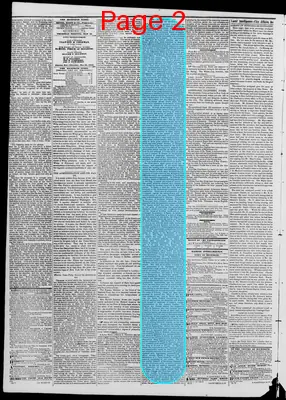
Richmond Daily Times
Richmond, Virginia
What is this article about?
The London Times reports on Europe's post-revolutionary tranquility under despotic control, analyzing instability in France under Napoleon III, political strife in Spain and Portugal, papal decline in Italy, tensions in Switzerland and Piedmont, and diplomatic maneuvers involving Belgium, Holland, and Denmark as of May 5.
Clipping

OCR Quality
Full Text
THE ASPECT OF EUROPE.
Although a state of apparent tranquility, under the severe control of despotic government, has succeeded to the hurricane which lately agitated Europe, it would imply a very superficial observation of the continental States to imagine that they have recovered their natural condition or resumed a policy at once stable in its principles and progressive in its results. On the contrary, it may well be doubted whether any of the States which were lately convulsed by anarchy have sufficient confidence in their own resources, and in the attachment of their subjects, to engage with success in any energetic political combination, or even to encounter, without extreme danger, the difficulties which it is the duty of governments to surmount in the ordinary course of human affairs. In France, every thing remains indefinite and obscure. The destinies and the policy of that nation are for the present enveloped in the mystery of a single mind, and circumscribed by the force of a single will. From time to time some adventurous conception or abrupt determination seems likely to change the course of affairs, and to renew the turmoil of the age. But more habitually a taste for luxurious indulgencies, a phlegmatic indolence of character, which only gives way to the pressure of great excitement, and perhaps a consciousness of failing health, tend to keep the Emperor of the French in the passive enjoyment of the extraordinary gifts of fortune. In this respect the prevailing mood of the French nation corresponds with that of its ruler, and he would probably find it as perilous and as difficult to rouse that people to the pursuit of any great undertaking, as it has been sometimes to restrain them from such enterprises. The petty mishaps which have here and there befallen the diplomacy of the Empire, have not yet ruffled the surface, and the reflection that any important change abroad would place France alone, and in opposition to the whole of Europe, has thus far proved an effectual check to her ambition. In truth, as the nation is kept in profound ignorance of the policy of the government, and even of the events occurring in other parts of the world, that spring of popular excitement which had of late years performed so great a part in the affairs of France, both at home and abroad, is unbent and at rest. But, by the same rule, the imperial government would not find it easy to call forth the energies of the nation without some very palpable emergency, because the same causes which render it submissive to absolute power, and indifferent to political questions, have directed its activity to other objects, and more especially to the pursuit of wealth. In some respects a government, a government conducted by men with a nicer sense of honor, with more acute political insight, with a livelier sympathy in those great questions that agitate the world, and with greater freedom of discussion., is more likely to put the peace of the world and the tranquility of the country in jeopardy than a government which acts like an anodyne after a fever fit; and although it is impossible to reckon in such a country as France on the duration of this period of suspended animation, which is obviously the result of the immoderate tension and alarm of the preceding years, it is, as long as it lasts, inoffensive to the rest of the world. But if we take a rapid survey of the rest of Europe, and especially of the minor States, where the existing order of things is not supported by vast military establishments, it is curious to observe in how many instances the governments of those countries are struggling with difficulties which are considerable in proportion to their respective magnitudes. In Portugal the declining health of Marshal Saldanha seems likely, ere long, to renew the contest of parties for that power which he obtained by a military revolt, though he has since exercised it with moderation. In Spain, a blow has twice been all but struck at the fundamental principles of the constitution. Every man of eminence in politics is arrayed against the extraordinary and destructive policy of the court. Narvaez himself is kept in banishment and in disgrace. The palace is the scene of intrigues between Christiana, Munoz, and their creatures, which can only be compared with the scandalous excesses of Godoy. The Queen herself has more than once been on the point of destroying that constitutional character which is her best title to the throne, and the house of Bourbon seems only to have prolonged its existence in Spain, to exhibit to the world the degradation of a race of kings.— Another member of that house, the King of Naples. has made himself the lackey and the tool of Louis Napoleon, His Minister in Paris was the first to run with his ready made credentials to recognise the new Empire; and the late prosecution instituted in France against several persons for their expressions contained in their private letters, were assisted by the reports of the police in Naples to the Minister of Police in Paris. The Papal Government continues to exhibit the total and irretrievable decay of its temporal authority, in direct connexion with unlimited and unprecedented claims to spiritual supremacy. A French brigade is its only defence in Rome; but in France it prohibits books, impugns the ecclesiastical law, suspends the clergy from their functions, and publishes edicts which are received by French bishops on their knees, with the fulsome ejaculation : "Peter has spoken by the lips of the immortal Pius IX." In Piedmont, the government struggles manfully in defence of the rights of the house of Savoy, the independence of the State, and the constitutional franchises of the people. But, with all its ability and zeal, it is the government of an intelligent minority, deserted by a large portion of the upper classes and of the clergy, ill supported in some parts of the king's dominions, and liable to be betrayed, in an emergency, by the Italian people. Between Austria and Piedmont, as well as between Austria and Switzerland, the seeds of hostility and ill neighborhood have been sown by Mazzini's mischievous insurrection; and the cabinet of Turin has once more been led to expose itself to peril, by a spirited defence of men who have done nothing to win the respect of the country. In Switzerland the old sore has broken afresh in the canton of Friburg. Tesin has been openly menaced by Austria; the effect of the Austrian minister's last note at Berne was such that the Swiss Federal Council was on the point of sending him his passports; and France holds herself in readiness to make a counter demonstration on the western frontier. To Belgium the French cabinet has despatched M. His de Butenval, who had recently proved himself at Turin to be one of their most unscrupulous agents; and some weeks since intimation reached the little court of Brussels to the effect that any serious acquisition made by Russia in the East would be held by France to constitute a sufficient ground or pretext for the abolition of existing territorial treaties on her own immediate frontier. At any rate the language of M. His de Butenval has revived the ready apprehensions of the Belgium government; and perhaps it is in connexion with this circumstance that the young Duke of Brabant, whose majority was recently celebrated as a national festival by the whole of Belgium, is shortly to proceed to Vienna to pay his respects to the Austrian court. Meanwhile King Leopold proceeds to Berlin, and the Emperor of Russia to Warsaw, whence it is probable these sovereigns will repair, with the King of Prussia to Vienna. In Holland, where the principles of a free Protestant people are indestructibly rooted in the staunch support and primitive manners of the nation, the Pope has repeated with aggravating circumstances, the affront already offered to England, by the establishment of a Papal hierarchy, without the assent of knowledge of the crown. The king has availed himself of the energy displayed by the ultra Protestant party, to eject a ministry to which he was not warmly attached; and, by the dissolution of the Second Chamber of the States, the new cabinet throws itself upon the high Orange and Protestant party in the country. Lastly, in Denmark, where the constitution framed in 1848, has virtually placed the supreme power in the hands of the minority, by requiring on certain questions that resolutions should be carried by three-fourths of the votes given, the government is once more thrown into
What sub-type of article is it?
What keywords are associated?
What entities or persons were involved?
Where did it happen?
Foreign News Details
Primary Location
Europe
Event Date
May 5
Key Persons
Outcome
apparent tranquility under despotic control, but underlying instability and difficulties in various states; no major conflicts reported, but tensions and intrigues persist.
Event Details
Survey of Europe's political situation post-revolutions: France in suspended animation under Napoleon III; Portugal facing party contests due to Saldanha's health; Spain with constitutional threats and court intrigues; Naples aligned with France; Papal temporal decay; Piedmont defending independence amid betrayals; Swiss-Austrian tensions; French diplomatic pressures on Belgium; Papal hierarchy affront in Holland; Danish constitutional issues leading to government instability.