Thank you for visiting SNEWPapers!
Sign up free
The Omaha Guide
Omaha, Douglas County, Nebraska
What is this article about?
Report on increasing farm tenancy in the US, focusing on Negro sharecroppers comprising 25.2% in 14 southern states, with statistics on poverty, incomes, migration, and recommendations for federal aid from WPA and state planning boards.
Merged-components note: Continuation of sharecroppers story from page 1 to page 5; original label on page 5 was 'story' but content matches domestic_news.
Clippings
1 of 2
OCR Quality
Full Text
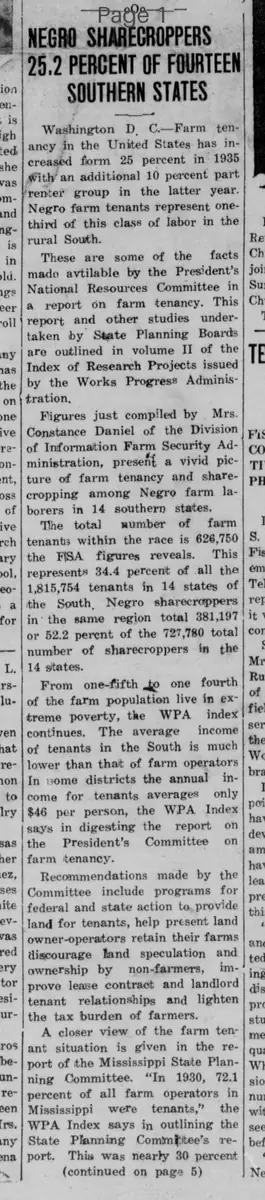
Washington D. C.-Farm tenancy in the United States has increased from 25 percent in 1935 with an additional 10 percent part renter group in the latter year.
Negro farm tenants represent one-third of this class of labor in the rural South.
These are some of the facts made available by the President's National Resources Committee in a report on farm tenancy. This report and other studies undertaken by State Planning Boards are outlined in volume II of the Index of Research Projects issued by the Works Progress Administration.
Figures just compiled by Mrs. Constance Daniel of the Division of Information Farm Security Administration, present a vivid picture of farm tenancy and share-cropping among Negro farm laborers in 14 southern states.
The total number of farm tenants within the race is 626,750 the FSA figures reveals. This represents 34.4 percent of all the 1,815,754 tenants in 14 states of the South. Negro sharecroppers in the same region total 381,197 or 52.2 percent of the 727,780 total number of sharecroppers in the 14 states.
From one-fifth to one fourth of the farm population live in extreme poverty, the WPA index continues. The average income of tenants in the South is much lower than that of farm operators. In some districts the annual income for tenants averages only $46 per person, the WPA Index says in digesting the report on the President's Committee on farm tenancy.
Recommendations made by the Committee include programs for federal and state action to provide land for tenants, help present land owner-operators retain their farms, discourage land speculation and ownership by non-farmers, improve lease contract and landlord tenant relationships and lighten the tax burden of farmers.
A closer view of the farm tenant situation is given in the report of the Mississippi State Planning Committee. "In 1930, 72.1 percent of all farm operators in Mississippi were tenants." the WPA Index says in outlining the State Planning Committee's report. This was nearly 30 percent
(continued on page 5)
NEGRO SHARECROPPERS (continued from page 1)
greater than the average for the United States, and represents 47 percent of the population in the State of Mississippi.
The WPA Index discloses that 71 percent of the tenant farms operated in Mississippi were by Negro tenants as compared with 29 percent for white tenants.
"Approximately 56 percent of all farms in the State were occupied by tenants who had been on the farm for less than five years," the WPA Index reports. "Of the owner-operated farms, 38.9 percent had been occupied by the same owner 15 years or more compared with only 4 percent of the tenant-operated farms."
The close relationship of farming to shifting populations is observed as the WPA Index outlines reports made by the State Planning Boards of Virginia, Illinois, North Carolina and Mississippi.
The loss by persons moving out of Virginia over an influx of new residents was 110,866 for Negroes and 97,265 for the white population.
Decrease in the number of children under five years of age in the rural population per one thousand families 15 to 44 years of age in Virginia was from 637 to 574. The average monthly wage of farmers in Virginia was $34 without board. The annual wage per wage earner in the manufacturing industry was reported as $878.
Through migration, Illinois gained a net increase of two hundred thousand Negroes in its population from 1900 to the last census, the WPA Index points out in an outline of a report of the Illinois State Planning Board.
Meanwhile, there was a loss by migration of 20 Negroes to every one hundred whites in North Carolina from 1880 to the last census.
Births and deaths of white citizens remain practically stable in Mississippi between 1925 and 1934. Births among Negro citizens in the State increased from 23,298 in 1925 to 25,563 in 1934. Deaths within the race decreased from 14,086 to 12,436 in respective years.
The WPA Index of Research Projects also lists and summarizes the situation of the Negro in farm management, population and migration, and general social problems.
Many of these research activities in urban and rural communities have been made possible by the assistance of the WPA Research Projects employing trained white collar workers taken from relief rolls.
What sub-type of article is it?
What keywords are associated?
What entities or persons were involved?
Where did it happen?
Domestic News Details
Primary Location
Fourteen Southern States
Key Persons
Outcome
negro farm tenants: 626,750 (34.4% of total tenants); negro sharecroppers: 381,197 (52.2% of total sharecroppers); extreme poverty for 20-25% of farm population; tenant incomes as low as $46 per person annually; recommendations for federal/state aid to tenants and owners.
Event Details
Farm tenancy increased to 25% in US by 1935; Negroes represent one-third of rural South tenants; WPA and President's Committee reports detail statistics on Negro tenancy and sharecropping in 14 southern states, poverty levels, state-specific data from Mississippi, Virginia, Illinois, North Carolina on tenancy rates, migration losses/gains, wages, and population shifts; Mississippi: 72.1% farm operators tenants in 1930, 71% by Negroes.