Thank you for visiting SNEWPapers!
Sign up free
Indiana State Sentinel
Indianapolis, Marion County, Indiana
What is this article about?
Trial of explosive gun cotton conducted in Washington on the 14th in presence of the President, using sample from Professor Schonbein. Results surprising but not fully satisfactory. Mr. Robertson to test improved version. Dr. Otto publishes preparation method using nitric acid, claiming simultaneous discovery. Advantages: cheaper, water-resistant. Commentary on its potential as gunpowder substitute and implications for warfare.
Clipping
OCR Quality
Full Text
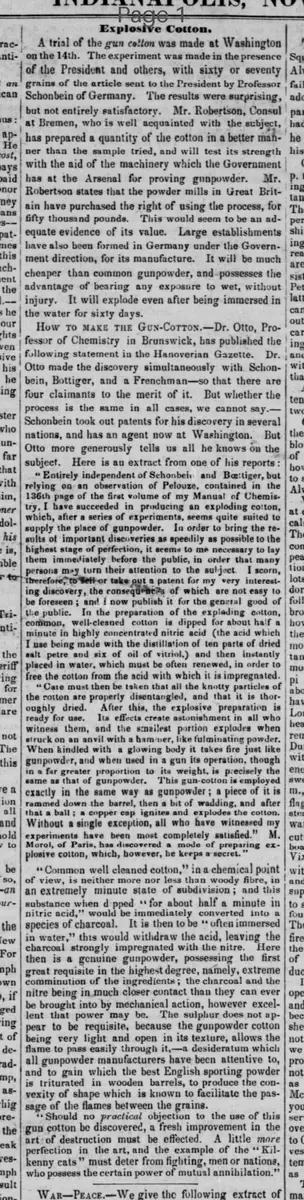
A trial of the gun cotton was made at Washington on the 14th. The experiment was made in the presence of the President and others, with sixty or seventy grains of the article sent to the President by Professor Schonbein of Germany. The results were surprising, but not entirely satisfactory. Mr. Robertson, Consul at Bremen, who is well acquainted with the subject, has prepared a quantity of the cotton in a better manner than the sample tried, and will test its strength with the aid of the machinery which the Government has at the Arsenal for proving gunpowder. Mr. Robertson states that the powder mills in Great Britain have purchased the right of using the process, for fifty thousand pounds. This would seem to be an adequate evidence of its value. Large establishments have also been formed in Germany under the Government direction, for its manufacture. It will be much cheaper than common gunpowder, and possesses the advantage of bearing any exposure to wet, without injury. It will explode even after being immersed in the water for sixty days.
How To Make The Gun-Cotton.—Dr. Otto, Professor of Chemistry in Brunswick, has published the following statement in the Hanoverian Gazette. Dr. Otto made the discovery simultaneously with Schonbein, Bottiger, and a Frenchman—so that there are four claimants to the merit of it. But whether the process is the same in all cases, we cannot say.— Schonbein took out patents for his discovery in several nations, and has an agent now at Washington. But Otto more generously tells us all he knows on the subject. Here is an extract from one of his reports:
"Entirely independent of Schonbein and Bottiger, but relying on an observation of Pelouze, contained in the 136th page of the first volume of my Manual of Chemistry, I have succeeded in producing an exploding cotton, which, after a series of experiments, seems quite suited to supply the place of gunpowder. In order to bring the results of important discoveries as speedily as possible to the highest stage of perfection, it seems to me necessary to lay them immediately before the public, in order that many persons may turn their attention to the subject. I scorn, therefore, to sell or take out a patent for my very interesting discovery, the consequences of which are not easy to be foreseen; and I now publish it for the general good of the public. In the preparation of the exploding cotton, common, well-cleaned cotton is dipped for about half a minute in highly concentrated nitric acid (the acid which I use being made with the distillation of ten parts of dried salt petre and six of oil of vitriol,) and then instantly placed in water, which must be often renewed, in order to free the cotton from the acid with which it is impregnated. "Care must then be taken that all the knotty particles of the cotton are properly disentangled, and that it is thoroughly dried." After this, the explosive preparation is ready for use. Its effects create astonishment in all who witness them, and the smallest portion explodes when struck on an anvil with a hammer, like fulminating powder. When kindled with a glowing body it takes fire just like gunpowder, and when used in a gun its operation, though in a far greater proportion to its weight, is precisely the same as that of gunpowder. This gun-cotton is employed exactly in the same way as gunpowder; a piece of it is rammed down the barrel, then a bit of wadding, and after that a ball; a copper cap ignites and explodes the cotton. Without a single exception, all who have witnessed my experiments have been most completely satisfied." M. Morol, of Paris, has discovered a mode of preparing explosive cotton, which, however, he keeps a secret.
"Common well cleaned cotton." in a chemical point of view, is neither more nor less than woody fibre, in an extremely minute state of subdivision; and this substance when dipped "for about half a minute in nitric acid," would be immediately converted into a species of charcoal. It is then to be "often immersed in water," this would withdraw the acid, leaving the charcoal strongly impregnated with the nitre. Here then is a genuine gunpowder, possessing the first great requisite in the highest degree, namely, extreme comminution of the ingredients; the charcoal and the nitre being in much closer contact than they can ever be brought into by mechanical action, however excellent that power may be. The sulphur does not appear to be requisite, because the gunpowder cotton being very light and open in its texture, allows the flame to pass easily through it,—a desideratum which all gunpowder manufacturers have been attentive to, and to gain which the best English sporting powder is triturated in wooden barrels, to produce the convexity of shape which is known to facilitate the passage of the flames between the grains.
"Should no practical objection to the use of this gun cotton be discovered, a fresh improvement in the art of destruction must be effected. A little more perfection in the art, and the example of the "Kilkenny cats" must deter from fighting, men or nations, who possess the certain power of mutual annihilation."
What sub-type of article is it?
What themes does it cover?
What keywords are associated?
What entities or persons were involved?
Where did it happen?
Story Details
Key Persons
Location
Washington
Event Date
On The 14th
Story Details
Trial of gun cotton in Washington on the 14th using sample from Schonbein yields surprising results; Robertson to test improved version. Otto publishes nitric acid preparation method, simultaneous discovery with others; advantages include water resistance, cheaper than gunpowder, used like powder. Chemical explanation and warning on destructive potential.