Thank you for visiting SNEWPapers!
Sign up free
Jenks's Portland Gazette
Portland, Cumberland County, Maine
What is this article about?
In Paris, Citizen Talleyrand publishes a vindication defending his revolutionary credentials against accusations from ex-nobles and foreigners, denying emigrant status and war-mongering. Charles Delacroix responds, clarifying his role in Lille negotiations and denying prior knowledge of the Egypt expedition under his ministry.
Merged-components note: Delacroix's observations are a direct response to Talleyrand's vindication in the preceding text, forming a cohesive foreign news article on French politics.
Clipping
OCR Quality
Full Text
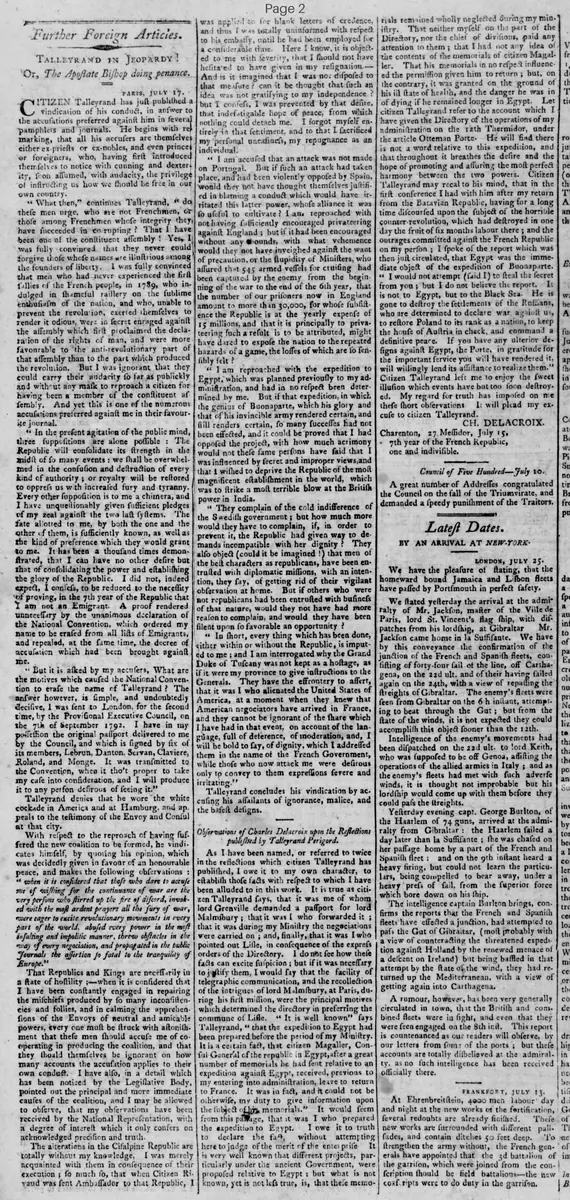
TALLEYRAND IN JEOPARDY!
Or, The Apostate Bishop doing penance.
PARIS, JULY 17.
Citizen Talleyrand has just published a vindication of his conduct, in answer to the accusations preferred against him in several pamphlets and journals. He begins with remarking, that all his accusers are themselves either ex-priests or ex-nobles, and even princes or foreigners, who, having first introduced themselves to notice with cunning and dexterity, soon assumed, with audacity, the privilege of instructing us how we should be free in our own country.
"What then," continues Talleyrand, "do these men urge, who are not Frenchmen, or those among Frenchmen whose integrity they have succeeded in corrupting? That I have been one of the constituent assembly! Yes, I was fully convinced that they never could forgive those whose names are illustrious among the founders of liberty. I was fully convinced that men who had never experienced the first follies of the French people, in 1789, who indulged in shameful raillery on the sublime enthusiasm of the nation, and who, unable to prevent the revolution, exerted themselves to render it odious, were in secret enraged against the assembly which first proclaimed the declaration of the rights of man, and were more favourable to the anti-revolutionary part of that assembly than to the part which produced the revolution. But I was ignorant that they could carry their audacity so far as publicly and without any mask to reproach a citizen for having been a member of the constituent assembly. And yet this is one of the numerous accusations preferred against me in their favourite journal."
"In the present agitation of the public mind, three suppositions are alone possible: The Republic will consolidate its strength in the midst of so many events: we shall be overwhelmed in the confusion and destruction of every kind of authority: or royalty will be restored to oppress us with increased fury and tyranny. Every other supposition is to me a chimera, and I have unquestionably given sufficient pledges of my zeal against the two last systems. The fate allotted to me, by both the one and the other of them, is sufficiently known, as well as the kind of preference which they would grant to me. It has been a thousand times demonstrated, that I can have no other desire but that of consolidating the power and establishing the glory of the Republic. I did not, indeed expect, I confess, to be reduced to the necessity of proving, in the 7th year of the Republic that I am not an Emigrant. A proof rendered unnecessary by the unanimous declaration of the National Convention, which ordered my name to be erased from all lists of Emigrants, and repealed, at the same time, the decree of accusation which had been brought against me."
"But it is asked by my accusers, What are the motives which caused the National Convention to erase the name of Talleyrand? The answer however, is simple, and undoubtedly decisive. I was sent to London, for the second time, by the Provisional Executive Council, on the 7th of September 1792. I have in my possession the original passport delivered to me by the Council, and which is signed by six of its members, Lebrun, Danton, Servan, Claviere, Roland, and Monge. It was transmitted to the Convention, when it thought proper to take my case into consideration, and I will produce it to any person desirous of seeing it."
Talleyrand denies that he wore the white cockade in America and at Hamburg, and appeals to the testimony of the Envoy and Consul at that city.
With respect to the reproach of having suffered the new coalition to be formed, he vindicates himself, by quoting his opinion, which was decidedly given in favour of an honourable peace, and makes the following observations:
"When it is considered that those who dare to accuse me of wishing for the continuance of war are the very persons who stirred up the fire of discord, invoked with the most ardent prayers all the fury of war, were eager to excite revolutionary movements in every part of the world, abused every power in the most insulting and impolitic manner, threw obstacles in the way of every negotiation, and propagated in the public journals the assertion so fatal to the tranquility of Europe."
That Republics and Kings are necessarily in a state of hostility;—when it is considered that I have been constantly engaged in repairing the mischiefs produced by so many inconsistencies and follies, and in calming the apprehensions of the Envoys of neutral and amicable powers, every one must be struck with astonishment that these men should accuse me of co-operating in producing the coalition, and that they should themselves be ignorant on how many accounts the accusation applies to their own conduct. I have also, in a detail which has been noticed by the Legislative Body, pointed out the principal and more immediate causes of the coalition, and I may be allowed to observe, that my observations have been received by the National Representation, with a degree of interest which it only confers on acknowledged precision and truth.
The alterations in the Cisalpine Republic are totally without my knowledge, I was merely acquainted with them in consequence of their execution; so much so, that when Citizen Rivaud was sent Ambassador to that Republic, I
Observations of Charles Delacroix upon the Reflections published by Talleyrand Perigord.
As I have been named, or referred to twice in the reflections which citizen Talleyrand has published, I owe it to my own character, to establish those facts with respect to which I have been alluded to in this work. It is true as citizen Talleyrand says, that it was I of whom lord Grenville demanded a passport for lord Malmesbury: that it was I who forwarded it; that it was during my Ministry the negotiations were carried on; and, finally, that it was I who pointed out Lille, in consequence of the express orders of the Directory. I do not see how these facts can excite suspicion; but if it was necessary to justify them, I would say that the facility of telegraphic communication, and the recollection of the intrigues of lord Malmesbury, at Paris, during his first mission, were the principal motives which determined the directory in preferring the commune of Lille. "It is well known" says Talleyrand, "that the expedition to Egypt had been prepared before the period of my Ministry. It is a certain fact, that citizen Magallon, Consul General of the republic in Egypt, after a great number of memorials he had sent relative to an expedition against Egypt, received, previous to my entering into administration, leave to return to France. It was in fact, and it could not be otherwise, my duty to give information upon the subject of his memorials." It would seem from this passage, that it was I who prepared the expedition to Egypt. I owe it to truth to declare the fact, without attempting here to judge of the merit of the enterprise. It is very well known that different projects, particularly under the ancient Government, were proposed relative to Egypt: but what is not known, yet is not less true, is, that these memorials remained wholly neglected during my ministry. That neither myself on the part of the Directory, nor the chief of divisions, paid any attention to them; that I had not any idea of the contents of the memorials of citizen Magallon. That his memorials in no respect influenced the permission given him to return; but, on the contrary, it was granted on the ground of his ill state of health, and the danger he was in of dying if he remained longer in Egypt. Let citizen Talleyrand refer to the account which I have given the Directory of the operations of my administration on the 10th Thermidor, under the article Ottoman Porte. He will find there is not a word relative to this expedition, and that throughout it breathes the desire and the hope of promoting and assuring the most perfect harmony between the two powers. Citizen Talleyrand may recall to his mind, that in the first conference I had with him after my return from the Batavian Republic, having for a long time discoursed upon the subject of the horrible counter-revolution, which had destroyed in one day the fruit of six months labour there; and the outrages committed against the French Republic on my person; I spoke of the report which was then just circulated, that Egypt was the immediate object of the expedition of Buonaparte.
"I would not attempt (said I) to steal the secret from you; but I do not believe the report. It is not to Egypt, but to the Black Sea. He is gone to destroy the settlements of the Russians, who are determined to declare war against us, to restore Poland to its rank as a nation, to keep the house of Austria in check, and command a definitive peace. If you have any ulterior designs against Egypt, the Porte, in gratitude for the important service you will have rendered it, will willingly lend its assistance to realize them."
Citizen Talleyrand left me to enjoy the sweet illusion which events have but too soon destroyed. My regard for truth has imposed on me these short observations. It will plead my excuse to citizen Talleyrand.
CH. DELACROIX.
Charenton, 27 Messidor, July 15,
7th year of the French Republic,
one and indivisible.
What sub-type of article is it?
What keywords are associated?
What entities or persons were involved?
Where did it happen?
Foreign News Details
Primary Location
Paris
Event Date
July 17, 1799
Key Persons
Event Details
Citizen Talleyrand publishes a vindication defending his conduct against accusations of being an ex-priest, emigrant, and favoring war or royalty, citing his role in the Constituent Assembly, mission to London in 1792, denial of wearing white cockade, advocacy for peace, and lack of knowledge on Cisalpine changes. Charles Delacroix responds, confirming his role in Lille negotiations and denying preparation of the Egypt expedition during his ministry, attributing Magallon's return to health reasons and expressing skepticism about Egypt as the target.