Thank you for visiting SNEWPapers!
Sign up free
Portland Gazette, And Maine Advertiser
Portland, Cumberland County, Maine
What is this article about?
An 1808 editorial criticizes the Jefferson administration for yielding to French influence via policies like the Embargo Act, amid news of French seizure of the U.S. ship Osage and threats to American commerce. It praises Federalist leaders Washington and Adams for firm foreign policy and calls for resistance to French usurpation to maintain independence.
Merged-components note: Direct textual continuation across pages of 'THE CRISIS' editorial from N.Y. Evening Post, extending into local commentary on latest European news and policy critique.
Clippings
1 of 2
OCR Quality
Full Text
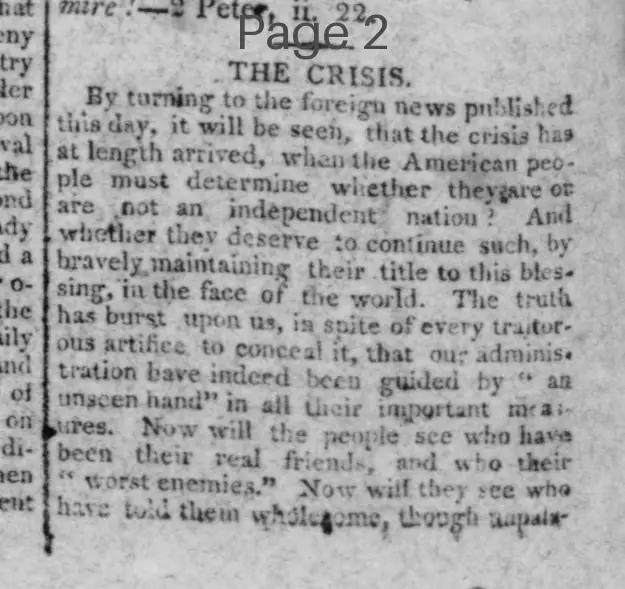
By turning to the foreign news published this day, it will be seen, that the crisis has at length arrived, when the American people must determine whether they are or are not an independent nation? And whether they deserve to continue such, by bravely maintaining their title to this blessing, in the face of the world. The truth has burst upon us, in spite of every traitorous artifice to conceal it, that our administration have indeed been guided by "an unseen hand" in all their important measures. Now will the people see who have been their real friends, and who their "worst enemies." Now will they see who have told them wholesome, though unpalatable truths.
Stable truths, and who have been deceiving them. Now will they remember the language and the warning of federal presses and federal representatives in Congress. Now will they no longer hesitate about tracing to their real sources the Non-Importation Act, the Embargo Act, and all its appendages as commanded a non-intercourse, strings of Supplements and circulars. Bonaparte has willed it, and it has been adopted. Nor has this been sufficient to satisfy him. His greedy impatience to have us fast in his clutches, will not permit him to wait for the movement of that current which has so long been silently but surely wasting us into his fatal embrace. The taste of the last two millions no longer smacks upon his palate; he wants to touch again, and the republican candidate for the chief magistracy has declared, in a whisper, that when he wants money he must have it. Americans! Are you ready? Are you ready to yield to French insolence, French usurpation, or will you issue a new edition of your Declaration of Independence, and assert your indefeasible right to levy war, conclude peace, contract alliances, and establish commerce? all which have been interdicted to you by the Emperor of the French, and wretches and traitors are found among yourselves to second this attack upon your national existence. The impudence to publish that the letter of Champagny, which conveyed the Emperor's denunciation, spoke 'the language of liberality and friendship.' But this will cease to astonish in a miserable and mercenary printer, when it is known that Mr. Eppes, the President's son-in-law, had the audacity to defend this same letter in the last speech he delivered in Congress. Americans! Are you ready, I ask again, to make the surrender demanded of you! It is a question that every man is solemnly called upon to put to himself, and to answer.
N.Y. Evening Post.
Portland, Monday, July 4, 1808.
LATEST FROM EUROPE.
By a late arrival at New-York, from Cork, (Ireland) London dates to May 10th, have been received. The United States' Dispatch Ship Osage, arrived in England from France 30th April, and the American Messengers, Messrs. Nourse and Lewis, immediately proceeded to London. It is probable our Minister Mr. Pinckney had, in consequence of the dispatches he received from our government, made his communications to the British Ministry, but nothing had transpired by which we can learn the result. It was expected the Osage would sail on her return to this country the last of May; her arrival may therefore be daily looked for, and the intelligence by her will, we presume, be highly interesting and important. The principal articles of information will be found under the foreign head. It appears that the Osage, on her arrival at L'Orient, was seized by the officers of the French government, because she had been spoken on her passage by a British cruiser. Mr. Lewis, the bearer of dispatches to Gen. Armstrong, was detained four days before he was permitted to proceed to Paris. Mr. Nourse, the bearer of the dispatches to Mr. Pinckney in London, was denied the common attentions of humanity and hospitality, being very sick at the time, was not allowed to go on shore, but compelled to remain on board a week. It is stated that Gen. Armstrong required of Bonaparte an abandonment of his decrees against our commerce, under the idea that a similar requisition would be made of the English government as to their orders in council, but received a positive refusal from the French government, accompanied with the insolent declarations, 'that the American government was already in possession of the unalterable determination of France, who would not permit a neutral state, and that, unless the American ports should be closed against Great Britain, until a maritime peace could be obtained, France and America must be considered as at war with each other.'
What will Mr. Jefferson and the leaders of his party, the apologists of Bonaparte and all his measures, say to this? If this is submitted to, we may as well acknowledge ourselves French colonies, and receive our laws by a Senate's Constitution at Paris. The Americans in France were much alarmed at their situation, and fearing a rupture between the two countries, had applied for passports, but were refused. If the British government was to treat our citizens and public agents in the manner Bonaparte does, our impartial democratic editors would set up a terrible bawling, from Maine to Georgia, about 'British insults and oppression,' and we should see it announced in those registers of the public sentiment, that at such and such a place, a 'large and respectable meeting of democratic citizens, convened for the purpose of taking into consideration the repeated insults and aggressions offered to this country by the tyrants of the ocean, Resolved, unanimously, that we will assist with our lives and fortunes, whatever measures republican Bonaparte may adopt to destroy the same.' But to the 'insults and aggression' of this French friend of the United States, the democratic papers observe the silence of the grave.
The federalists never have nor never will be the apologists for the real wrongs and injuries we receive from Great Britain; but experience has taught us, that the principles adopted and practised by the immortal Washington, and which were pursued by his successor, (Mr. Adams) in regard to our foreign relations, are alone capable of preserving the independence and prosperity of our country. When we had serious and just cause of complaint against any nation, Washington adjusted the differences by impartial negotiation. This was the case during his administration with regard to England, although the partisans of France in this country were at that time, and ever since have been, clamorous for a war with England. For preventing which, Washington was denounced as a traitor! and those who acted with him, as 'tories.' When France violated our national rights, and commenced war upon American citizens and property, President Adams endeavored to obtain reparation by fair and honorable negotiation: but the proposals of our ministers of peace and reconciliation were rejected with insult and contempt. When all hopes of amicable adjustment failed, did Mr. Adams adopt a cringing servile mode of conduct? No. The man who defended his country's rights against the tyrannical encroachment of Britain, would never consent to prostitute his country's sovereignty and interests to France, or any other power. He did not buy a treaty by giving fifteen millions for a wilderness, and afterwards add two millions more!! But upon this correct principle, 'in peace friends, in war enemies,' he declared to France and the world that the American people were not under a 'colonial sense of fear.' In this situation of affairs, when France was at open war with this country, President Adams did not order the laying an embargo, which would have spread ruin and distress throughout the land; but he, like a true and faithful friend to the people, their interest and rights, commenced a system of measures which effectually protected our citizens and property from capture and plunder. France soon saw it was in vain to think of making the American Government tributary, while federal men were at the helm of state—and accordingly abandoned the scheme of compelling the United States to enter into her views. Fortunate would it have been for America, if her rulers, to this day, had have pursued a similar policy. The present times afford the best comment on the policy of deviating from the principles and measures of the Washington and Adams administrations. It has brought trouble and loss to the door of the humblest cottage of the humblest citizen of Massachusetts; and will most assuredly bring on ruin and national degradation, if persisted in.
What sub-type of article is it?
What keywords are associated?
What entities or persons were involved?
Editorial Details
Primary Topic
French Threats To American Independence And Commerce
Stance / Tone
Strongly Anti Jefferson Administration And Pro Federalist Foreign Policy
Key Figures
Key Arguments