Thank you for visiting SNEWPapers!
Sign up free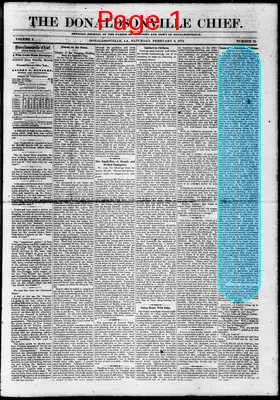
Editorial
February 8, 1873
The Donaldsonville Chief
Donaldsonville, Gonzales, Ascension County, Louisiana
What is this article about?
Editorial discusses Hon. Horatio Seymour's address to the National Prison Association, arguing that crime stems from societal neglect of the poor and idle. It critiques punishment alone, advocating employment, education, and addressing social conditions to prevent crime, referencing figures like Tweed, Ames, and Stokes.
Clipping

OCR Quality
95%
Excellent
Full Text
Cause and Prevention of Crime.
[From the N. O. Republican.]
The Hon. Horatio Seymour has made an address before the National Prison Association at Baltimore which is worthy of consideration by all who value the prosperity and liberties of society. He thinks that crime is the moral disease of society, and that the duty of the statesman is, like that of the physician, to make the diagnosis of the disease and analyze all the causes of its existence. This is true. Liberty is the reward of virtue. It is the highest premium of order. Order is the first point of self-government. Nothing is more common, yet nothing can be more absurd, than to expect the reform of manhood by punishment. We agree with Mr. Seymour that punishment should be swift and certain, but has society performed its duty when it provides the prison-house and the gibbet? Society pursues its pleasure and its business. It takes no concern of the idle and the needy. The poor boy without food or clothes yields to necessity and relieves the importunities of nature. The poor woman, working often through cold and rain at a pittance which will not maintain food, fire and clothing, is driven by desperation to vice and from vice to crime. Vanity passes her each day, it notes her pale cheeks, thin figure and scanty dress; by and by society sees her at the bar for an evil act, and is next invited to the private rehearsal of her execution for infanticide. Very well, society instantly vindicates itself by exclaiming, "Vicious and abandoned creature! Let her be put to death, to avenge the violated law, and as an example to others." But this death vindicates no law. The poor creature at first wished only to sustain life, not to violate law. She thought only of food, warmth, raiment; they made an imperious demand for satisfaction. She obeyed nature, she did not think to violate law. So society goes on its wicked and thoughtless way, absolutely justified to itself that it has slain one whom it has seduced. It has committed crime, it has not vindicated law. Mr. Seymour explains the duty of educating the poor. But he well adds, education may also improve the powers of evil. He will pardon us. The first duty of the country is to employ the people. You can not educate a child without sufficient food or comfortable clothing. The body demands its necessities to be supplied first, then the mind will act willingly and inquiringly. Let it be admitted that two duties can be combined: that the child may eat and read at the same time. Very well. But merely intellectual pabulum is not attractive. Indeed, it might almost be affirmed that the large majority of those who learn to read do so to improve their physical condition. Few love learning in the abstract. If society has then employed and instructed its members, those who violate the law are worthily and properly punished. They can not turn upon society, as Paul Clifford the convict, and say: "I was your ignorant pauper; you passed me daily in the streets without regarding my need or my ignorance; when I yielded to that which you had never troubled yourself to teach me was wrong, or to the necessity of the hour, you committed a crime—what I have done was the consequence of your criminal neglect of duty." It was then he, Bulwer, uttered that great truth which might have emanated from a statesman: "The very worst use you can make of a man is to hang him." The capital punishment of a man (and we believe in capital punishment) is the atonement of society for its own criminal neglect of duty. A parent rears a child in ignorance and bad associations. What does society say? That the parent is responsible for the offense committed by the child. Very well: How has society treated its children? They are the poor and ignorant. Mr. Seymour traces all the crimes of Tweed and Ames and Stokes, though he does not name them, to the same laws, and commends to statesmen the study of social condition as the best means of criminal cure. We commend his sentiments heartily.
[From the N. O. Republican.]
The Hon. Horatio Seymour has made an address before the National Prison Association at Baltimore which is worthy of consideration by all who value the prosperity and liberties of society. He thinks that crime is the moral disease of society, and that the duty of the statesman is, like that of the physician, to make the diagnosis of the disease and analyze all the causes of its existence. This is true. Liberty is the reward of virtue. It is the highest premium of order. Order is the first point of self-government. Nothing is more common, yet nothing can be more absurd, than to expect the reform of manhood by punishment. We agree with Mr. Seymour that punishment should be swift and certain, but has society performed its duty when it provides the prison-house and the gibbet? Society pursues its pleasure and its business. It takes no concern of the idle and the needy. The poor boy without food or clothes yields to necessity and relieves the importunities of nature. The poor woman, working often through cold and rain at a pittance which will not maintain food, fire and clothing, is driven by desperation to vice and from vice to crime. Vanity passes her each day, it notes her pale cheeks, thin figure and scanty dress; by and by society sees her at the bar for an evil act, and is next invited to the private rehearsal of her execution for infanticide. Very well, society instantly vindicates itself by exclaiming, "Vicious and abandoned creature! Let her be put to death, to avenge the violated law, and as an example to others." But this death vindicates no law. The poor creature at first wished only to sustain life, not to violate law. She thought only of food, warmth, raiment; they made an imperious demand for satisfaction. She obeyed nature, she did not think to violate law. So society goes on its wicked and thoughtless way, absolutely justified to itself that it has slain one whom it has seduced. It has committed crime, it has not vindicated law. Mr. Seymour explains the duty of educating the poor. But he well adds, education may also improve the powers of evil. He will pardon us. The first duty of the country is to employ the people. You can not educate a child without sufficient food or comfortable clothing. The body demands its necessities to be supplied first, then the mind will act willingly and inquiringly. Let it be admitted that two duties can be combined: that the child may eat and read at the same time. Very well. But merely intellectual pabulum is not attractive. Indeed, it might almost be affirmed that the large majority of those who learn to read do so to improve their physical condition. Few love learning in the abstract. If society has then employed and instructed its members, those who violate the law are worthily and properly punished. They can not turn upon society, as Paul Clifford the convict, and say: "I was your ignorant pauper; you passed me daily in the streets without regarding my need or my ignorance; when I yielded to that which you had never troubled yourself to teach me was wrong, or to the necessity of the hour, you committed a crime—what I have done was the consequence of your criminal neglect of duty." It was then he, Bulwer, uttered that great truth which might have emanated from a statesman: "The very worst use you can make of a man is to hang him." The capital punishment of a man (and we believe in capital punishment) is the atonement of society for its own criminal neglect of duty. A parent rears a child in ignorance and bad associations. What does society say? That the parent is responsible for the offense committed by the child. Very well: How has society treated its children? They are the poor and ignorant. Mr. Seymour traces all the crimes of Tweed and Ames and Stokes, though he does not name them, to the same laws, and commends to statesmen the study of social condition as the best means of criminal cure. We commend his sentiments heartily.
What sub-type of article is it?
Crime Or Punishment
Social Reform
What keywords are associated?
Crime Prevention
Social Reform
Punishment Critique
Poverty And Crime
Education And Employment
National Prison Association
What entities or persons were involved?
Hon. Horatio Seymour
National Prison Association
Tweed
Ames
Stokes
Paul Clifford
Bulwer
Editorial Details
Primary Topic
Causes And Prevention Of Crime Through Social Reform
Stance / Tone
Advocacy For Societal Responsibility Over Punitive Measures
Key Figures
Hon. Horatio Seymour
National Prison Association
Tweed
Ames
Stokes
Paul Clifford
Bulwer
Key Arguments
Crime Is A Moral Disease Requiring Diagnosis Of Social Causes
Punishment Should Be Swift But Society Must Address Poverty And Need
Neglect Of The Poor Leads To Crime; Society Seduces Individuals Into Vice
Education Alone Insufficient Without Employment And Basic Needs Met
Capital Punishment Atones For Society's Neglect
Study Social Conditions To Cure Crime