Thank you for visiting SNEWPapers!
Sign up free
Edgefield Advertiser
Edgefield, Edgefield County, South Carolina
What is this article about?
Parliament ordered auction sales of encumbered Irish estates from Oct. 1849 to Oct. 1854, yielding £15,500,000, with creditors receiving £10,610,000. This ended many chancery suits, replaced impoverished landlords with energetic proprietors, and facilitated English/Scottish immigration, transforming Ireland's society and economy amid mass emigration of Irish peasantry.
Clipping
OCR Quality
Full Text
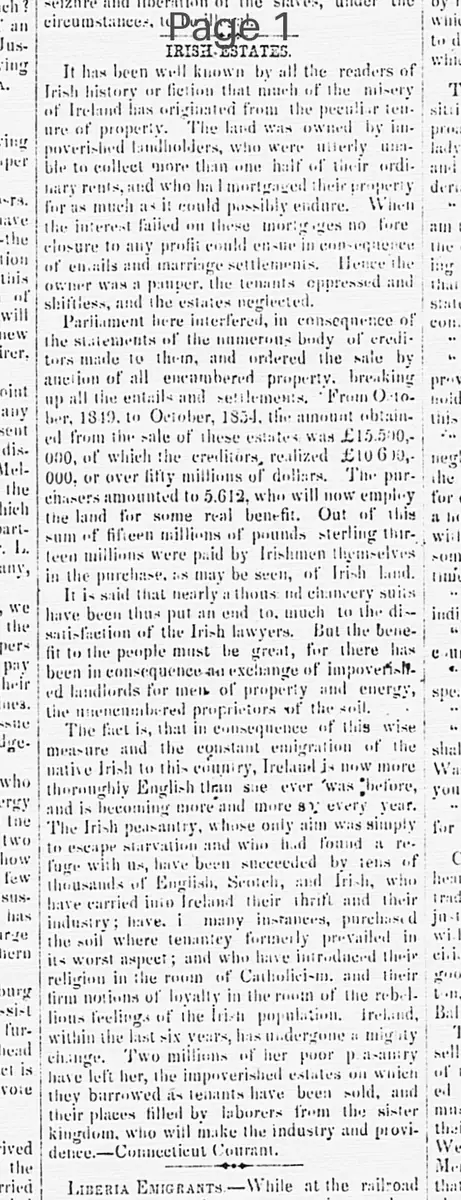
It has been well known by all the readers of Irish history or fiction that much of the misery of Ireland has originated from the peculiar tenure of property. The land was owned by impoverished Landholders, who were utterly unable to collect more than one half of their ordinary rents, and who had mortgaged their property for as much as it could possibly endure. When the interest failed on these mortgages no foreclosure to any profit could ensue in consequence of entails and marriage settlements. Hence the owner was a pauper, the tenants oppressed and shiftless, and the estates neglected.
Parliament here interfered, in consequence of the statements of the numerous body of creditors made to them, and ordered the sale by auction of all encumbered property, breaking up all the entails and settlements. From Oct. 1849, to October, 1854, the amount obtained from the sale of these estates was £15,500,000, of which the creditors realized £10,610,000, or over fifty millions of dollars. The purchasers amounted to 5,612, who will now employ the land for some real benefit. Out of this sum of fifteen millions of pounds sterling thirteen millions were paid by Irishmen themselves in the purchase, as may be seen, of Irish Land.
It is said that nearly a thousand chancery suits have been thus put an end to, much to the dissatisfaction of the Irish lawyers. But the benefit to the people must be great, for there has been in consequence an exchange of impoverished landlords for men of property and energy, the unencumbered proprietors of the soil.
The fact is, that in consequence of this wise measure and the constant emigration of the native Irish to this country, Ireland is now more thoroughly English than she ever was before, and is becoming more so every year. The Irish peasantry, whose only aim was simply to escape starvation and who had found a refuge with us, have been succeeded by tens of thousands of English, Scotch, and Irish, who have carried into Ireland their thrift and their industry; have, in many instances, purchased the soil where tenancy formerly prevailed in its worst aspect; and who have introduced their religion in the room of Catholicism, and their firm notions of loyalty in the room of the rebellious feelings of the Irish population. Ireland, within the last six years, has undergone a mighty change. Two millions of her poor peasantry have left her, the impoverished estates on which they borrowed as tenants have been sold, and their places filled by laborers from the sister kingdom, who will make the industry and providence.—Connecticut Courant.
What sub-type of article is it?
What keywords are associated?
Where did it happen?
Foreign News Details
Primary Location
Ireland
Event Date
Oct. 1849 To October 1854
Outcome
£15,500,000 from sales, creditors realized £10,610,000; 5,612 purchasers; nearly a thousand chancery suits ended; two millions of poor peasantry emigrated; replaced by english, scotch, and irish laborers
Event Details
Impoverished Irish landholders unable to collect rents due to mortgages, entails, and settlements led to neglected estates and oppressed tenants. Parliament ordered auction sales of encumbered properties, breaking entails and settlements. Sales from Oct. 1849 to Oct. 1854 totaled £15,500,000, with £13,000,000 paid by Irishmen. This exchanged impoverished landlords for men of property and energy, ended many suits, and with emigration, introduced thrift, industry, Protestantism, and loyalty, transforming Ireland over the last six years.