Thank you for visiting SNEWPapers!
Sign up free
Story
September 29, 1913
The Bennington Evening Banner
Bennington, Bennington County, Vermont
What is this article about?
George I. Moore and son L. E. Moore harvested a remarkable corn crop yielding about 100 bushels of shelled corn per acre on their three-acre field in Bennington Village, despite a poor season with late spring, drought, and frosts.
Clipping
OCR Quality
95%
Excellent
Full Text
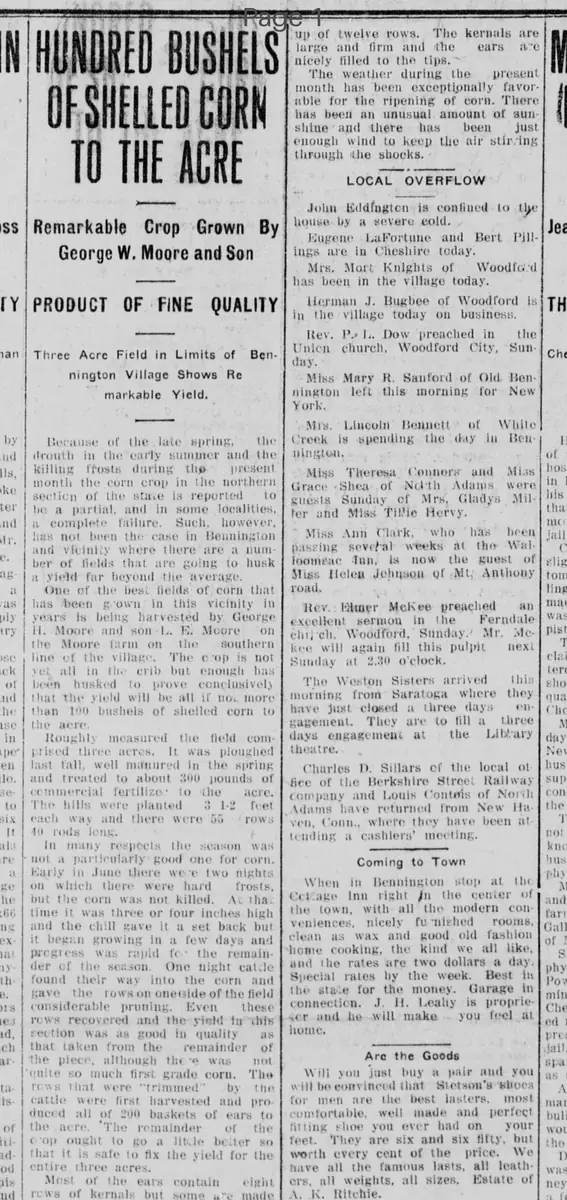
HUNDRED BUSHELS OF SHELLED CORN TO THE ACRE
Remarkable Crop Grown By George W. Moore and Son
PRODUCT OF FINE QUALITY
Three Acre Field in Limits of Bennington Village Shows Remarkable Yield.
Because of the late spring, the drouth in the early summer and the killing frosts during the present month the corn crop in the northern section of the state is reported to be a partial, and in some localities, a complete failure. Such, however, has not been the case in Bennington and vicinity where there are a number of fields that are going to husk a yield far beyond the average.
One of the best fields of corn that has been grown in this vicinity in years is being harvested by George I. Moore and son L. E. Moore on the Moore farm on the southern line of the village. The crop is not yet all in the crib but enough has been husked to prove conclusively that the yield will be all if no more than 100 bushels of shelled corn to the acre.
Roughly measured the field comprised three acres. It was ploughed last fall, well manured in the spring and treated to about 300 pounds of commercial fertilizer to the acre. The hills were planted 3 1-2 feet each way and there were 55 rows 40 rods long.
In many respects the season was not a particularly good one for corn. Early in June there were two nights on which there were hard frosts, but the corn was not killed. At that time it was three or four inches high and the chill gave it a set back but it began growing in a few days and progress was rapid for the remainder of the season. One night cattle found their way into the corn and gave the rows on one side of the field considerable pruning. Even these rows recovered and the yield in this section was as good in quality as that taken from the remainder of the piece, although there was not quite so much first grade corn. The rows that were "trimmed" by the cattle were first harvested and produced all of 200 baskets of ears to the acre. The remainder of the crop ought to go a little better so that it is safe to fix the yield for the entire three acres.
Most of the ears contain eight rows of kernels but some are made up of twelve rows. The kernels are large and firm and the ears are nicely filled to the tips.
The weather during the present month has been exceptionally favorable for the ripening of corn. There has been an unusual amount of sunshine and there has been just enough wind to keep the air stirring through the shocks.
Remarkable Crop Grown By George W. Moore and Son
PRODUCT OF FINE QUALITY
Three Acre Field in Limits of Bennington Village Shows Remarkable Yield.
Because of the late spring, the drouth in the early summer and the killing frosts during the present month the corn crop in the northern section of the state is reported to be a partial, and in some localities, a complete failure. Such, however, has not been the case in Bennington and vicinity where there are a number of fields that are going to husk a yield far beyond the average.
One of the best fields of corn that has been grown in this vicinity in years is being harvested by George I. Moore and son L. E. Moore on the Moore farm on the southern line of the village. The crop is not yet all in the crib but enough has been husked to prove conclusively that the yield will be all if no more than 100 bushels of shelled corn to the acre.
Roughly measured the field comprised three acres. It was ploughed last fall, well manured in the spring and treated to about 300 pounds of commercial fertilizer to the acre. The hills were planted 3 1-2 feet each way and there were 55 rows 40 rods long.
In many respects the season was not a particularly good one for corn. Early in June there were two nights on which there were hard frosts, but the corn was not killed. At that time it was three or four inches high and the chill gave it a set back but it began growing in a few days and progress was rapid for the remainder of the season. One night cattle found their way into the corn and gave the rows on one side of the field considerable pruning. Even these rows recovered and the yield in this section was as good in quality as that taken from the remainder of the piece, although there was not quite so much first grade corn. The rows that were "trimmed" by the cattle were first harvested and produced all of 200 baskets of ears to the acre. The remainder of the crop ought to go a little better so that it is safe to fix the yield for the entire three acres.
Most of the ears contain eight rows of kernels but some are made up of twelve rows. The kernels are large and firm and the ears are nicely filled to the tips.
The weather during the present month has been exceptionally favorable for the ripening of corn. There has been an unusual amount of sunshine and there has been just enough wind to keep the air stirring through the shocks.
What sub-type of article is it?
Curiosity
Personal Triumph
What themes does it cover?
Triumph
Survival
What keywords are associated?
Corn Crop
Remarkable Yield
100 Bushels
Bennington
Agricultural Success
Weather Adversity
What entities or persons were involved?
George I. Moore
L. E. Moore
Where did it happen?
Bennington Village, Moore Farm On The Southern Line Of The Village
Story Details
Key Persons
George I. Moore
L. E. Moore
Location
Bennington Village, Moore Farm On The Southern Line Of The Village
Event Date
Present Month (Harvest Time, After Early Summer Drought And June Frosts)
Story Details
George I. Moore and son L. E. Moore harvested a three-acre corn field yielding approximately 100 bushels of shelled corn per acre, despite late spring, early summer drought, June frosts, and cattle damage, on their farm in Bennington.