Thank you for visiting SNEWPapers!
Sign up free
Editorial
May 23, 1835
Kentucky Gazette
Lexington, Fayette County, Kentucky
What is this article about?
This editorial advocates for temperance in food to promote clearness and vigor of intellect, citing physiological laws, personal experience, and historical examples of great philosophers and modern intellectuals who practiced moderation.
Clipping
OCR Quality
98%
Excellent
Full Text
TEMPERANCE IN FOOD.
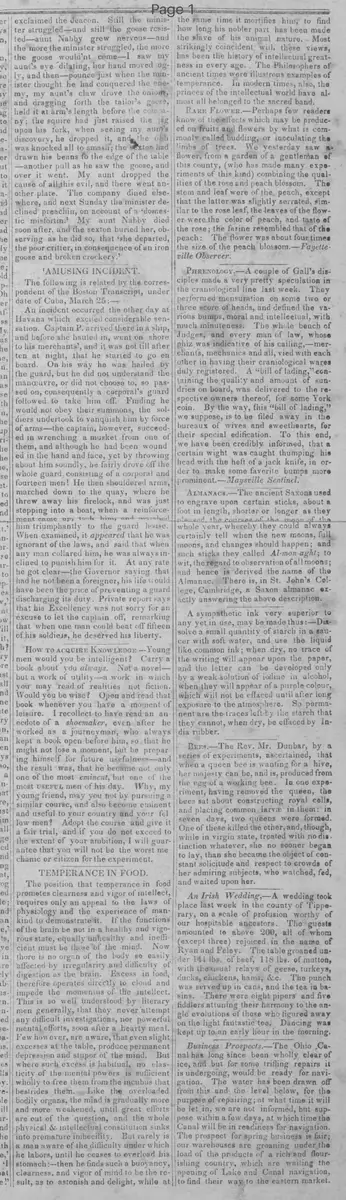
The position that temperance in food promotes clearness and vigor of intellect, requires only an appeal to the laws of physiology and the experience of mankind to demonstrate it. 'If the functions of the brain be not in a healthy and vigorous state, equally unhealthy and inefficient must be those of the mind. Now there is no organ of the body so easily affected by irregularity and difficulty of digestion as the brain. Excess in food, therefore operates directly to cloud and impede the movements of the intellect. This is so well understood by literary men generally, that they never attempt any difficult investigations, nor powerful mental efforts, soon after a hearty meal. Few however, are aware, that even slight excesses at the table, produce permanent depression and stupor of the mind. But where such excess is habitual, no elasticity of the mental powers is sufficient wholly to free them from the incubus that bestrides them. Like the overloaded bodily organs, the mind is gradually more and more weakened, until great efforts are out of the question, and the whole physical & intellectual constitution sinks into premature imbecility. But rarely is a man aware of the difficulty under which he labors, until he ceases to overload his stomach:-then he finds such a buoyancy, clearness, and vigor of mind to be the result, as to astonish and delight, while at the same time it mortifies him, to find how long his nobler part has been made the slave of his animal nature. Most strikingly coincident with these views, has been the history of intellectual greatness in every age. The Philosophers of ancient times were illustrious examples of temperance. In modern times, also, the princes of the intellectual world have almost all belonged to the sacred band.
The position that temperance in food promotes clearness and vigor of intellect, requires only an appeal to the laws of physiology and the experience of mankind to demonstrate it. 'If the functions of the brain be not in a healthy and vigorous state, equally unhealthy and inefficient must be those of the mind. Now there is no organ of the body so easily affected by irregularity and difficulty of digestion as the brain. Excess in food, therefore operates directly to cloud and impede the movements of the intellect. This is so well understood by literary men generally, that they never attempt any difficult investigations, nor powerful mental efforts, soon after a hearty meal. Few however, are aware, that even slight excesses at the table, produce permanent depression and stupor of the mind. But where such excess is habitual, no elasticity of the mental powers is sufficient wholly to free them from the incubus that bestrides them. Like the overloaded bodily organs, the mind is gradually more and more weakened, until great efforts are out of the question, and the whole physical & intellectual constitution sinks into premature imbecility. But rarely is a man aware of the difficulty under which he labors, until he ceases to overload his stomach:-then he finds such a buoyancy, clearness, and vigor of mind to be the result, as to astonish and delight, while at the same time it mortifies him, to find how long his nobler part has been made the slave of his animal nature. Most strikingly coincident with these views, has been the history of intellectual greatness in every age. The Philosophers of ancient times were illustrious examples of temperance. In modern times, also, the princes of the intellectual world have almost all belonged to the sacred band.
What sub-type of article is it?
Science Or Medicine
Moral Or Religious
What keywords are associated?
Temperance In Food
Intellectual Vigor
Physiology Of Brain
Excess Eating Effects
Historical Philosophers
Editorial Details
Primary Topic
Temperance In Food For Intellectual Vigor
Stance / Tone
Advocacy For Moderation In Eating
Key Arguments
Excess In Food Clouds And Impedes Intellect Via Brain's Sensitivity To Digestion
Literary Men Avoid Mental Efforts After Hearty Meals
Slight Excesses Cause Permanent Mental Depression
Habitual Excess Leads To Weakened Mind And Premature Imbecility
Ceasing Overload Reveals Buoyancy And Clearness Of Mind
Historical Philosophers Exemplified Temperance