Thank you for visiting SNEWPapers!
Sign up free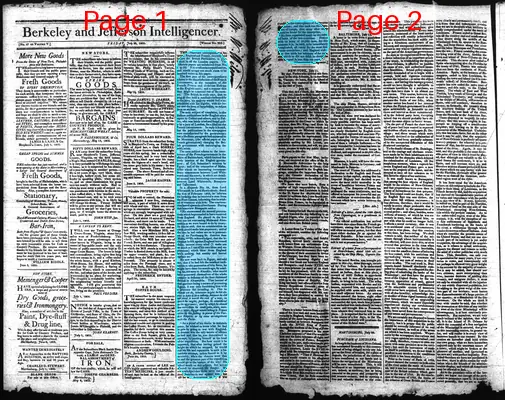
Berkeley And Jefferson Intelligencer
Martinsburg, Berkeley County, Virginia
What is this article about?
Publication of extensive correspondence between Britain and France before Parliament, covering French complaints on exiled princes, press libels, Swiss interference, Egypt mission, Malta evacuation, and a detailed February 1803 conversation between Bonaparte and Lord Whitworth on provocations and war risks.
Merged-components note: Continuation of the correspondence between England and France across pages, indicated by sequential reading order and matching topic.
Clippings

1 of 2
OCR Quality
Full Text
The first part of the correspondence relates to the dissatisfaction of the French Government, at the reception of the French Princes and ci-devant Bishops at the English court; and a request that they might be removed out of the country. The British in reply says, that as long as they hold a conduct conformably to the laws, his majesty would feel it inconsistent with his dignity, with his honor and the laws of hospitality, to refuse them an asylum.
The next subject of complaint is the libelous publications in the English news papers by Cobbett and others, and by Peltier, who was lately tried and found guilty by a jury of London, for a libel on the French Government. In reply it is said that the publications in the newspapers were unauthorised by the government; that a libellous paragraph had appeared in the Moniteur, (the official paper of the French government) charging the British government with encouraging the publication.
The next subject relates to the interference of the French government in the affairs of Switzerland, which excited the lively interest of the English government; of Col. Sebastian's mission to Egypt; and of the evacuation of Malta.
After which an interesting correspondence commences between Lord Whitworth and his court; in which are detailed several very interesting conversations between Lord Whitworth, Bonaparte and Talleyrand.
In a dispatch No. 38, from Lord Whitworth to Lord Hawkesbury, dated the 21st of February 1803, he informs his lordship that he received a note from the First Consul, informing that he wished to converse with him. The conversation lasted upwards of two hours. During this interview Bonaparte said-
"He enumerated the several provocations which he pretended to have received from England. He placed in the first line our not evacuating Malta and Alexandria as we were bound to do by treaty. In this he said, that no consideration on earth should make him acquiesce; and of the two he had rather see us in possession of the Faubourg St. Antoine than Malta. He acknowledged, that the irritation he felt against England increased daily, because every wind (I make use as much as I can of his own ideas and expressions) which blew from England brought nothing but enmity and hatred against me.
He now went back to Egypt, and told me, that if he had felt the smallest inclination to take possession of it by force, he might have done it a month ago, by sending 25,000 men to Aboukir, who would have possessed themselves of the whole country in defiance of the four thousand British in Alexandria. That instead of that garrison being a means of protecting Egypt, it was only furnishing him with a pretence for invading it. This he should not do, whatever might be his desire to have it as a colony, because he did not think it worth the risk of a war, in which he might, perhaps, be considered as the aggressor, and by which he should lose more than he could gain, since, sooner or later, Egypt would belong to France either by the falling to pieces of the Turkish Empire, or by some arrangement with the Porte.
"As a proof of his desire to maintain peace, he wished to know what he had to gain by going to war with England. A descent was the only means of offence he had and that he was determined to attempt, by putting himself at the head of the expedition. But how could it be supposed, that after having gained the height on which he stopped, he would risk his life and reputation in such a hazardous attempt, unless forced to it by necessity, when the chances were that he and the greatest part of the expedition would go to the bottom of the sea? He talked much on this subject, but never affected to diminish the danger. He acknowledged that there were one hundred chances to one against him; but till he was determined on it, if war should be the consequence of the present discussion; and that such was the disposition of troops, that army after army would be found for the enterprize.
"He then expatiated much on the natural force of the two countries. France with an army of 40,000 men, for this moment it is, he said, to be immediately completed, all ready for the most desperate enterprises; and England with a fleet that made her mistress of the seas, and which he did not think he should be able to equal in less than ten years."
[Commercial Intelligencer.]
What sub-type of article is it?
What keywords are associated?
What entities or persons were involved?
Where did it happen?
Foreign News Details
Primary Location
France
Event Date
21st Of February 1803
Key Persons
Outcome
bonaparte lists provocations including malta and alexandria non-evacuation, egypt threats, expresses irritation but desire for peace, deems invasion risky with 100 to 1 odds against success, compares french army of 40,000 to british naval superiority.
Event Details
Correspondence from No. 1 to 70 details French dissatisfaction with English reception of exiled French Princes and bishops, requesting removal; British refusal on hospitality grounds. Complaints on libels by Cobbett, Peltier (convicted), countered by French Moniteur libel. Discussions on French interference in Switzerland, Col. Sebastian's Egypt mission, Malta evacuation. Key dispatch No. 38 reports two-hour conversation where Bonaparte enumerates English provocations, defends potential Egypt seizure, asserts future French claims, questions war benefits, outlines invasion risks, and contrasts military strengths.