Thank you for visiting SNEWPapers!
Sign up free
The Webster Echo
Addison, Webster Springs, Webster County, West Virginia
What is this article about?
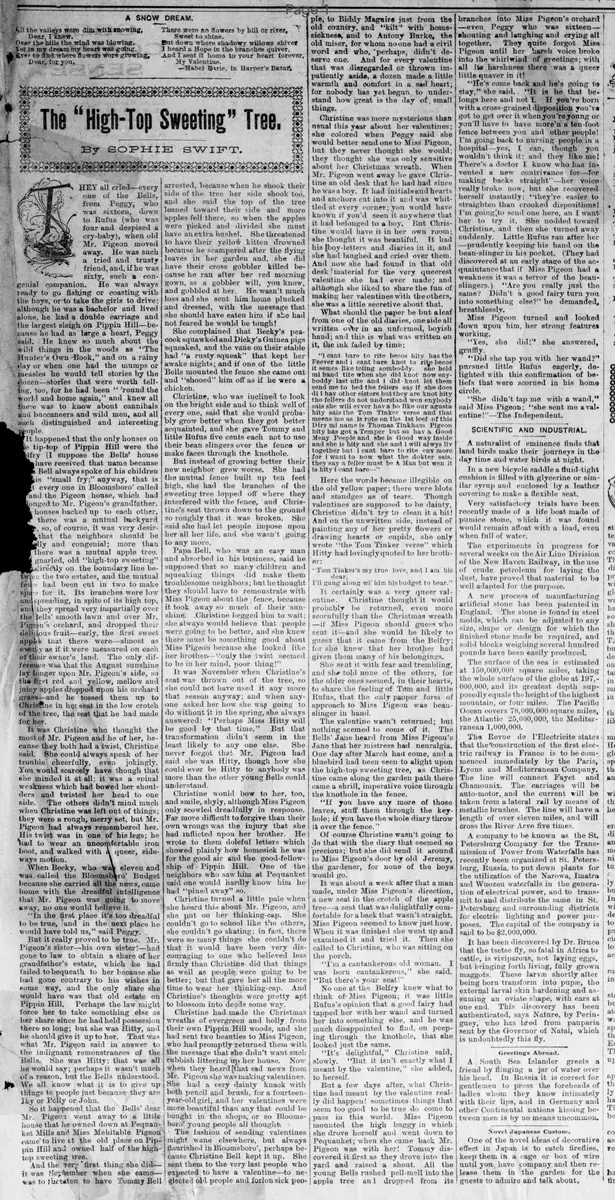
The Bell family mourns the departure of their kind neighbor Mr. Pigeon, forced out by his grumpy sister Miss Hitty over a family estate. Young Christine sends a heartfelt valentine with Mr. Pigeon's childhood diary entry expressing love for his sister, softening Miss Pigeon's heart. She reconciles, returns the home to her brother, and aids Christine's disability.
Merged-components note: Merged the image into the literary story as it spatially overlaps with the text bounding box and follows sequentially in reading order, indicating it is an illustration for the article.
Clipping
OCR Quality
Full Text
By SOPHIE SWIFT.
Hey, all cried—every one of the Bells, from Peggy, who was sixteen, down to Rufus (who was four and despised a cry-baby), when old Mr. Pigeon moved away. He was such a tried and trusty friend, and, if he was sixty, such a congenial companion. He was always ready to go fishing or coasting with the boys, or to take the girls to drive: although he was a bachelor and lived alone, he had a double carriage and the largest sleigh on Pippin Hill—because he had as large a heart, Peggy said. He knew so much about the wild things in the woods as "The Hunter's Own Book," and on a rainy day or when one had the mumps or measles he would tell stories by the dozen—stories that were worth telling, too, for he had been "'round the world and home again," and knew all there was to know about cannibals and buccaneers and wild men, and all such distinguished and interesting people.
It happened that the only houses on the tip-top of Pippin Hill were the Belfry (I suppose the Bells' house have received that name because Bell always spoke of his children his "small fry:" anyway, that is what every one in Bloomsboro' called it) and the Pigeon house, which had belonged to Mr. Pigeon's grandfather. The houses backed up to each other, there was a mutual backyard, so, of course, it was very desirable that the neighbors should be friendly and congenial; more than that, there was a mutual apple tree. A gnarled, old "high-top sweeting" directly on the boundary line between the two estates, and the mutual fence had been cut in two to make space for it. Its branches were low and spreading, in spite of its high top, and they spread very impartially over the Bells' smooth lawn and over Mr. Pigeon's orchard, and dropped their delicious fruit—early, the first sweet apples that there were—almost as evenly as if it were measured on each of their owner's land. The only difference was that the August sunshine lay longer upon Mr. Pigeon's side, so the first red and yellow, mellow and juicy apples dropped upon his orchard grass—and he tossed them up to Christine in her seat in the low crotch of the tree, the seat that he had made for her.
It was Christine who thought the most of Mr. Pigeon and he of her, because they both had a twist, Christine said. She could always speak of her trouble cheerfully, even jokingly. You would scarcely have thought that she minded it at all; it was a spinal weakness which had bowed her shoulders and twisted her head to one side. The others didn't mind much when Christine was left out of things; they were a rough, merry set, but Mr. Pigeon had always remembered her. His twist was in one of his legs; he had to wear an uncomfortable iron boot, and walked with a queer, side-ways motion.
When Becky, who was eleven and was called the Bloomsboro' Budget because she carried all the news, came home with the dreadful intelligence that Mr. Pigeon was going to move away, no one would believe it. "In the first place it's too dreadful to be true, and in the next place he would have told us," said Peggy. But it really proved to be true. Mr. Pigeon's sister—his own sister!—had gone to law to obtain a share of her grandfather's estate, which he had failed to bequeath to her because she had gone contrary to his wishes in some way, and the only share she would have was that old estate on Pippin Hill. Perhaps the law might force her to take something else as her share since he had held possession there so long: but she was Hitty, and he should give it up to her. That was what Mr. Pigeon said in answer to the indignant remonstrances of the Bells. She was Hitty: that was all he would say: perhaps it wasn't much of a reason, but the Bells understood. We all know what it is to give up things to people just because they are Kitty or Polly or John.
So it happened that the Bells' dear Mr. Pigeon went away to a little house that he owned down at Pequanket Mills and Miss Mehitable Pigeon came to live at the old place on Pippin Hill and owned half of the high-top sweeting tree. And the very first thing she did—it was September when she came—was to threaten to have Tommy Bell arrested, because when he shook their side of the tree her side shook too. And she said the top of the tree leaned toward their side and more apples fell there, so when the apples were picked and divided she must have an extra bushel. She threatened to have their yellow kitten drowned because he scampered after the flying leaves in her garden and, she did have their cross gobbler killed because he ran after her red morning gown, as a gobbler will, you know, and gobbled at her. He wasn't much loss and she sent him home plucked and dressed, with the message that she should have eaten him if she had not feared he would be tough!
She complained that Becky's peacock squawked and Dicky's Guinea pigs squeaked, and the vane on their stable had "a rusty squeak" that kept her awake nights; and if one of the little Bells mounted the fence she came out and 'shooed' him off as if he were a chicken. Christine, who was inclined to look on the bright side and to think well of every one, said that she would probably grow better when they got better acquainted, and she gave Tommy and little Rufus five cents each not to use their bean slingers over the fence or make faces through the knothole. But instead of growing better their new neighbor grew worse. She had the mutual fence built up ten feet high, she had the branches of the sweeting tree lopped off where they interfered with the fence, and Christine's seat thrown down to the ground so roughly that it was broken. She said she had let people impose upon her all her life, and she wasn't going to any more.
Papa Bell, who was an easy man and absorbed in his business, said he supposed that so many children and squeaking things did make them troublesome neighbors; but he thought they should have to remonstrate with Miss Pigeon about the fence, because it took away so much of their sunshine. Christine begged him to wait: she always would believe that people were going to be better, and she knew there must be something good about Miss Pigeon because she looked like her brother—only the twist seemed to be in her mind, poor thing!
It was November when Christine's seat was thrown out of the tree, so she could not have used it any more that season anyway; and when any one asked her how she was going to do without it in the spring, she always answered: "Perhaps Miss Hitty will be good by that time." But that transformation didn't seem in the least likely to any one else. She never forgot that Mr. Pigeon had said she was Hitty, though how she could ever be Hitty to anybody was more than the other young Bells could understand. Christine would bow to her, too, and smile, shyly, although Miss Pigeon only scowled dreadfully in response. Far more difficult to forgive than their own wrongs was the injury that she had inflicted upon her brother. He wrote to them doleful letters which showed plainly how homesick he was for the good air and the good-fellow-ship of Pippin Hill. One of the neighbors who saw him at Pequanket said one would hardly know him he had "pined away" so.
Christine turned a little pale when she heard this about Mr. Pigeon, and she put on her thinking-cap. She couldn't go to school like the others, she couldn't go skating; in fact, there were so many things she couldn't do that it would have been very discouraging to one who believed less firmly than Christine did that things as well as people were going to be better; but that gave her all the more time to wear her thinking-cap. And Christine's thoughts were pretty apt to blossom into deeds some way.
Christine had made the Christmas wreaths of evergreen and holly from their own Pippin Hill woods, and she had sent two beauties to Miss Pigeon, who had promptly returned them with the message that she didn't want such rubbish littering up her house. Now when they heard that sad news from Mr. Pigeon she was making valentines. She had a very dainty knack with both pencil and brush, for a fourteen-year-old girl, and her valentines were more beautiful than any that could be bought in the shops, or so Bloomsboro' young people all thought. The fashion of sending valentines might wane elsewhere, but always flourished in Bloomsboro', perhaps because Christine Bell kept it up. She sent them to the very last people who expected to have a valentine—to neglected old people and forlorn sick people, to Biddy Maguire just from the old country, and filled with home-sickness, and to Antony Burke, the old miser, for whom no one had a civil word and who, perhaps, didn't deserve one. And for every valentine that was disregarded or thrown impatiently aside, a dozen made a little warmth and comfort in a sad heart; for nobody has yet begun to understand how great is the joy of small things.
Christine was more mysterious than usual this year about her valentines; she colored when Peggy said she would better send one to Miss Pigeon, but they never thought she would; they thought she was only sensitive about her Christmas wreath. When Mr. Pigeon went away he gave Christine an old desk that he had had since he was a boy. It had initials and hearts and anchors cut into it and was whittled at every corner; you would have known if you'd seen it anywhere that it had belonged to a boy. But Christine would have it in her own room; she thought it was beautiful. It had his boy-letters and diaries in it, and she had laughed and cried over them. And now she had found in that old desk material for the very queerest valentine she had ever made: and although she liked to share the fun of making her valentines with the others, she was a little secretive about that.
What should the paper be but a leaf from one of the old diaries, one side all written over in an unformed, boyish hand: and this is what was written on it, the ink faded by time:
"I cant bare to rite becos hity has the Feever and i cant bare knot to rito becos it semes like teling somboddy. she held mi hnnd tite when she did knot now enyboddy last nite and i did-knot let them send me to bed the fellers say if she does di i hav other sistors but they are knot hity the fellers do not understand wen enybody sais she will evver hava bo like our agustn hity sais the Tom Tinker verse and that meens me as is rote on the Ist leef of this Diry mi name is Thomas Tinkham Pigeon hity has got a Temper but so hav a Good Meny Peeple and she is Good way inside and she is hity and she and i will alwys liv together but i cant bare to rite eny more for i want to now what the dokter sais. they say a feller must be A Man but wen it is hity i cant bare—"
Here the words became illegible on the old yellow paper: there were blots and smudges as of tears. Though valentines are supposed to be dainty, Christine didn't try to clean it a bit! And on the unwritten side, instead of painting any of her pretty flowers or drawing hearts or cupids, she only wrote "the Tom Tinker verse" which Hitty had lovingly quoted to her brother:
"Tom Tinker's my true love, and I am his dear,
I'll gang along wi' him his budget to bear."
It certainly was a very queer valentine. Christine thought it would probably be returned, even more scornfully than the Christmas wreath—if Miss Pigeon should guess who sent it—and she would be likely to guess that it came from the Belfry; for she knew that her brother had given them many of his belongings. She sent it with fear and trembling, and she told none of the others, for the older ones seemed, in their hearts, to share the feeling of Tom and little Rufus, that the only proper form of approach to Miss Pigeon was bean-slinger in hand.
The valentine wasn't returned; but nothing seemed to come of it. The Bells' Jane heard from Miss Pigeon's Jane that her mistress had neuralgia. One day after March had come, and a bluebird had been seen to alight upon the high-top sweeting tree, as Christine came along the garden path there came a shrill, imperative voice through the knothole in the fence.
"If you have any more of those leaves, stuff them through the keyhole: if you have the whole diary throw it over the fence."
Of course Christine wasn't going to do that with the diary that seemed so precious; but she did send it around to Miss Pigeon's door by old Jeremy, the gardener, for none of the boys would go.
It was about a week after that a man made, under Miss Pigeon's direction, a new seat in the crotch of the apple tree—a seat that was delightfully comfortable for a back that wasn't straight. Miss Pigeon seemed to know just how. When it was finished she went up and examined it and tried it. Then she called to Christine, who was sitting on the porch.
"I'm a cantankerous old woman. I was born cantankerous," she said. "But there's your seat!"
No one at the Belfry knew what to think of Miss Pigeon; it was little Rufus's opinion that a good fairy had tapped her with her wand and turned her into something else, and he was much disappointed to find, on peeping through the knothole, that she looked just the same.
"It's delightful," Christine said slowly. But it isn't exactly what I meant by the valentine, she added, to herself.
But a few days after, what Christine had meant by the valentine really did happen! Sometimes things that seem too good to be true do come to pass in this world. Miss Pigeon mounted the high buggy in which she drove herself and went down to Pequanket; when she came back Mr. Pigeon was with her! Tommy discovered it first as they drove into the yard and raised a shout. All the young Bells rushed pell-mell into the apple tree and dropped from its branches into Miss Pigeon's orchard—even Peggy who was sixteen—shouting and laughing and crying all together. They quite forgot Miss Pigeon until her harsh voice broke into the whirlwind of greetings; with all its harshness there was a queer little quaver in it!
"He's come back and he's going to stay," she said. "It is he that belongs here and not I. If you're born with a cross-grained disposition you've got to get over it when you're young or you'll have to have more'n a ten-foot fence between you and other people! I'm going back to nursing people in a hospital—yes, I can, though you wouldn't think it: and they like me! There's a doctor I know who has invented a new contrivance for—for making backs straight"—her voice really broke now, but she recovered herself instantly; "they're easier to straighten than crooked dispositions! I'm going to send one here, and I want her to try it." She nodded toward Christine, and then she turned away suddenly. Little Rufus ran after her—prudently keeping his hand on the bean-slinger in his pocket. (They had discovered at an early stage of the acquaintance that if Miss Pigeon had a weakness it was a terror of the bean-slingers.) "Are you really just the same? Didn't a good fairy turn you into something else?" he demanded, breathlessly.
Miss Pigeon turned and looked down upon him, her strong features working.
"Yes, she did!" she answered, gruffly.
"Did she tap you with her wand?" pursued little Rufus eagerly, delighted with this confirmation of beliefs that were scorned in his home circle.
"She didn't tap me with a wand," said Miss Pigeon: "she sent me a valentine!"—The Independent.
What sub-type of article is it?
What themes does it cover?
What keywords are associated?
What entities or persons were involved?
Literary Details
Title
The "High Top Sweeting" Tree.
Author
By Sophie Swift.
Key Lines