Thank you for visiting SNEWPapers!
Sign up free
The North Carolinian
Fayetteville, Cumberland County, North Carolina
What is this article about?
In a letter dated May 10, 1856, from Rockingham, Walter L. Steele defends his political loyalty against accusations from the Argus editor, recounts his Whig history, explains leaving the Know Nothing Party, opposes the American Party's stance on the Kansas-Nebraska Act, and pledges support for candidates defending Southern rights against Black Republicans.
Clipping
OCR Quality
Full Text
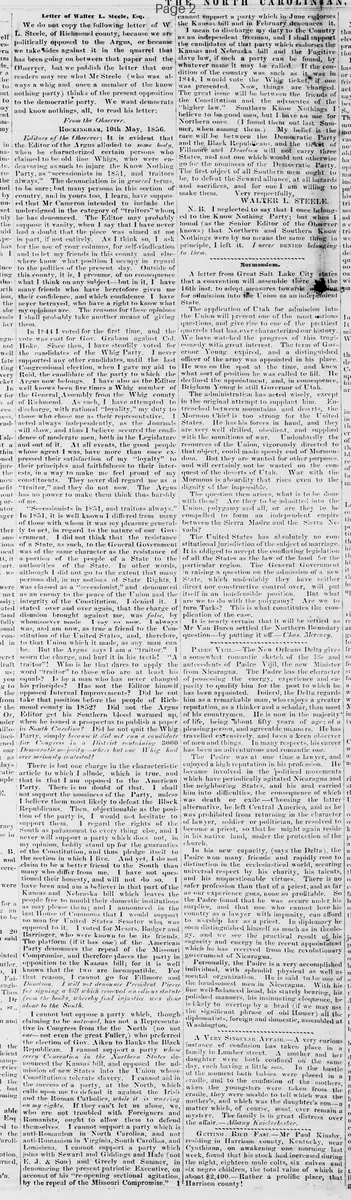
From the Observer.
ROCKINGHAM, 10th May, 1856.
Editors of the Observer: It is evident that the Editor of the Argus alluded to some body, when he characterized certain persons who claimed to be old line Whigs, who were endeavoring as such to injure the Know Nothing Party, as "secessionists in 1851, and traitors always." The denunciation is in general terms, to be sure: but many persons in this section of country, and in yours too, I learn, have supposed that Mr Cameron intended to include the undersigned in the category of "traitors" whom he has denounced. The Editor may probably suppose it vanity, when I say that I have never had a doubt that the piece was aimed at me in part, if not entirely. As I think so, I ask for the use of your columns, for self-vindication and to let my friends in this county and elsewhere know what position I occupy in regard to the politics of the present day. Outside of this county, it is, I presume, of no consequence what I think on any subject--but in it, I have many friends who have heretofore given me their confidence, and which confidence I have never betrayed, who have a right to know what my opinions are. The reasons for these opinions I shall probably take another means of giving them.
In 1844 I voted for the first time, and the vote was cast for Gov. Graham against Col. Hoke. Since then, I have steadily voted for the candidates of the Whig Party. I never supported any other candidates, until the last Congressional election, when I gave my aid to Reid, the candidate of the party to which the Argus now belongs. I have also as the Editor well knows been five times a Whig member of the General Assembly from the Whig county of Richmond. As such, I have attempted to discharge, with rational "loyalty," my duty to those who chose me as their representative. I acted always independently, as the Journals will show, and thus I believe secured the confidence of moderate men, both in the Legislature and out of it. At all events, the good people whose agent I was, have more than once expressed their satisfaction of my "loyalty" to their principles and faithfulness to their interests, in a way to make me feel proud of my constituents. They never did regard me as a "traitor," and they do not now. The Argus has no power to make them think thus harshly of me.
"Secessionists in 1851, and traitors always."
In 1851 it is well known I differed from many of those with whom it was my pleasure generally to act, in regard to the nature of our Government. I did not think that the resistance of a State, as such, to the General Government was of the same character as the resistance of a portion of the people of a State to the authorities of the State. In other words, although I did not go to the extent that many persons did, in my notions of State Rights, I was classed as a "secessionist," and denounced as an enemy to the peace of the Union and the integrity of the Constitution. I denied it. I stated over and over again, that the charge of disunion brought against me, was false, by whomsoever made. I say so now. I always was, and am now, as true a friend to the Constitution of the United States, and, therefore, to that Union which it made, as any man can be.
But the Argus says I am a "traitor."
I scorn the charge, and hurl it in his teeth! "A traitor"! Who is he that dares to apply the word "traitor" to those who are at least his equals? Is he a man who has never changed his principles? Has not the Editor himself opposed Internal Improvements? Did he not take that position before the people of Richmond county in 1852? Did not the Argus Editor get his Southern blood warmed up, when he issued a prospectus to publish a paper in South Carolina? Did he not quit the Whig Party, simply because it did not run a candidate for Congress in a District containing 3000 Democratic majority---where but one Whig ever seriously contested?
There is but one charge in the characteristic article to which I allude, which is true, and that is that I am opposed to the American Party.
There is no doubt of that. I shall not support the nominees of the Party, unless I believe them most likely to defeat the Black Republicans. Then, objectionable as the position of the party is, I would not hesitate to support them.
I regard the rights of the South as paramount to every thing else, and I never will support a party which does not, in my opinion, boldly stand up for the guaranties of the Constitution, and thus pledge itself to the section in which I live. And yet, I do not claim to be a better friend to the South than many who differ from me. I have not questioned their honesty, and will not do so.
I have been and am a believer in that part of the Kansas and Nebraska bill which leaves the people free to mould their domestic institutions as may please them; and I announced in the last House of Commons that I would support no man for United States Senator who was opposed to it. I voted for Messrs. Badger and Barringer, who were known to be its friends.
The platform (if it has one) of the American Party denounces the repeal of the Missouri Compromise, and therefore places the party in opposition to the Kansas bill; for it is well known that the two are incompatible. For that reason, I cannot go for Fillmore and Donelson. I will not denounce President Pierce for signing a bill which removed an odious statute from the books, whereby foul injustice was done alone to the South.
I cannot but oppose a party which, though claiming to be national, has not a Representative in Congress from the North (no not one-not even the great Fuller.) who preferred the election of Gov. Aiken to Banks the Black Republican. I cannot support a party whose every Convention in the Northern States denounces the Kansas bill, and opposed the admission of new States into the Union whose Constitutions tolerate slavery. I cannot aid in the success of a party, at the North, which calls upon me to defend it against the Irish and the Roman Catholics, while it is warring on my rights. If they can't let us alone, we, who are not troubled with Foreigners and Romanists, ought to allow them to defend themselves. I cannot support a party which is anti-Romanism in North Carolina, and not anti-Romanism in Virginia, South Carolina, and Louisiana. I cannot support a party which joins with Seward and Giddings and Hale (not E. J. & Son and Greeley and Sumner, in denouncing the present patriotic Executive, on account of his "re-opening sectional agitation, by the repeal of the Missouri Compromise."
I cannot support a party which in June endorses the Kansas bill and in February denounces it.
I mean to discharge my duty to the Country as an independent, freeman, and I shall support the candidates of that party which endorses the Kansas and Nebraska bill and the Fugitive slave law, if such a party can be found, by whatever name it may be called. If the condition of the country was such as it was in 1844, I would vote the Whig ticket, if one was presented. Now, things are changed.
The great issue will be between the friends of the Constitution and the advocates of the "higher law." Southern Know Nothings I believe to be good men, but I have no use for Northern ones. (I found them out last Summer, when among them.) My belief is the race will be between the Democratic Party and the Black Republicans, and the ticket of Fillmore and Donelson will not carry three States, and not one which would not otherwise go for the nominees of the Democratic Party.
The first object of all Southern men ought to be, to defeat the Seward alliance, at all hazards and sacrifices, and for one I am willing to make them.
Very respectfully,
WALTER L. STEELE.
N. B. I neglected to say that I once belonged to the Know Nothing Party: but when I found (as the Senior Editor of the Observer knows) that Northern and Southern Know Nothings were by no means the same thing in principle, I left it. I never DENIED belonging to them.
What sub-type of article is it?
What themes does it cover?
What keywords are associated?
What entities or persons were involved?
Letter to Editor Details
Author
Walter L. Steele
Recipient
Editors Of The Observer
Main Argument
walter l. steele defends his loyalty against traitor accusations, explains his opposition to the american (know nothing) party due to its stance against the kansas-nebraska act, and commits to supporting parties that defend southern constitutional rights and the kansas-nebraska bill to defeat black republicans.
Notable Details