Thank you for visiting SNEWPapers!
Sign up free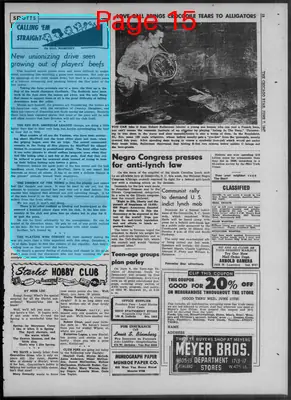
Story
June 7, 1947
The Chicago Star
Chicago, Cook County, Illinois
What is this article about?
Commentary on the 1947 baseball season's team struggles, particularly the Cardinals and Yankees, amid growing player dissatisfaction with management, fines, and contracts, signaling a renewed push for unionization post-WWII.
Clipping
OCR Quality
98%
Excellent
Full Text
SPORTS!
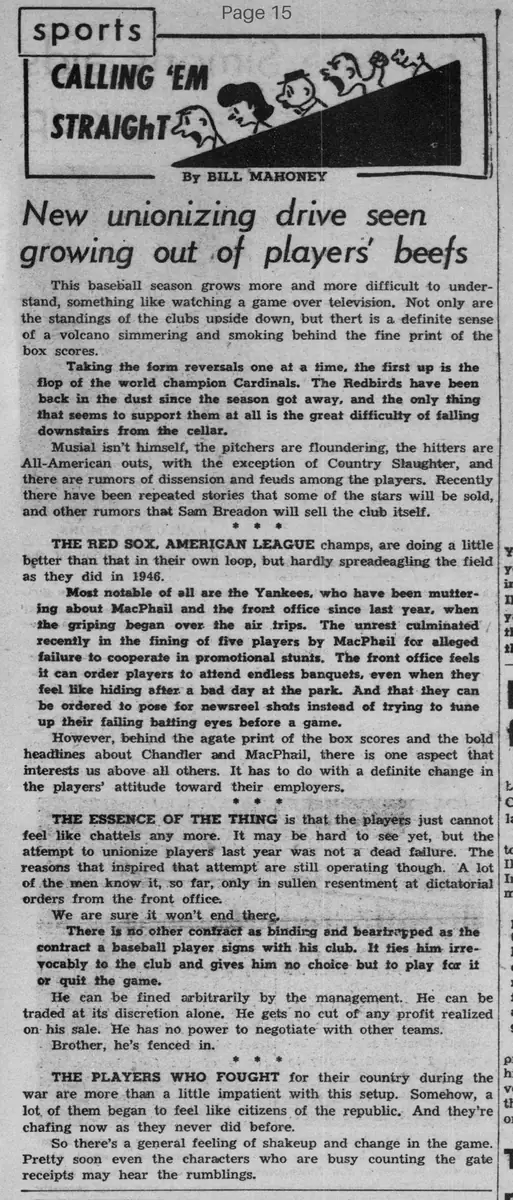
New Unionizing Drive Seen Growing Out of Players' Beefs
This baseball season grows more and more difficult to understand, something like watching a game over television. Not only are the standings of the clubs upside down, but there is a definite sense of a volcano simmering and smoking behind the fine print of the box scores.
Taking the form reversals one at a time, the first up is the flop of the world champion Cardinals. The Redbirds have been back in the dust since the season got away, and the only thing that seems to support them at all is the great difficulty of falling downstairs from the cellar.
Musial isn't himself, the pitchers are floundering, the hitters are All-American outs, with the exception of Country Slaughter, and there are rumors of dissension and feuds among the players. Recently there have been repeated stories that some of the stars will be sold, and other rumors that Sam Breadon will sell the club itself.
The Red Sox, American League champs, are doing a little better than that in their own loop, but hardly spread-eagling the field as they did in 1946.
Most notable of all are the Yankees, who have been muttering about MacPhail and the front office since last year, when the griping began over the air trips. The unrest culminated recently in the fining of five players by MacPhail for alleged failure to cooperate in promotional stunts. The front office feels it can order players to attend endless banquets, even when they feel like hiding after a bad day at the park. And that they can be ordered to pose for newsreel shots instead of trying to tune up their failing batting eyes before a game.
However, behind the agate print of the box scores and the bold headlines about Chandler and MacPhail, there is one aspect that interests us above all others. It has to do with a definite change in the players' attitude toward their employers.
The essence of the thing is that the players just cannot feel like chattels any more. It may be hard to see yet, but the attempt to unionize players last year was not a dead failure. The reasons that inspired that attempt are still operating though. A lot of the men know it, so far, only in sullen resentment at dictatorial orders from the front office.
We are sure it won't end there.
There is no other contract as binding and barren as the contract a baseball player signs with his club. It ties him irrevocably to the club and gives him no choice but to play for it or quit the game.
He can be fined arbitrarily by the management. He can be traded at its discretion alone. He gets no cut of any profit realized on his sale. He has no power to negotiate with other teams.
Brother, he's fenced in.
The players who fought for their country during the war are more than a little impatient with this setup. Somehow, a lot of them began to feel like citizens of the republic. And they're chafing now as they never did before.
So there's a general feeling of shakeup and change in the game. Pretty soon even the characters who are busy counting the gate receipts may hear the rumblings.
New Unionizing Drive Seen Growing Out of Players' Beefs
This baseball season grows more and more difficult to understand, something like watching a game over television. Not only are the standings of the clubs upside down, but there is a definite sense of a volcano simmering and smoking behind the fine print of the box scores.
Taking the form reversals one at a time, the first up is the flop of the world champion Cardinals. The Redbirds have been back in the dust since the season got away, and the only thing that seems to support them at all is the great difficulty of falling downstairs from the cellar.
Musial isn't himself, the pitchers are floundering, the hitters are All-American outs, with the exception of Country Slaughter, and there are rumors of dissension and feuds among the players. Recently there have been repeated stories that some of the stars will be sold, and other rumors that Sam Breadon will sell the club itself.
The Red Sox, American League champs, are doing a little better than that in their own loop, but hardly spread-eagling the field as they did in 1946.
Most notable of all are the Yankees, who have been muttering about MacPhail and the front office since last year, when the griping began over the air trips. The unrest culminated recently in the fining of five players by MacPhail for alleged failure to cooperate in promotional stunts. The front office feels it can order players to attend endless banquets, even when they feel like hiding after a bad day at the park. And that they can be ordered to pose for newsreel shots instead of trying to tune up their failing batting eyes before a game.
However, behind the agate print of the box scores and the bold headlines about Chandler and MacPhail, there is one aspect that interests us above all others. It has to do with a definite change in the players' attitude toward their employers.
The essence of the thing is that the players just cannot feel like chattels any more. It may be hard to see yet, but the attempt to unionize players last year was not a dead failure. The reasons that inspired that attempt are still operating though. A lot of the men know it, so far, only in sullen resentment at dictatorial orders from the front office.
We are sure it won't end there.
There is no other contract as binding and barren as the contract a baseball player signs with his club. It ties him irrevocably to the club and gives him no choice but to play for it or quit the game.
He can be fined arbitrarily by the management. He can be traded at its discretion alone. He gets no cut of any profit realized on his sale. He has no power to negotiate with other teams.
Brother, he's fenced in.
The players who fought for their country during the war are more than a little impatient with this setup. Somehow, a lot of them began to feel like citizens of the republic. And they're chafing now as they never did before.
So there's a general feeling of shakeup and change in the game. Pretty soon even the characters who are busy counting the gate receipts may hear the rumblings.
What sub-type of article is it?
Historical Event
What themes does it cover?
Justice
Misfortune
Bravery Heroism
What keywords are associated?
Baseball Unionization
Player Unrest
Management Conflicts
Team Flops
Contract Issues
What entities or persons were involved?
Musial
Country Slaughter
Sam Breadon
Macphail
Chandler
Where did it happen?
Major League Baseball
Story Details
Key Persons
Musial
Country Slaughter
Sam Breadon
Macphail
Chandler
Location
Major League Baseball
Event Date
This Baseball Season
Story Details
Struggles of Cardinals and Yankees amid player dissension, fines by management, restrictive contracts, and growing resentment leading to renewed unionization efforts influenced by wartime experiences.