Thank you for visiting SNEWPapers!
Sign up free
Editorial
December 5, 1797
Gazette Of The United States, & Philadelphia Daily Advertiser
Philadelphia, Philadelphia County, Pennsylvania
What is this article about?
A New York editorial critiques Pennsylvania Chief Justice M'Kean's charge to the grand jury on libeling, accusing it of partiality toward French and Spanish ministers while ignoring libels against U.S. officials, and inconsistency in addressing press detraction of public figures.
Clipping
OCR Quality
95%
Excellent
Full Text
By this day's Mail.
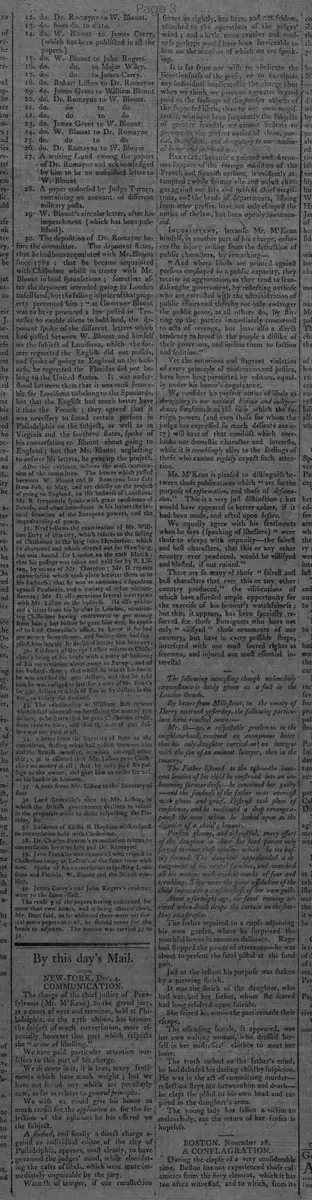
NEW-YORK, Dec. 4.
COMMUNICATION.
The charge of the chief justice of Pennsylvania (Mr. M'Kean) to the grand jury, at a court of oyer and terminer, held at Philadelphia, on the 27th ultimo, has become the subject of much conversation, more especially however that part which respects the "crime of libelling."
We have paid particular attention ourselves to this part of his charge. We discover in it, it is true, many sentiments which have much weight; but we have not found any which are peculiarly new, as far as relates to general principles. We wish we could give his honor as much credit for the application as for the selection of the opinions he has offered on the subject.
A studied, and finally a direct charge against an individual editor of the city of Philadelphia, appears, most clearly, to have governed the judge's mind, while elucidating the cases of libels, which were more immediately cognizable by the jury. Warmth of temper, if our recollection serves us rightly, has been, not seldom, attached to the operations of the judge's mind; and a little more caution and coolness perhaps would have been serviceable to him on the occasion of which we are speaking.
It is far from our wish to vindicate the licentiousness of the press, or to exculpate any individual implicated in the charge; but when we think we perceive a greater regard paid to the feelings of the foreign objects of the punished libels, than to our own magistrates, who have been frequently the subjects of greater scandal, we cannot hesitate to pronounce the present notice of them, partial, inconsistent, and derogatory to our national honor and independence.
PARTIAL, because a pointed and strenuous support of the foreign ministers of the French and Spanish nations, is evidently attempted; while former vile and unjust charges against our late and present chief magistrate, and the heads of departments, issuing from other presses, have not only escaped the notice of the law, but been openly countenanced.
INCONSISTENT, because—Mr. M'Kean himself, in another part of his charge, enforces the injury arising from the detraction of public characters, by remarking—“And where libels are printed against persons employed in a public capacity, they receive an aggravation, as they tend to scandalize the government, by reflecting on those who are entrusted with the administration of public affairs and thereby not only endanger the public peace, as all others do, by stirring up the parties immediately concerned to acts of revenge, but have also a direct tendency to breed in the people a dislike of their governors, and incline them to faction and sedition.”
Yet the notorious and flagrant violation of every principle of moderation and justice, have been long permitted by editors, equally under his honor's cognizance. We consider his present notice of libels as derogatory to our national honour and independence, forasmuch as the view which the foreign powers (and even those for whom the judge has expressed so much delicate anxiety) will have of that conduct which overlooks our domestic character and interests, while it is tremblingly alive to the feelings of those who cannot rightly expect such attention.
Mr. M'Kean is pleased to distinguish between those publications which "are for the purpose of reformation, and those of defamation." This is a very just distinction; but would have appeared in better colors, if it had been made, and acted upon before.
We equally agree with his sentiments when he says (speaking of libellers) "were those to escape with impunity—the fairest and best characters, that this or any other country ever produced, would be vilified and blasted, if not ruined."
There are so many of those "fairest and best characters that ever this or any other country produced," the vilifications of which have afforded ample opportunity for the exercise of his honour's watchfulness; but this, it appears, has been peculiarly reserved for those Foreigners who have not only "vilified" those ornaments of our country, but have in every possible shape, interfered with our most sacred rights as freemen, and injured our most essential interests!
NEW-YORK, Dec. 4.
COMMUNICATION.
The charge of the chief justice of Pennsylvania (Mr. M'Kean) to the grand jury, at a court of oyer and terminer, held at Philadelphia, on the 27th ultimo, has become the subject of much conversation, more especially however that part which respects the "crime of libelling."
We have paid particular attention ourselves to this part of his charge. We discover in it, it is true, many sentiments which have much weight; but we have not found any which are peculiarly new, as far as relates to general principles. We wish we could give his honor as much credit for the application as for the selection of the opinions he has offered on the subject.
A studied, and finally a direct charge against an individual editor of the city of Philadelphia, appears, most clearly, to have governed the judge's mind, while elucidating the cases of libels, which were more immediately cognizable by the jury. Warmth of temper, if our recollection serves us rightly, has been, not seldom, attached to the operations of the judge's mind; and a little more caution and coolness perhaps would have been serviceable to him on the occasion of which we are speaking.
It is far from our wish to vindicate the licentiousness of the press, or to exculpate any individual implicated in the charge; but when we think we perceive a greater regard paid to the feelings of the foreign objects of the punished libels, than to our own magistrates, who have been frequently the subjects of greater scandal, we cannot hesitate to pronounce the present notice of them, partial, inconsistent, and derogatory to our national honor and independence.
PARTIAL, because a pointed and strenuous support of the foreign ministers of the French and Spanish nations, is evidently attempted; while former vile and unjust charges against our late and present chief magistrate, and the heads of departments, issuing from other presses, have not only escaped the notice of the law, but been openly countenanced.
INCONSISTENT, because—Mr. M'Kean himself, in another part of his charge, enforces the injury arising from the detraction of public characters, by remarking—“And where libels are printed against persons employed in a public capacity, they receive an aggravation, as they tend to scandalize the government, by reflecting on those who are entrusted with the administration of public affairs and thereby not only endanger the public peace, as all others do, by stirring up the parties immediately concerned to acts of revenge, but have also a direct tendency to breed in the people a dislike of their governors, and incline them to faction and sedition.”
Yet the notorious and flagrant violation of every principle of moderation and justice, have been long permitted by editors, equally under his honor's cognizance. We consider his present notice of libels as derogatory to our national honour and independence, forasmuch as the view which the foreign powers (and even those for whom the judge has expressed so much delicate anxiety) will have of that conduct which overlooks our domestic character and interests, while it is tremblingly alive to the feelings of those who cannot rightly expect such attention.
Mr. M'Kean is pleased to distinguish between those publications which "are for the purpose of reformation, and those of defamation." This is a very just distinction; but would have appeared in better colors, if it had been made, and acted upon before.
We equally agree with his sentiments when he says (speaking of libellers) "were those to escape with impunity—the fairest and best characters, that this or any other country ever produced, would be vilified and blasted, if not ruined."
There are so many of those "fairest and best characters that ever this or any other country produced," the vilifications of which have afforded ample opportunity for the exercise of his honour's watchfulness; but this, it appears, has been peculiarly reserved for those Foreigners who have not only "vilified" those ornaments of our country, but have in every possible shape, interfered with our most sacred rights as freemen, and injured our most essential interests!
What sub-type of article is it?
Press Freedom
Legal Reform
What keywords are associated?
Libel Charge
Press Freedom
Judicial Partiality
Foreign Ministers
National Honor
Public Characters
What entities or persons were involved?
Mr. M'kean
Chief Justice Of Pennsylvania
French Ministers
Spanish Ministers
Chief Magistrate
Heads Of Departments
Editorial Details
Primary Topic
Critique Of Chief Justice M'kean's Charge On Libeling
Stance / Tone
Critical Of Judicial Partiality And Inconsistency
Key Figures
Mr. M'kean
Chief Justice Of Pennsylvania
French Ministers
Spanish Ministers
Chief Magistrate
Heads Of Departments
Key Arguments
Judge's Charge Shows Partiality By Supporting Foreign Ministers Over Domestic Officials
Inconsistent Application Of Principles Against Libels On Public Characters
Derogatory To National Honor By Prioritizing Foreign Feelings
Distinction Between Reformative And Defamatory Publications Should Have Been Applied Earlier
Libels Against American Leaders Have Been Ignored While Foreign Ones Are Addressed