Thank you for visiting SNEWPapers!
Sign up free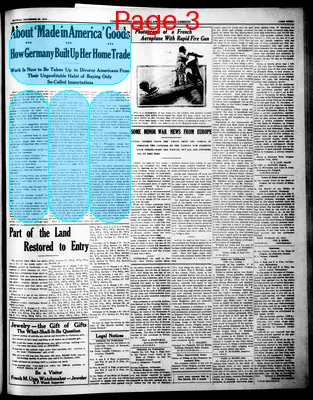
The Evening Herald
Klamath Falls, Klamath County, Oregon
What is this article about?
Promotional article urging Americans to buy 'Made in U.S.A.' goods to retain nearly $2 billion annually spent on imports, citing German Chambers of Commerce circular as example. Notes $448,312,948 in manufactured imports for year ending June 1914 and incorporation of Made in America Products Association to demonstrate American product superiority.
Clipping
OCR Quality
Full Text
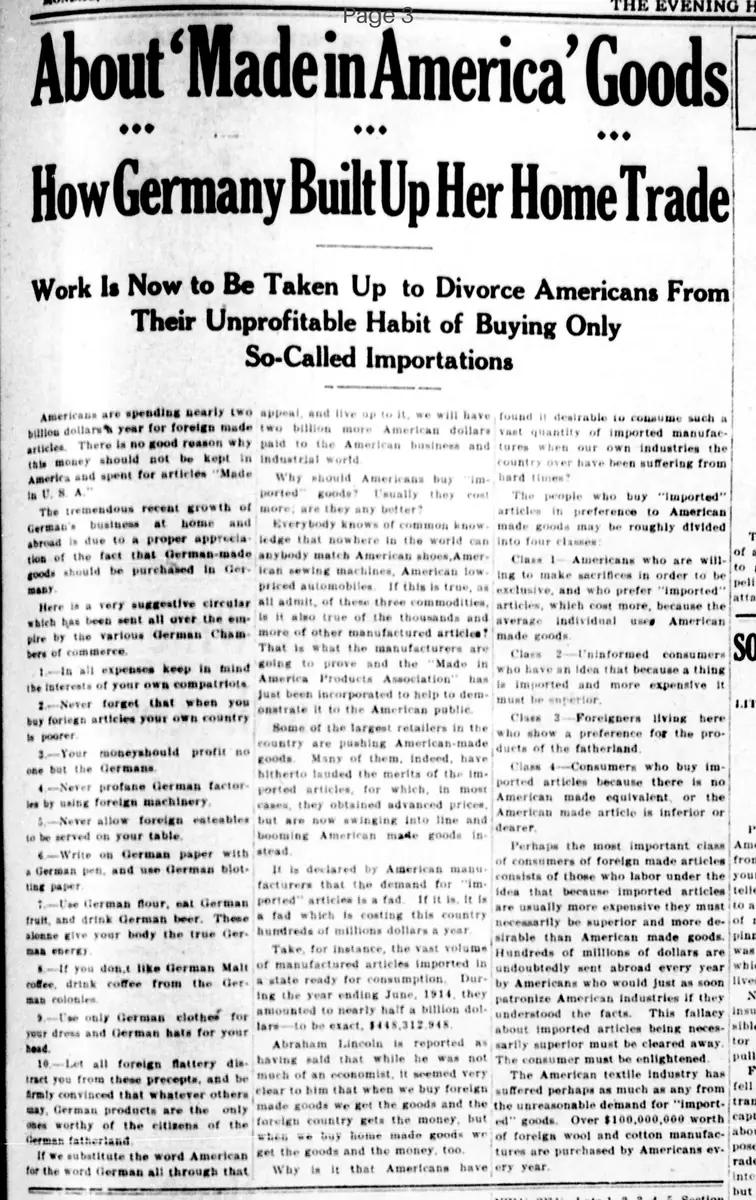
How Germany Built Up Her Home Trade
Work Is Now to Be Taken Up to Divorce Americans From Their Unprofitable Habit of Buying Only So-Called Importations.
Americans are spending nearly two billion dollars a year for foreign made articles. There is no good reason why this money should not be kept in America and spent for articles "Made in U. S. A."
The tremendous recent growth of Germany's business at home and abroad is due to a proper appreciation of the fact that German-made goods should be purchased in Germany.
Here is a very suggestive circular which has been sent all over the empire by the various German Chambers of commerce.
1—In all expenses keep in mind the interests of your own compatriots.
2—Never forget that when you buy foreign articles your own country is poorer.
3—Your money should profit no one but the Germans.
4—Never profane German factories by using foreign machinery.
5—Never allow foreign vegetables to be served on your table.
6—Write on German paper with a German pen, and use German blotting paper.
7—Use German flour, eat German fruit, and drink German beer. These alone give your body the true German spirit.
8—If you don't like German malt coffee, drink coffee from the German colonies.
9—Use only German cloth for your dress and German hats for your head.
10—Let all foreign flattery distract you from these precepts, and be firmly convinced that whatever others may, German products are the only ones worthy of the citizens of the German fatherland.
If we substitute the word American for the word German all through that appeal, and live up to it, we will have two billion more American dollars paid to the American business and industrial world.
Why should Americans buy imported goods? Usually they cost more, are they any better?
Everybody knows of common knowledge that nowhere in the world can anybody match American shoes, American sewing machines, American low-priced automobiles. If this is true, as all admit, of these three commodities, is it also true of the thousands and more of other manufactured articles?
That is what the manufacturers are going to prove and the "Made in America Products Association" has just been incorporated to help to demonstrate it to the American public.
Some of the largest retailers in the country are pushing American-made goods. Many of them, indeed, have hitherto lauded the merits of the imported articles, for which, in most cases, they obtained advanced prices, but are now swinging into line and booming American made goods instead.
It is declared by American manufacturers that the demand for "imported" articles is a fad. If it is, it is a fad which is costing this country hundreds of millions dollars a year.
Take, for instance, the vast volume of manufactured articles imported in a state ready for consumption.
During the year ending June, 1914, they amounted to nearly half a billion dollars—to be exact, $448,312,948.
Abraham Lincoln is reported as having said that while he was not much of an economist, it seemed very clear to him that when we buy foreign made goods we get the goods and the foreign country gets the money, but when we buy home made goods we get the goods and the money too.
Why is it that Americans have found it desirable to consume such a vast quantity of imported manufactures when our own industries the country over have been suffering from hard times?
The people who buy "Imported" articles in preference to American made goods may be roughly divided into four classes.
Class 1—Americans who are willing to make sacrifices in order to be exclusive, and who prefer "imported" articles, which cost more, because the average individual uses American made goods.
Class 2—Uninformed consumers who have an idea that because a thing is imported and more expensive it must be superior.
Class 3—Foreigners living here who show a preference for the products of the fatherland.
Class 4—Consumers who buy imported articles because there is no American made equivalent, or the American made article is inferior or dearer.
Perhaps the most important class of consumers of foreign made articles consists of those who labor under the idea that because imported articles are usually more expensive they must necessarily be superior and more desirable than American made goods.
Hundreds of millions of dollars are undoubtedly sent abroad every year by Americans who would just as soon patronize American industries if they understood the facts.
This fallacy about imported articles being necessarily superior must be cleared away. The consumer must be enlightened.
The American textile industry has suffered perhaps as much as any from the unreasonable demand for "imported" goods. Over $100,000,000 worth of foreign wool and cotton manufactures are purchased by Americans every year.
What sub-type of article is it?
What keywords are associated?
Domestic News Details
Event Details
Americans spend nearly two billion dollars yearly on foreign-made articles; promotes keeping money in America by buying U.S.A.-made goods. German growth due to buying German products; shares German Chambers of Commerce circular with 10 precepts favoring German goods. Substituting 'American' for 'German' in circular urged. Questions why buy costlier imports when American shoes, sewing machines, automobiles unmatched. Made in America Products Association incorporated to prove American goods superior. Retailers shifting to promote American-made. Import fad costs hundreds of millions; $448,312,948 in ready-for-consumption manufactures imported year ending June 1914. Quotes Abraham Lincoln on benefits of home-made goods. Analyzes four classes of import buyers: exclusivity seekers, uninformed on superiority, foreigners preferring homeland products, those lacking American equivalents. Calls to enlighten consumers on fallacy of import superiority, especially in textiles with over $100M in foreign wool/cotton imports yearly.