Thank you for visiting SNEWPapers!
Sign up free
Editorial
January 6, 1826
Rhode Island American And Providence Gazette
Providence, Providence County, Rhode Island
What is this article about?
Editorial critiques fluctuations in New England's money market, attributing them to rivalries among Boston banks that restrict circulation of other banks' notes, harming commerce. Advocates for banks to facilitate exchanges and loans without internal conflicts.
Clipping
OCR Quality
95%
Excellent
Full Text
AMERICAN AND GAZETTE.
FRIDAY MORNING, JANUARY 6, 1826.
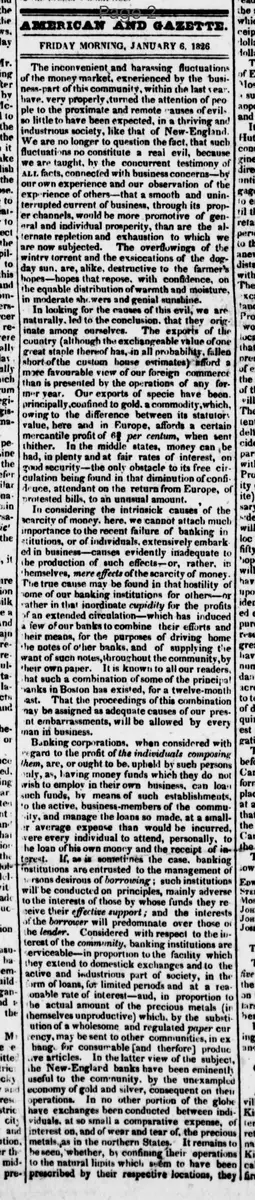
The inconvenient and harassing fluctuations of the money market, experienced by the business-part of this community, within the last year, have very properly turned the attention of people to the proximate and remote causes of evils so little to have been expected, in a thriving and industrious society, like that of New-England. We are no longer to question the fact, that such fluctuations do constitute a real evil, because we are taught, by the concurrent testimony of ALL facts, connected with business concerns—by our own experience and our observation of the experience of others—that a smooth and uninterrupted current of business, through its proper channels, would be more promotive of general and individual prosperity, than are the alternate repletion and exhaustion to which we are now subjected. The overflowings of the wintry torrent and the exsiccations of the dog-day sun, are, alike, destructive to the farmer's hopes—hopes that repose, with confidence, on the equable distribution of warmth and moisture, in moderate showers and genial sunshine.
In looking for the causes of this evil, we are naturally led to the conclusion, that they originate among ourselves. The exports of the country (although the exchangeable value of one great staple thereof has, in all probability, fallen short of the customhouse estimates) afford a more favourable view of our foreign commerce than is presented by the operations of any former year. Our exports of specie have been, principally, confined to gold, a commodity, which, owing to the difference between its statutory value, here and in Europe, affords a certain mercantile profit of 6 per centum, when sent thither. In the middle states, money can be had, in plenty and at fair rates of interest, on good security—the only obstacle to its free circulation being found in that diminution of confidence, attendant on the return from Europe, of protested bills, to an unusual amount.
In considering the intrinsic causes of the scarcity of money, here, we cannot attach much importance to the recent failure of banking institutions, or of individuals, extensively embarked in business—causes evidently inadequate to the production of such effects—or, rather, in themselves, mere effects of the scarcity of money. The true cause may be found in that hostility of some of our banking institutions for others—or rather in that inordinate cupidity for the profits of an extended circulation—which has induced a few of our banks to combine their efforts and their means, for the purposes of driving home the notes of other banks, and of supplying the want of such notes, throughout the community, by their own paper. It is known to all our readers, that such a combination of some of the principal banks in Boston has existed, for a twelve-month past. That the proceedings of this combination may be assigned as adequate causes of our present embarrassments, will be allowed by every man in business.
Banking corporations, when considered with regard to the profit of the individuals composing them, are, or ought to be, upheld by such persons only, as, having money funds which they do not wish to employ in their own business, can loan such funds, by means of such establishments, to the active, business-members of the community, and manage the loans so made, at a smaller average expense than would be incurred, were every individual to attend, personally, to the loan of his own money and the receipt of interest. If, as is sometimes the case, banking institutions are entrusted to the management of persons desirous of borrowing; such institutions will be conducted on principles, mainly adverse to the interests of those by whose funds they receive their effective support; and the interests of the borrower will predominate over those of the lender. Considered with respect to the interest of the community, banking institutions are serviceable—in proportion to the facility which they extend to domestic exchanges and to the active and industrious part of society, in the form of loans, for limited periods and at a reasonable rate of interest—and, in proportion to the actual amount of the precious metals (in themselves unproductive) which, by the substitution of a wholesome and regulated paper currency, may be sent to other communities, in exchange for consumable [and therefore] productive articles. In the latter view of the subject, the New-England banks have been eminently useful to the community, by the unexampled economy of gold and silver, consequent on their operations. In no other portion of the globe have exchanges been conducted between individuals, at so small a comparative expense, of interest on, and of wear and tear of, the precious metals, as in the northern States. It remains to be seen, whether, by confining their operations to the natural limits which seem to have been prescribed by their respective locations, they will continue to be thus promotive of individual prosperity and public economy; or, whether by their mutual jealousies and intestine warfare, they are to become a curse, instead of a blessing, to the community.
In order to form some estimate of the good or evil which our banks are capable of extending or inflicting, let us suppose, that, in Rhode-Island, the annual exchanges amount to $800,000—that those exchanges are effected by a paper circulation of $600,000—which is bottomed upon a deposit, in specie, of $200,000. Let us suppose, again, that the Boston banks, associated for that purpose, have obtained the notes of our banks to the amount of $50,000, for which they require the specie—that that specie is brought back, by a similar demand of our banks on those of Boston, and constantly liable, at any moment, to be thus taken and re-turned—it is very clear, that the Rhode-Island banks have, for all purposes of their ordinary business, lost the support of $50,000 in specie—that, if $200,000 in specie are necessary to maintain a circulation of $600,000, their circulation must be reduced to $450,000—and, that, if a circulation of $600,000 be necessary to an aggregate annual exchange of $80,000,000, the actual business of the State must be reduced by one quarter. Will the business of Boston increase, proportionably? Like causes, produce like effects—the $50,000 in specie, retained from its ordinary uses, here, and appropriated to this new trade of exchange and re-exchange, must be balanced by a like sum, thus retained in Boston—and must occasion a similar reduction of currency and of aggregate commercial operations, there. The expense-account-extraordinary of the associated banks will go far to absorb their extra profits on circulation, and the community will be the loser, by the whole of the business thus obstructed, as well as by the unproductive labour of those employed, in counting and transporting its specie.
FRIDAY MORNING, JANUARY 6, 1826.
The inconvenient and harassing fluctuations of the money market, experienced by the business-part of this community, within the last year, have very properly turned the attention of people to the proximate and remote causes of evils so little to have been expected, in a thriving and industrious society, like that of New-England. We are no longer to question the fact, that such fluctuations do constitute a real evil, because we are taught, by the concurrent testimony of ALL facts, connected with business concerns—by our own experience and our observation of the experience of others—that a smooth and uninterrupted current of business, through its proper channels, would be more promotive of general and individual prosperity, than are the alternate repletion and exhaustion to which we are now subjected. The overflowings of the wintry torrent and the exsiccations of the dog-day sun, are, alike, destructive to the farmer's hopes—hopes that repose, with confidence, on the equable distribution of warmth and moisture, in moderate showers and genial sunshine.
In looking for the causes of this evil, we are naturally led to the conclusion, that they originate among ourselves. The exports of the country (although the exchangeable value of one great staple thereof has, in all probability, fallen short of the customhouse estimates) afford a more favourable view of our foreign commerce than is presented by the operations of any former year. Our exports of specie have been, principally, confined to gold, a commodity, which, owing to the difference between its statutory value, here and in Europe, affords a certain mercantile profit of 6 per centum, when sent thither. In the middle states, money can be had, in plenty and at fair rates of interest, on good security—the only obstacle to its free circulation being found in that diminution of confidence, attendant on the return from Europe, of protested bills, to an unusual amount.
In considering the intrinsic causes of the scarcity of money, here, we cannot attach much importance to the recent failure of banking institutions, or of individuals, extensively embarked in business—causes evidently inadequate to the production of such effects—or, rather, in themselves, mere effects of the scarcity of money. The true cause may be found in that hostility of some of our banking institutions for others—or rather in that inordinate cupidity for the profits of an extended circulation—which has induced a few of our banks to combine their efforts and their means, for the purposes of driving home the notes of other banks, and of supplying the want of such notes, throughout the community, by their own paper. It is known to all our readers, that such a combination of some of the principal banks in Boston has existed, for a twelve-month past. That the proceedings of this combination may be assigned as adequate causes of our present embarrassments, will be allowed by every man in business.
Banking corporations, when considered with regard to the profit of the individuals composing them, are, or ought to be, upheld by such persons only, as, having money funds which they do not wish to employ in their own business, can loan such funds, by means of such establishments, to the active, business-members of the community, and manage the loans so made, at a smaller average expense than would be incurred, were every individual to attend, personally, to the loan of his own money and the receipt of interest. If, as is sometimes the case, banking institutions are entrusted to the management of persons desirous of borrowing; such institutions will be conducted on principles, mainly adverse to the interests of those by whose funds they receive their effective support; and the interests of the borrower will predominate over those of the lender. Considered with respect to the interest of the community, banking institutions are serviceable—in proportion to the facility which they extend to domestic exchanges and to the active and industrious part of society, in the form of loans, for limited periods and at a reasonable rate of interest—and, in proportion to the actual amount of the precious metals (in themselves unproductive) which, by the substitution of a wholesome and regulated paper currency, may be sent to other communities, in exchange for consumable [and therefore] productive articles. In the latter view of the subject, the New-England banks have been eminently useful to the community, by the unexampled economy of gold and silver, consequent on their operations. In no other portion of the globe have exchanges been conducted between individuals, at so small a comparative expense, of interest on, and of wear and tear of, the precious metals, as in the northern States. It remains to be seen, whether, by confining their operations to the natural limits which seem to have been prescribed by their respective locations, they will continue to be thus promotive of individual prosperity and public economy; or, whether by their mutual jealousies and intestine warfare, they are to become a curse, instead of a blessing, to the community.
In order to form some estimate of the good or evil which our banks are capable of extending or inflicting, let us suppose, that, in Rhode-Island, the annual exchanges amount to $800,000—that those exchanges are effected by a paper circulation of $600,000—which is bottomed upon a deposit, in specie, of $200,000. Let us suppose, again, that the Boston banks, associated for that purpose, have obtained the notes of our banks to the amount of $50,000, for which they require the specie—that that specie is brought back, by a similar demand of our banks on those of Boston, and constantly liable, at any moment, to be thus taken and re-turned—it is very clear, that the Rhode-Island banks have, for all purposes of their ordinary business, lost the support of $50,000 in specie—that, if $200,000 in specie are necessary to maintain a circulation of $600,000, their circulation must be reduced to $450,000—and, that, if a circulation of $600,000 be necessary to an aggregate annual exchange of $80,000,000, the actual business of the State must be reduced by one quarter. Will the business of Boston increase, proportionably? Like causes, produce like effects—the $50,000 in specie, retained from its ordinary uses, here, and appropriated to this new trade of exchange and re-exchange, must be balanced by a like sum, thus retained in Boston—and must occasion a similar reduction of currency and of aggregate commercial operations, there. The expense-account-extraordinary of the associated banks will go far to absorb their extra profits on circulation, and the community will be the loser, by the whole of the business thus obstructed, as well as by the unproductive labour of those employed, in counting and transporting its specie.
What sub-type of article is it?
Economic Policy
Trade Or Commerce
What keywords are associated?
Money Market Fluctuations
Banking Institutions
Currency Circulation
Boston Banks Combination
New England Commerce
Specie Exports
Paper Currency
What entities or persons were involved?
Boston Banks
New England Banks
Rhode Island Banks
Editorial Details
Primary Topic
Fluctuations In The Money Market Caused By Bank Rivalries
Stance / Tone
Critical Of Inter Bank Hostilities And Combinations
Key Figures
Boston Banks
New England Banks
Rhode Island Banks
Key Arguments
Fluctuations In Money Market Harm Business Prosperity
Causes Originate From Internal Bank Hostilities And Combinations
Boston Banks Combine To Drive Out Other Banks' Notes
Banks Should Facilitate Loans And Exchanges For Community Benefit
Bank Rivalries Reduce Circulation And Commerce
Example: Rhode Island Circulation Reduced By 25% Due To Specie Demands