Thank you for visiting SNEWPapers!
Sign up free
Gazette Of The United States
New York, New York County, New York
What is this article about?
Extract of a letter from Brussels dated December 25, 1789, providing a detailed account of the Belgic Revolution against Austrian rule, including uprisings in Turnhout and Brussels, defeats of imperial forces, and the formation of a patriot army, with reflections on potential American commercial benefits.
Merged-components note: Continuation of letter to the editor about the revolution in the Belgic states across pages 2 and 3; second component originally labeled 'foreign_news', but it is part of the letter, so relabeled 'letter_to_editor'.
Clippings
1 of 2
OCR Quality
Full Text
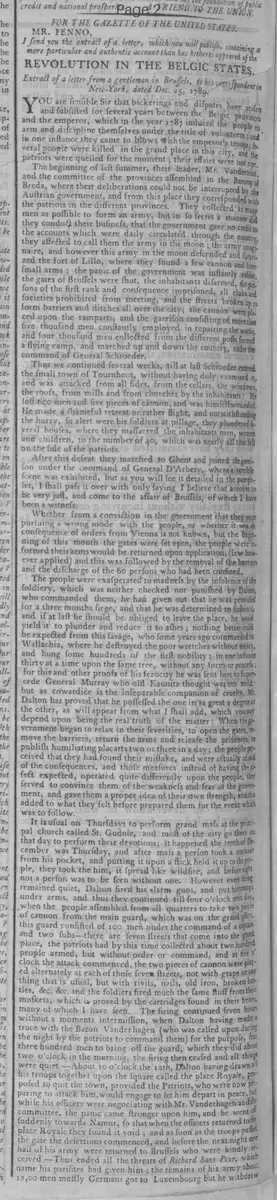
MR. FENNO,
I send you the extract of a letter which you will publish, containing a
more particular and authentic account than has hitherto appeared of the
REVOLUTION IN THE BELGIC STATES.
Extract of a letter from a gentleman in Brussels, to his correspondent in
New-York, dated Dec. 25, 1789.
YOU are sensible Sir that bickerings and disputes have arisen
and subsisted for several years between the Belgic provinces
and the emperor, which in the year 1787 induced the people to
arm and discipline themselves under the title of volunteers; and
in one instance they came to blows with the emperor's troops; sev-
eral people were killed in the grand place in this city, and the
patriots were quelled for the moment; their affairs were not ripe.
The beginning of last summer, their leader, Mr. Van der Noot,
and the committee of the provinces assembled in the Barony of
Breda, where their deliberations could not be interrupted by the
Austrian government, and from this place they corresponded with
the patriots in the different provinces. They collected as many
men as possible to form an army, but in so secret a manner did
they conduct their business, that the government gave no credit to
the accounts which were daily circulated through the country,
they affected to call them the army in the moon; the army imagi-
nary, and however this army in the moon descended and surpri-
zed the fort of Lillo, where they found a few cannon and some
small arms; the panic of the government was instantly visible,
the gates of Brussels were shut, the inhabitants disarmed, 60 per-
sons of the first rank and consequence imprisoned, all clubs and
societies prohibited from meeting, and the streets broken up to
form barriers and ditches all over the city; the cannon were pla-
ced upon the ramparts, and the garrison consisting of more than
five thousand men constantly employed in repairing the works,
and four thousand men collected from the different posts formed
a flying camp, and marched up and down the country, under the
command of General Schroeder.
Thus we continued several weeks, till at last Schroeder entered
the small town of Turnhout, without having duly examined it,
and was attacked from all sides, from the cellars, the windows,
the roofs, from mills and from churches by the inhabitants: He
lost 600 men and five pieces of cannon, and was himself wounded.
He made a shameful retreat or rather flight, and notwithstanding
the hurry, so alert were his soldiers at pillage, they plundered sev-
eral houses, where they massacred the inhabitants men, women
and children, to the number of 40, which was nearly all that fell
on the side of the patriots.
After this defeat they marched to Ghent and joined the garri-
son under the command of General D'Arcy, where a terrible
scene was exhibited, but as you will see it detailed in the pamph-
let, I shall pass it over with only saying I believe that account to
be very just, and come to the affair of Brussels, of which I have
been a witness.
Whether from a conviction in the government that they were
pursuing a wrong mode with the people, or whether it was in
consequence of orders from Vienna is not known, but the begin-
ning of this month the gates were set open, the people were in-
formed their arms would be returned upon application, (few how-
ever applied) and this was followed by the removal of the barriers
and the discharge of the 60 persons who had been confined.
The people were exasperated to madness by the insolence of the
soldiery, which was neither checked nor punished by Dalton,
who commanded them, he had given out that he was provided
for a three months siege, and that he was determined to sustain it
and if at last he should be obliged to leave the place, he would
yield it to plunder and reduce it to ashes; nothing better could
be expected from this savage, who some years ago commanded in
Wallachia, where he destroyed the poor wretches without mercy,
and hung some hundreds of the first nobility; in one instance
thirty at a time upon the same tree, without any form or process;
for this and other proofs of his ferocity he was sent here to super-
cede General Murray who old Kaunitz thought was too mild:
but as cowardice is the inseparable companion of cruelty, Mr.
Dalton has proved that he possessed the one in as great a degree as
the other, as will appear from what I shall add, which you may
depend upon being the real truth of the matter: When the go-
vernment began to relax in their severities, to open the gates, re-
move the barriers, return the arms and release the prisoners, to
publish humiliating placards two or three in a day; the people per-
ceivd that they had found their mistake, and were actually afraid
of the consequences, and those measures instead of having the ef-
fect expected, operated quite differently upon the people, they
served to convince them of the weakness and fear of the govern-
ment, and gave them a proper idea of their own strength, and this
added to what they felt before prepared them for the event which
was to follow.
It is usual on Thursdays to perform grand mass at the princi-
pal church called St. Gudule, and most of the city go there on
that day to perform their devotions; it happened the tenth of De-
cember was Thursday, and after mass a person took a cockade
from his pocket, and putting it upon a stick held it up to the peo-
ple, they took the hint, it spread like wildfire, and before night
not a person was to be seen without one. However every thing
remained quiet, Dalton fired his alarm guns, and put his troops
under arms, and thus they continued till four o'clock next day,
when the people assembled from all quarters to take two pieces
of cannon from the main guard, which was on the grand place,
this guard consisted of 100 men under the command of a captain
and place, the patriots had by this time collected about two hundred
people armed, but without order or command, and at five o'
clock the attack commenced, the two pieces of cannon were play-
ed alternately at each of those even streets, not with grape or any
thing that is usual, but with rivets, nails, old iron, broken bot-
tles, &c. &c. and the soldiers fired much the same stuff from their
muskets, which is proved by the cartridges found in their boxes,
many of which I have seen. The firing continued seven hours
without a moments intermission, when Dalton having made a
truce with the Baron Van der Noot (who was called upon during
the night by the patriots to command them) for the purpose, sent
three hundred men to bring off the guard, which they did about
two o'clock in the morning, the firing then ceased and all things
were quiet -About 10 o'clock the 12th, Dalton having drawn all
his troops together upon the square called the place Royale, pro-
posed to quit the town, provided the Patriots, who were now pre-
paring to attack him, would engage to let him depart in peace, but
while his officers were negotiating with Mr. Van der Noot and the committee, the panic came stronger upon him, and he went off suddenly towards Namur that when the officers returned to the place Royale they found it void; and as soon as the troops passed the gate the desertions commenced and before the next night one half of his army were returned to Brussels who were kindly received.
Thus ended all the threats of Richard Sans Peur which his partisans had given him; the remains of his army about 1200 men mostly Germans got to Luxembourg but he withdrew.
himself privately on the road and has not been heard of since.—
So precipitate was his flight that he left in the Caisse Militaire two millions of florins in money, in the Tresor Royal three millions, twelve pieces of heavy brass artillery, twenty light pieces, arms and accoutrements for 20 thousand men, cloathing for 30 thousand, and an immense quantity of flour, and other provision, ammunition and forage, altogether, to the amount of about a million sterling; besides this they took a great quantity of the like articles at Ghent, at Malines where was the grand Arsenal, at Mons, at Namur, and at Louvaine, so that they are provided with all that is necessary to cloath and arm sixty thousand men, which they are raising; the province of Flanders has already completed its quota, which is 20,000. Brabant has made much progress, its quota is 17,000, so that the other eleven provinces, to wit, Hainault, Luxembourg, Limbourg, Gueldres, Namur, Marche of Antwerp, and Malines, have only 23,000 to furnish among them, and such is the population of this country, and so roused are the people by injuries already felt, and by the apprehension of what they must suffer should they once again fall under the dominion of the House of Austria, that they find no difficulty in picking their men. The deserters from the Imperial army (mostly born in the low countries) give great assistance in disciplining and instructing the recruits; they have a General Mr. Vander Mersch who, tho I do not think him a Washington, has a good character, and much merit; he is disinterested, cool, cautious, and brave, and about the age of 65 years. He has seen service, and his conduct since he has had the command of the Patriot Army, shews, that he can act either with the activity of a Frenchman, or the mill-horse motion of a German.
From this state of their affairs, it should seem there is small prospect of those provinces ever coming again under the Austrian yoke, even should England, Prussia, and Holland not lend them assistance. But instead of those powers remaining idle spectators, they are expected to declare for them as soon as they are in entire possession of the country, that is to say when they have gained the possession of the Citadel of Antwerp, and the fortress of Luxembourg, this opinion is very general, from a belief that England and Holland have furnished the money which was necessary for the business, and of which they have had such supplies as to enable them to pay down for every thing they have had, as well as paying their army regularly ten-pence sterling per day.
What commercial advantages will arise to America from this revolution, it is not easy to point out at present, but I think one may expect them to be considerable, the consumption of rice, indigo, tobacco, flaxseed, timber, &c. is very considerable, and their manufactures of coarse woolens and linens, their fustians, laces, &c. will be afforded cheaper than from France or England, and consequently a good exchange.
The inhabitants in general look up to America with veneration and respect; they consider her struggle and success as the first cause of the revolution in France, and of the recovery of their own liberty, consequently not only the states but the merchants, manufacturers, &c. in their individual capacities will receive with open arms any proposals which Congress may think proper to make.
However I am but poorly qualified to judge what will or will not contribute to the advantage of nations.
What sub-type of article is it?
What themes does it cover?
What keywords are associated?
What entities or persons were involved?
Letter to Editor Details
Author
A Gentleman In Brussels
Recipient
Mr. Fenno
Main Argument
provides a detailed and authentic account of the recent revolution in the belgic states against austrian rule, highlighting key military events and the patriots' successes, with optimism for their independence and potential benefits to american commerce.
Notable Details