Thank you for visiting SNEWPapers!
Sign up free
Virginia Argus
Richmond, Virginia
What is this article about?
Edward Livingston defends himself in a public address against General James Wilkinson's courtroom accusation of complicity in Aaron Burr's treasonous conspiracy. He details his financial obligations to Burr, the arrests of Bollman and others, and Wilkinson's refusal to substantiate charges under oath in New Orleans court, December 1806.
Clipping
OCR Quality
Full Text
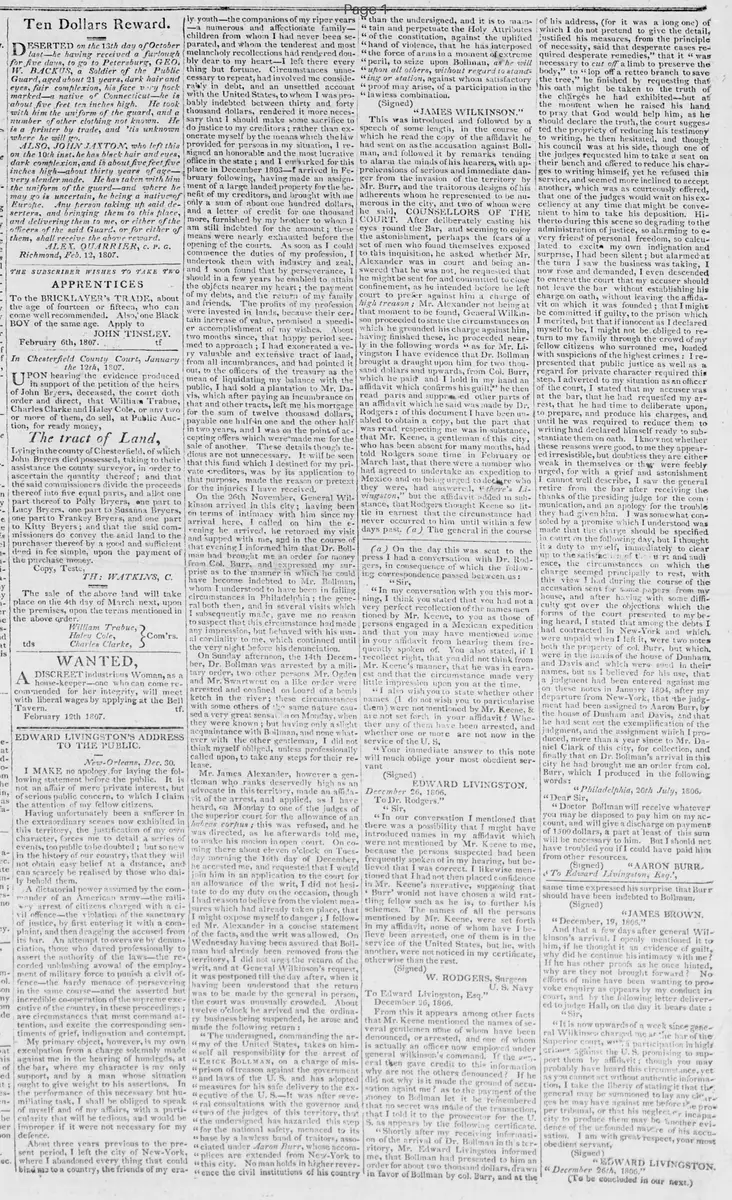
New-Orleans, Dec. 30.
I MAKE no apology for laying the following statement before the public. It is not an affair of mere private interest, but of serious public concern, to which I claim the attention of my fellow citizens.
Having unfortunately been a sufferer in the extraordinary scenes now exhibited in this territory, the justification of my own character, forces me to detail a series of events, too public to be doubted; but so new in the history of our country, that they will not obtain easy belief at a distance, and can scarcely be realised by those who daily behold them.
A dictatorial power assumed by the commander of an American army--the military arrest of citizens charged with a civil offence--the violation of the sanctuary of justice, by first entering it with a complaint, and then dragging the accused from its bar. An attempt to overawe by denunciation, those who dared professionally to assert the authority of the laws--the recorded unblushing avowal of the employment of military force to punish a civil offence--the hardy menace of persevering in the same course--and the asserted but incredible co-operation of the supreme executive of the country, in these proceedings; are circumstances that must command attention, and excite the corresponding sentiments of grief, indignation and contempt.
My primary object, however, is my own exculpation from a charge solemnly made against me in the hearing of hundreds, at the bar, where my character is my only support, and by a man whose situation ought to give weight to his assertions. In the performance of this necessary but humiliating task, I shall be obliged to speak of myself and of my affairs, with a particularity that will be tedious, and would be improper if it were not necessary for my defence.
About three years previous to the present period, I left the city of New-York, where I abandoned every thing that could bind me to a country, the friends of my early youth--the companions of my riper years--a numerous and affectionate family--children from whom I had never been separated, and whom the tenderest and most melancholy recollections had rendered doubly dear to my heart--I left there every thing but fortune. Circumstances unnecessary to repeat, had involved me considerably in debt, and an unsettled account with the United States, to whom I was probably indebted between thirty and forty thousand dollars, rendered it more necessary that I should make some sacrifice to do justice to my creditors; rather than exonerate myself by the means which the law provided for persons in my situation, I resigned an honorable and the most lucrative office in the state; and I embarked for this place in December 1803--I arrived in February following, having made an assignment of a large landed property for the benefit of my creditors, and brought with me only a sum of about one hundred dollars, and a letter of credit for one thousand more, furnished by my brother to whom I am still indebted for the amount; these means were nearly exhausted before the opening of the courts. As soon as I could commence the duties of my profession, I undertook them with industry and zeal, and I soon found that by perseverance, I should in a few years be enabled to attain the objects nearer my heart; the payment of my debts, and the return of my family and friends. The profits of my profession were invested in lands, because their certain increase of value, promised a speedier accomplishment of my wishes. About two months since, that happy period seemed to approach; I had exonerated a very valuable and extensive tract of land, from all incumbrances, and had pointed it out, to the officers of the treasury as the mean of liquidating my balance with the public, I had sold a plantation to Mr. Davis, which after paying an incumbrance on that and other tracts, left me his mortgage for the sum of twelve thousand dollars, payable one half in one and the other half in two years, and I was on the point of accepting offers which were made me for the sale of another. These details though tedious are not unnecessary. It will be seen that this fund which I destined for my private creditors, was by its application to that purpose, made the reason or pretext for the injuries I have received.
On the 26th November. General Wilkinson arrived in this city; having been on terms of intimacy with him since my arrival here, I called on him the evening he arrived, he returned my visit and supped with me, and in the course of that evening I informed him that Dr. Bollman had brought me an order for money from Col. Burr, and expressed my surprise as to the manner in which he could have become indebted to Mr. Bollman, whom I understood to have been in failing circumstances in Philadelphia; the general both then, and in several visits which I subsequently made, gave me no reason to suspect that this circumstance had made any impression, but behaved with his usual cordiality to me, which continued until the very night before his denunciation.
On Sunday afternoon, the 14th December, Dr. Bollman was arrested by a military order, two other persons Mr. Ogden and Mr. Swartwout on a like order were arrested and confined on board of a bomb ketch in the river: these circumstances with some others of the same nature caused a very great sensation on Monday, when they were known; but having only a slight acquaintance with Bollman, and none whatever with the other gentleman, I did not think myself obliged, unless professionally called upon, to take any steps for their release.
Mr. James Alexander, however a gentleman who ranks deservedly high as an advocate in this territory, made an affidavit of the arrest, and applied, as I have heard, on Monday to one of the judges of the superior court for the allowance of an habeas corpus: this was refused, and he was directed, as he afterwards told me, to make his motion in open court. On coming there about eleven o'clock on Tuesday morning the 16th day of December, he accosted me, and requested that I would join him in an application to the court for an allowance of the writ, I did not hesitate to do my duty on the occasion, though I had reason to believe from the violent measures which had already taken place, that I might expose myself to danger; I followed Mr. Alexander in a concise statement of the facts, and the writ was allowed. On Wednesday having been assured that Bollman had already been removed from the territory, I did not urge the return of the writ, and at General Wilkinson's request, it was postponed till the day after, when it having been understood that the return was to be made by the general in person, the court was unusually crowded. About twelve o'clock he arrived and the ordinary business being suspended, he arose and made the following return:
"The undersigned, commanding the army of the United States, takes on himself all responsibility for the arrest of Erick Bollman, on a charge of misprison of treason against the government and laws of the U. S. and has adopted measures for his safe delivery to the executive of the U. S.--It was after several consultations with the governor and two of the judges of this territory, that the undersigned has hazarded this step for the national safety, menaced to its base by a lawless band of traitors, associated under Aaron Burr, whose accomplices are extended from New-York to this city. No man holds in higher reverence the civil institutions of his country than the undersigned, and it is to maintain and perpetuate the Holy Attributes of the constitution, against the uplifted hand of violence, that he has interposed the force of arms in a moment of extreme peril, to seize upon Bollman, as he will upon all others, without regard to standing or station, against whom satisfactory proof may arise, of a participation in the lawless combination."
(Signed) "JAMES WILKINSON."
This was introduced and followed by a speech of some length, in the course of which he read the copy of the affidavit he had sent on as the accusation against Bollman, and followed it by remarks tending to alarm the minds of his hearers, with apprehensions of serious and immediate danger from the invasion of the territory by Mr. Burr, and the traitorous designs of his adherents whom he represented to be numerous in the city, and two of whom were he said, COUNSELLORS OF THE COURT. After deliberately casting his eyes round the Bar, and seeming to enjoy the astonishment, perhaps the fears of a set of men who found themselves exposed to this inquisition, he asked whether Mr. Alexander was in court and being answered that he was not, he requested that he might be sent for and committed to close confinement, as he intended before he left court to prefer against him a charge of high treason; Mr. Alexander not being at that moment to be found, General Wilkinson proceeded to state the circumstances on which he grounded his charge against him, having finished these, he proceeded nearly in the following words "as for Mr. Livingston I have evidence that Dr. Bollman brought a draught upon him for two thousand dollars and upwards, from Col. Burr, which he paid and I hold in my hand an affidavit which confirms his guilt," he then read parts and suppressed other parts of an affidavit which he said was made by Dr. Rodgers: of this document I have been unable to obtain a copy, but the part that was read respecting me was in substance, that Mr. Keene, a gentleman of this city, who has been absent for many months, had told Rodgers some time in February or March last, that there were a number who had agreed to undertake an expedition to Mexico and on being urged to declare who they were, had answered, "there's Livingston," but the affidavit added in substance, that Rodgers thought Keene so little in earnest that the circumstance had never occurred to him until within a few days past. (a) The general in the course of his address, (for it was a long one) of which I do not pretend to give the detail, justified his measures, from the principle of necessity, said that desperate cases required desperate remedies," that it "was necessary to cut off a limb to preserve the body," to "lop off a rotten branch to save the tree," he finished by requesting that his oath might be taken to the truth of the charges he had exhibited--but at the moment when he raised his hand. to pray that God would help him, as he should declare the truth, the court suggested the propriety of reducing his testimony to writing, he then hesitated, and though his council was at his side, though one of the judges requested him to take a seat on their bench and offered to reduce his charges to writing himself, yet he refused this service, and seemed more inclined to accept another, which was as courteously offered, that one of the judges would wait on his excellency at any time that might be convenient to him to take his deposition. Hitherto during this scene so degrading to the administration of justice, so alarming to every friend of personal freedom, so calculated to excite my own indignation and surprise, I had been silent; but alarmed at the turn I saw the business was taking. I now rose and demanded, I even descended to entreat the court that my accuser should not leave the bar without establishing his charge on oath, without leaving the affidavit on which it was founded; that I might be committed if guilty, to the prison which I merited, but that if innocent as I declared myself to be, I might not be obliged to return to my family through the crowd of my fellow citizens who surrounded me, loaded with suspicions of the highest crimes: I represented that public justice as well as a regard for private character required this step, I adverted to my situation as an officer of the court, I stated that my accuser was at the bar, that he had requested my arrest, that he had time to deliberate upon, to prepare, and produce his charges, and until he was required to reduce them to writing had declared himself ready to substantiate them on oath. I know not whether these reasons were good, to me they appeared irresistible, but doubtless they are either weak in themselves or they were feebly urged, for with a grief and astonishment I cannot well describe, I saw the general retire from the bar after receiving the thanks of the presiding judge for the communication, and an apology for the trouble they had given him. I was somewhat consoled by a promise which I understood was made that the charge should be specified in court on the following day, but I thought it a duty to myself, immediately to clear up to the satisfaction of the court and audience, the circumstances on which the charge seemed principally to rest, with this view I had during the course of the accusation sent for some papers from my house, and after having with some difficulty got over the objections which the forms of the court presented to my being heard, I stated that among the debts I had contracted in New-York and which were unpaid when I left it, were two notes both the property of col. Burr. but which, were in the hands of the house of Dunham and Davis and which were sued in their names, but as I believed for his use, that a judgment had been entered against me on these notes in January 1804, after my departure from New-York, that the judgment had been assigned to Aaron Burr, by the house of Dunham and Davis, and that he had sent out the exemplification of the judgment, and the assignment which I produced, more than a year since to Mr. Daniel Clark of this city, for collection, and finally that on Dr. Bollman's arrival in this city he had brought me an order from col. Burr, which I produced in the following words:
"Philadelphia, 26th July, 1806.
"Dear Sir,
"Doctor Bollman will receive whatever you may be disposed to pay him on my account, and will give a discharge on payment of 1500 dollars, a part at least of this sum will be necessary to him. But I should not have troubled you if I could have paid him from other resources.
(Signed) "AARON BURR
To Edward Livingston, Esq."
And that a few days after general Wilkinson's arrival. I openly mentioned it to him, if he thought it an evidence of guilt, why did he continue his intimacy with me? If he has other proofs as he once hinted, why are they not brought forward? No efforts of mine have been wanting to provoke enquiry as appears by my conduct in court, and by the following letter delivered to judge Hall, on the day it bears date:
"Sir,
"It is now upwards of a week since general Wilkinson, charged me at the bar of the Superior court, with a participation in high crimes against the U. S. promising to support them by affidavit; though you may probably have heard this circumstance, yet as you cannot act without authentic information, I take the liberty of stating it that the general may be summoned to lay any charges he may have against me before proper tribunal, or that his neglect or incapacity to produce them may be further evidence of the unfounded nature of his accusation. I am with great respect, your most obedient servant,
(Signed) EDWARD LIVINGSTON.
December 26th, 1806."
(To be concluded in our next.)
What sub-type of article is it?
What themes does it cover?
What keywords are associated?
What entities or persons were involved?
Where did it happen?
Story Details
Key Persons
Location
New Orleans
Event Date
December 1806
Story Details
Edward Livingston recounts his move to New Orleans to pay debts, his professional success, and financial ties to Aaron Burr. He describes General Wilkinson's military arrests, courtroom accusation of Livingston's involvement in Burr's treason plot based on a payment to Bollman, and Wilkinson's refusal to swear to the charges, prompting Livingston's public defense.