Thank you for visiting SNEWPapers!
Sign up free
The New Hampshire Gazette
Portsmouth, Rockingham County, New Hampshire
What is this article about?
Diplomatic exchanges (1812-1813) reveal US acceptance of Russian Emperor Alexander's mediation offer to end War of 1812 with Britain, amid reports of British rejection and US affirmations of neutrality toward other powers like France and Russia. Key figures: Monroe, Adams, Romanzoff.
Merged-components note: Merged continuation of diplomatic correspondence on Russian mediation across pages 1 and 2, as the text flows sequentially in reading order.
Clippings
1 of 2
OCR Quality
Full Text
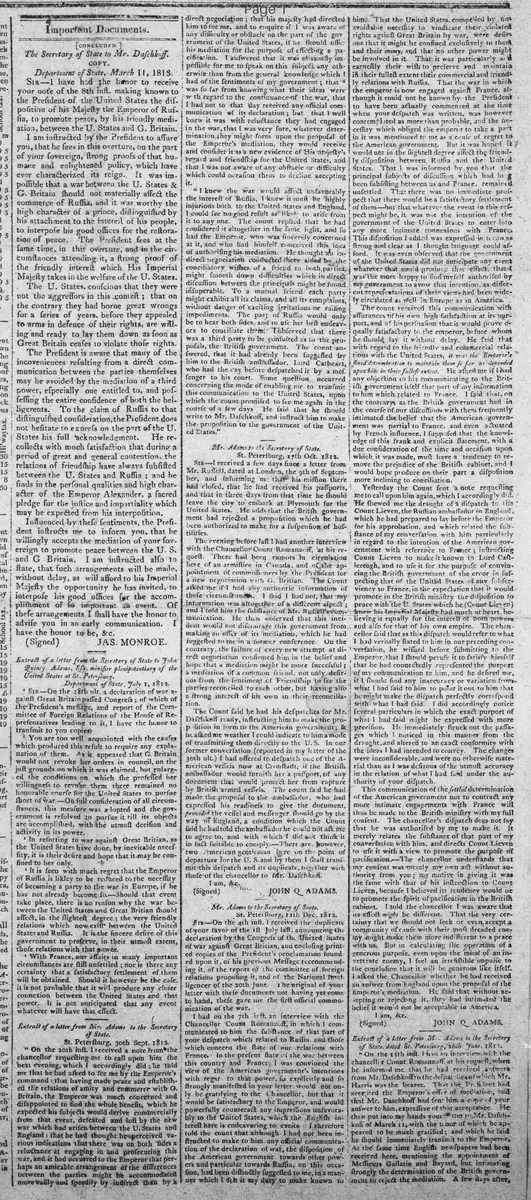
The Secretary of State to Mr. Daschkoff.
Department of State, March 11, 1813.
Sir—I have had the honor to receive your note of the 8th inst. making known to the President of the United States the disposition of his Majesty the Emperor of Russia, to promote peace, by his friendly mediation, between the U. States and G. Britain.
I am instructed by the President to assure you, that he sees in this overture, on the part of your sovereign, strong proofs of that humane and enlightened policy, which have ever characterized its reign. It was impossible that a war between the U. States & G. Britain should not materially affect the commerce of Russia, and it was worthy the high character of a prince, distinguished by his attachment to the interest of his people, to interpose his good offices for the restoration of peace. The President sees at the same time, in this overture, and in the circumstances attending it, a strong proof of the friendly interest which His Imperial Majesty takes in the welfare of the U. States.
The U. States, conscious that they were not the aggressors in this contest; that on the contrary they had borne great wrongs for a series of years, before they appealed to arms in defence of their rights, are willing and ready to lay them down as soon as Great Britain ceases to violate those rights.
The President is aware that many of the inconveniences resulting from a direct communication between the parties themselves may be avoided by the mediation of a third power, especially one entitled to, and possessing the entire confidence of both the belligerents. To the claim of Russia to that distinguished consideration, the President does not hesitate to express on the part of the U. States his full acknowledgment. He recollects with much satisfaction that during a period of great and general contention, the relations of friendship have always subsisted between the U. States and Russia: and he finds in the personal qualities and high character of the Emperor Alexander, a sacred pledge for the justice and impartiality which may be expected from his interposition.
Influenced by these sentiments, the President instructs me to inform you, that he willingly accepts the mediation of your sovereign to promote peace between the U. S. and G. Britain. I am instructed also to state, that such arrangements will be made, without delay, as will afford to his Imperial Majesty the opportunity he has invited, to interpose his good offices for the accomplishment of so important an event. Of these arrangements I shall have the honor to advise you in an early communication.
I have the honor to be, &c.
(Signed) JAS. MONROE.
Extract of a letter from the Secretary of State to John Quincy Adams, Esq. minister plenipotentiary of the United States at St. Petersburg.
Department of State, July 1, 1812.
SIR—On the 18th ult. a declaration of war against Great Britain passed Congress; of which the President's message, and report of the Committee of Foreign Relations of the House of Representatives leading to it, I have the honor to transmit to you copies.
You are too well acquainted with the causes which produced this result to require any explanation of them. As it appeared that G. Britain would not revoke her orders in council, on the just grounds on which it was claimed, but enlarged the conditions on which she professed her willingness to revoke them there remained no honorable course for the United States to pursue short of war.—On full consideration of all circumstances, this measure was adopted and the government is resolved to pursue it till its objects are accomplished, with the utmost decision and activity in its power.
In resorting to war against Great Britain, as the United States have done, by inevitable necessity, it is their desire and hope that it may be confined to her only.
It is seen with much regret that the Emperor of Russia is likely to be reduced to the necessity of becoming a party to the war in Europe, if he has not already become so.—Should that event take place, there is no reason why the war between the United States and Great Britain should affect, in the slightest degree, the very friendly relations which now exist between the United States and Russia. It is the sincere desire of this government to preserve, in their utmost extent, those relations with that power.
With France, our affairs in many important circumstances are still unsettled; nor is there any certainty that a satisfactory settlement of them will be obtained. Should it however be the case, it is not probable that it will produce any closer connexion between the United States and that power. It is not anticipated that any event whatever will have that effect.
Extract of a letter from Mr. Adams to the Secretary of State.
St. Petersburg, 30th Sept. 1812.
"On the 20th inst. I received a note from the chancellor requesting me to call upon him the next evening, which I accordingly did; he told me that he had asked to see me by the Emperor's command: that having made peace and established the relations of amity and commerce with G. Britain, the Emperor was much concerned and disappointed to find the whole benefit, which he expected his subjects would derive commercially from that event, defeated and lost by the new war which had arisen between the U. States and England: that he had thought he perceived various indications that there was on both sides a reluctance at engaging in and prosecuting this war, and it had occurred to the Emperor that perhaps an amicable arrangement of the differences between the parties might be accommodated more easily and speedily by indirect than by a direct negociation; that his majesty had directed him to see me, and to enquire if I was aware of any difficulty or obstacle on the part of the government of the United States, if he should offer his mediation for the purpose of effecting a pacification. I answered that it was obviously impossible for me to speak on this subject any otherwise than from the general knowledge which I had of the sentiments of my government; that I was so far from knowing what their ideas were with regard to the continuance of the war, that I had not to that day received any official communication of its declaration; but that I well knew it was with reluctance they had engaged in the war, that I was very sure, whatever determination they might form upon the proposal of the Emperor's mediation, they would receive and consider it as a new evidence of His majesty's regard and friendship for the United States, and that I was not aware of any obstacle or difficulty which could occasion them to decline accepting it.
"I knew the war would affect unfavorably the interest of Russia, I knew it must be highly injurious both to the United States and England. I could see no good result as likely to arise from it to any one. The count replied that he had considered it altogether in the same light, and so had the Emperor, who was sincerely concerned at it, and who had himself conceived this idea of authorizing his mediation. He thought an indirect negociation conducted there aided by the conciliatory wishes of a friend to both parties, might smooth down difficulties which in direct discussion between the principals might be found insuperable. To a mutual friend each party might exhibit all its claims, and all its complaints, without danger of exciting irritations or raising impediments. The part of Russia would only be to hear both sides, and to use her best endeavors to conciliate therein. I observed that there was a third party to be consulted as to the proposals, the British government. The count answered, that it had already been suggested by him to the British ambassador, Lord Cathcart, who had the day before despatched it by a messenger to his court. Some question occurred concerning the mode of enabling me to transmit this communication to the United States, upon which the count promised to see me again in the course of a few days He said that he should write to Mr. Daschkoff, and instruct him to make the proposition to the government of the United States."
Mr. Adams to the Secretary of State.
St. Petersburg, 17th Oct. 1812.
Sir—I received a few days since a letter from Mr. Russell, dated at London, the 9th of September, and informing me that his mission there had closed, that he had received his passports, and that in three days from that time he should leave the city to embark at Plymouth for the United States. He adds that the British government had rejected a proposition which he had been authorized to make for a suspension of hostilities.
The evening before last I had another interview with the Chancellor Count Romanzoff, at his request. There had been rumors in circulation here of an armistice in Canada, and of the appointment of commissioners by the President for a new negociation with G. Britain. The Count asked me if I had any authentic information of these circumstances. I said I had not, that my information was altogether of a different sort; and I told him the substance of Mr. Russell's communication. He then observed that this incident would not discourage this government from making an offer of its mediation, which he had suggested to me in a former conference. On the contrary, the failure of every new attempt at direct negociation confirmed him in the belief and hope that a mediation might be more successful; a mediation of a common friend, not only desirous from the sentiment of Friendship to see the parties reconciled to each other, but having also a strong interest of his own in their reconciliation.
The Count said he had his despatches for Mr. Daschkoff ready, instructing him to make the proposition in form to the American government; & he asked me whether I could indicate to him a mode of transmitting them directly to the U. S. In our former conversation (reported in my letter of the 30th ult.) I had offered to dispatch one of the American vessels now at Cronstadt, if the British ambassador would furnish her a passport, of any document that would protect her from capture by British armed vessels. The count said he had made the proposal to the ambassador, who had expressed his readiness to give the document, provided the vessel and messenger should go by the way of England, a condition which the Count said he had told the ambassador he could not ask me to agree to, and with which I did not think it in fact suitable to comply.—There are, however, two American gentlemen here on the point of departure for the U. S. and by them I shall transmit this despatch and its duplicate, together with those of the chancellor to Mr. Daschkoff.
I am, &c.
(Signed)
JOHN Q. ADAMS.
Mr. Adams to the Secretary of State.
St. Petersburg, 11th Dec. 1812.
Sir—On the 4th inst. I received the duplicate of your favor of the 1st July last, announcing the declaration by the Congress of the United States of war against Great Britain, and enclosing printed copies of the President's proclamation founded upon it, of his previous Message recommending it, of the report of the committee of foreign relations proposing it, and of the National Intelligencer of the 20th June. The original of your letter with these documents not having yet come to hand, these gave me the first official communication of the war.
I had on the 7th inst. an interview with the Chancellor Count Romanzoff, in which I communicated to him the substance of that part of your despatch which related to Russia, and those which concern the state of our relations with France.—In the present state of the war between this country and France, I was convinced the view of this American government's intentions with regard to that power, so explicitly and so strongly manifested in your letter, would not only be gratifying to the Chancellor, but that it would be satisfactory to the Emperor, and would powerfully counteract any impressions unfavorably to the United States, which the English interest here is endeavoring to excite. I therefore told the count that although I had not been instructed to make to him, any official communication of the declaration of war, the disposition of the American government towards other powers and particularly towards Russia, on this occasion, had been distinctly suggested to me, in a manner which I felt it my duty to make known to him. That the United States, compelled by unavoidable necessity to vindicate their violated rights against Great Britain by war, were desirous that it might be confined exclusively to them and their enemy, and that no other power might be involved in it. That it was particularly and earnestly their wish to preserve and maintain in their fullest extent their commercial and friendly relations with Russia. That the war in which the emperor is now engaged against France, although it could not be known by the President to have been actually commenced at the time when your despatch was written, was however contemplated as more than probable, and the necessity which obliged the emperor to take a part in it was mentioned to me as a cause of regret to the American government. But it was hoped it would not in the slightest degree affect the friendly disposition between Russia and the United States. That I was informed by you that the principal subjects of discussion which had so long been subsisting between us and France, remained unsettled. That there was no immediate prospect that there would be a satisfactory settlement of them—but that whatever the event in this respect might be, it was not the intention of the government of the United States to enter into any more intimate connexions with France. This disposition I added was expressed in terms as strong and clear as I thought language could afford. It was even observed that the government of the United States did not anticipate any event whatever that could produce that effect, that I was the more happy to find myself authorized by my government to avow that intention, as different representations of their views had been widely circulated as well in Europe as in America."
The count received this communication with assurances of his own high satisfaction at its purport, and of his persuasion that it would prove equally satisfactory to the emperor, before whom he should lay it without delay. He said that with regard to the friendly and commercial relations with the United States, it was the Emperor's fixed determination to maintain them so far as depended upon him in their fullest extent. He asked me if I had any objection to his communicating to the British government itself that part of my information to him which related to France. I said that, on the contrary as the British government had in the course of our discussions with them frequently intimated the belief that the American government was partial to France, and even actuated by French influence, I supposed that the knowledge of this frank and explicit statement, with a due consideration of the time and occasion upon which it was made, must have a tendency to remove the prejudice of the British cabinet, and I would hope produce on their part a disposition more inclining to conciliation.
Yesterday the Count sent a note requesting me to call upon him again, which I accordingly did. He shewed me the draught of a dispatch to the Count Lieven, the Russian ambassador in England, which he had prepared to lay before the Emperor for his approbation, and which related the substance of my conversation with him particularly in regard to the intention of the American government with reference to France; instructing Count Lieven to make it known to Lord Castlereagh, and to use it for the purpose of convincing the British government of the error in suspecting that of the United States of any subserviency to France, in the expectation that it would promote in the British ministry the disposition to peace with the U. States which he (Count Lieven) knew his Imperial Majesty had much at heart, believing it equally for the interest of both powers, and also for that of his own empire. The chancellor said that as this dispatch would refer to what I had verbally stated to him in our preceding conversation, he wished before submitting to the Emperor, that I should peruse it to satisfy himself that he had connectedly represented the purport of my communication to him, and he desired me, if I should find any inaccuracy or variation from what I had said to him, to point it out to him that he might make the dispatch perfectly correspond with what I had said. I did accordingly notice several particulars in which the exact purport of what I had said might be expressed with more precision. He immediately struck out the passages which I noticed in this manner from the draught, and altered to an exact conformity with the ideas I had intended to convey. The changes were inconsiderable, and were no otherwise material than as I was desirous of the utmost accuracy in the relation of what I had said under the authority of your dispatch.
This communication of the settled determination of the American government not to contract any more intimate engagements with France will thus be made to the British ministry with my full consent. The chancellor's dispatch does not say that he was authorized by me to make it. It merely relates the substance of that part of my conversation with him, and directs Count Lieven to use it with a view to promote the purpose of pacification.—The chancellor understands that my consent was merely my own act without authority from you; my motive in giving it was the same with that of his instruction to Count Lieven, because I believed its tendency would be to promote the spirit of pacification in the British cabinet. I told the chancellor I was aware that its effect might be different. That the very certainty that we should not seek or even accept a community of cause with their most dreaded enemy might make them more indifferent to a peace with us. But in calculating this operation of a generous purpose, even upon the mind of an inveterate enemy, I feel an irresistible impulse to the conclusion that it will be generous like itself.
I asked the Chancellor whether he had received an answer from England upon the proposal of the Emperor's mediation. He said that without accepting or rejecting it, they had intimated the belief it would not be acceptable in America.
I am, &c.
(Signed)
JOHN Q. ADAMS.
Extract of a letter from Mr. Adams to the Secretary of State, dated St. Petersburg, 26th June, 1813.
"On the 19th inst. I had an interview with the chancellor Count Romanzoff, at his request, when he informed me that he had received answers from Mr. Daschkoff to the despatches of which Mr. Harris was the bearer. That the President had accepted the Emperor's offer of mediation, and that Mr. Daschkoff had sent him a copy of your answer to him, expressive of that acceptance. He then put into my hands your letter to Mr. Daschkoff of March 11, with the tenor of which he appeared to be much gratified; and which he said he should immediately transmit to the Emperor. At the same time English newspapers had been received here, mentioning the appointment of Messieurs Gallatin and Bayard, but intimating strongly the determination of the British government to reject the mediation. A few days after,
I received from a friend the National Intelligencer of 15th April, containing an editorial paragraph concerning the appointments of those gentlemen, which I communicated to the count on the 22d. I observed to him, that however the British government might think proper to act on this occasion, that of the United States would at least have manifested, in a signal manner, at once its earnest and constant desire for a just and honorable peace, and its sense of the motives which had induced the Emperor's offer. That the President could not have adopted a measure better adapted to do honor to his Majesty's proposal than by the appointment of two persons among the most distinguished of our citizens, to co-operate on the part of the United States, in accomplishing the Emperor's friendly and benevolent purpose; and that if it should eventually fail of being successful, at least the true and only source of its failure would be known. The count had received, since he saw me last, dispatches from Count Lieven. That the British minister in terms of much politeness had intimated to him, that there was no sovereign whose mediation they should more readily accept than that of the Emperor, but that their differences with the United States were of a nature involving principles of the internal government of the British nation, and which it was thought were not susceptible of being committed to the discussion of any mediation. The count added, that it would remain to be considered, whether after this, and after the solemn step taken by the government of the U. States, it would be advisable to renew the offer to the British ministry, and give them an opportunity for a reconsideration. It was possible that further reflection might lead to a different resolution, and he should submit the question to the Emperor's determination. Different circumstances furnished other materials for deliberations.
What sub-type of article is it?
What keywords are associated?
What entities or persons were involved?
Where did it happen?
Foreign News Details
Primary Location
St. Petersburg
Event Date
From July 1, 1812 To June 26, 1813
Key Persons
Outcome
united states accepts emperor of russia's offer of mediation to promote peace with great britain; british government indicates likely rejection of mediation.
Event Details
Diplomatic correspondence details Russia's offer of mediation between the United States and Great Britain during the War of 1812. Secretary of State James Monroe accepts the mediation on March 11, 1813. Letters from John Quincy Adams in St. Petersburg report discussions with Chancellor Count Romanzoff on the proposal, US desire to limit war to Britain, and efforts to communicate intentions regarding France to counter British suspicions. British responses suggest reluctance to accept mediation.