Thank you for visiting SNEWPapers!
Sign up free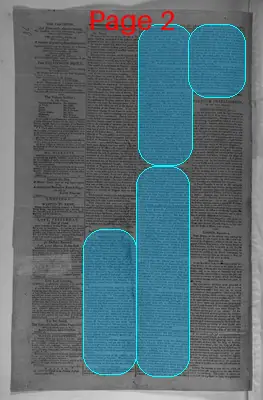
Gazette Of The United States, & Philadelphia Daily Advertiser
Philadelphia, Philadelphia County, Pennsylvania
What is this article about?
Phocion No. VIII defends John Adams' advocacy for checks and balances against Jacobin critics, quoting Jefferson's similar early views in Notes on Virginia and highlighting his inconsistencies. Refutes 'Hampden's' false claims about Adams' Senate votes and praises Adams' republicanism.
Merged-components note: Sequential components forming a single continuous editorial article 'PHOCION-No. VIII'; text flows directly from one to the next across adjacent bounding boxes in reading order.
Clipping
OCR Quality
Full Text
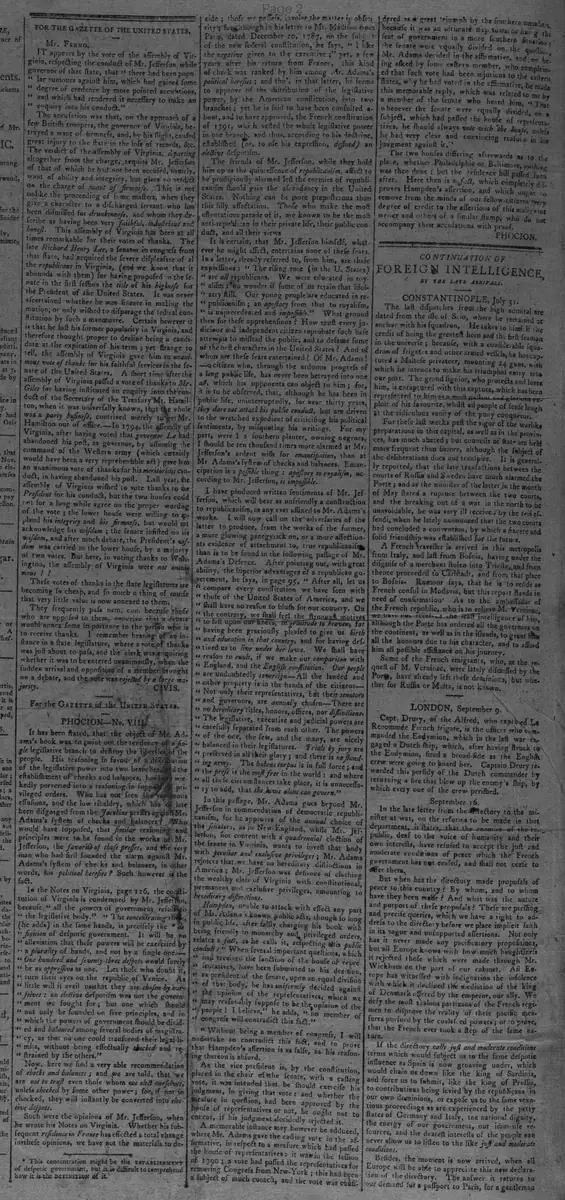
PHOCION-No. VIII
It has been stated, that the object of Mr. Adams's book was to point out the tendency of a single legislative branch to destroy the liberties of the people. His reasoning in favour of a distribution of the legislative power into two branches, and the establishment of checks and balances, has been wickedly perverted into a reasoning in support of privileged orders. Who has not seen the venomous effusions, and the low ribaldry, which has of late been disgorged from the Jacobine press against Mr. Adams's system of checks and balances? Who would have supposed, that similar reasoning and principles were to be found in the works of Mr. Jefferson, the favorite of those press, and the very man who had first sounded the alarm against Mr. Adams's system of checks and balances, in other words, his political heresies? Such however is the fact.
In the Notes on Virginia, page 126, the constitution of Virginia is condemned by Mr. Jefferson, because " all the powers of government result to the legislative body." " The concentrating the, (he adds) in the same hands, is precisely the definition of despotic government. It will be no alleviation that these powers will be exercised by a plurality of hands, and not by a single one. One hundred and seventy-three despots would surely be as oppressive as one. Let those who doubt it, turn their eyes on the republic of Venice. As little will it avail us that they are chosen by ourselves : an elective despotism was not the government we fought for; but one which should not only be founded on free principles, and in which the powers of government should be divided and balanced among several bodies of magistracy, as that no one could transcend their legal limits, without being effectually checked and restrained by the others."
Now, here we find a very able recommendation of checks and balances ; and we are told, that we are not to trust even those whom we elect ourselves, unless checked by some other power ; for, if not so checked, they will instantly be converted into elective despots.
Such were the opinions of Mr. Jefferson, when he wrote his Notes on Virginia. Whether his subsequent residence in France has effected a total change in these opinions, we have not the materials to decide ; those we pass, involve the matter in obscurity: for although in his letter to Mr. Madison from Paris, dated December 20, 1787, on the subject of the new federal constitution, he says, " I like the negative given to the executive ;" yet, a few years after his return from France, this kind of check was ranked by him among Mr. Adams's political heresies ; and tho', in that latter, he seems to approve of the distribution of the legislative power, by the American constitution, into two branches; yet he is said to have been consulted about, and to have approved, the French constitution of 1791, which vested the whole legislative power in one branch, and thus, according to his doctrine, established. (or, to use his expression, defined) an elective despotism.
The friends of Mr. Jefferson, while they hold him up as the quintessence of republicanism. affect to be prodigiously alarmed lest the enemies of republicanism should gain the ascendancy in the United States. Nothing can be more preposterous than this silly affectation. Those who make the most ostentatious parade of it, are known to be the most anti-republican in their private life, their public conduct, and all their views
It is certain, that Mr. Jefferson himself, whatever he might affect, entertains none of these fears. In a letter, already referred to, from him, are these expressions : " The rising race (in the U. States) are all republicans. We were educated in royalism : no wonder if some of us retain that idolatry still. Our young people are educated in republicanism; an apostacy from that to royalism, is unprecedented and impossible." What ground then for these apprehensions? How must every judicious and independent citizen reprobate such base attempts to mislead the public, and to defame some of the best characters in the United States? And of whom are these fears entertained? Of Mr. Adams! a citizen who, through the arduous progress of a long public life, has never been betrayed into one act, which his opponents can object to him; for, it is to be observed, that, although he has been in public life, uninterruptedly, for near thirty years, they dare not attack his public conduct, but are driven to the wretched expedient of criticizing his political sentiments, by misquoting his writings. For my part, were I a southern planter, owning negroes, I should be ten thousand times more alarmed at Mr. Jefferson's ardent wish for emancipation, than at Mr Adams's system of checks and balances. Emancipation is a possible thing : apostacy to royalism, according to Mr. Jefferson, is impossible.
I have produced written sentiments of Mr. Jefferson, which will bear as unfriendly a construction to republicanism, as any ever affixed to Mr. Adams's works. I will now call on the adversaries of the latter to produce, from the works of the former, a more glowing panegyrick on, or a more affectionate attachment to, true republicanism than is to be found in the following passage of Mr. Adams's Defence. After pointing out, with great ability, the superior advantages of a republican government, he says, in page 95, " After all, let us compare every constitution we have seen with those of the United States of America, and we shall have no reason to blush for our country. On the contrary, we shall feel the strongest motives to fall upon our knees, in gratitude to heaven, for having been graciously pleased to give us birth and education in that country, and for having destined us to live under her laws. We shall have reason to exult, if we make our comparison with England, and the English constitution. Our people are undoubtedly sovereign--All the landed and other property is in the hands of the citizens-- Not only their representatives, but their senators and governors, are annually chosen--There are no hereditary titles, honors, offices, nor distinctions. The legislative, executive and judicial powers are carefully separated from each other. The powers of the one, the few, and the many, are nicely balanced in their legislatures. Trials by jury are preserved in all their glory; and there is no standing army. The habeas corpus is in full force; and the press is the most free in the world : and where all these circumstances take place, it is unnecessary to add, that the laws alone can govern."
In this passage, Mr. Adams goes beyond Mr. Jefferson in commendation of democratic republicanism, for he approves of the annual choice of the senators, as in New-England, while Mr. Jefferson, not content with a quadrennial election of the senate in Virginia, wants to invest that body with peculiar and exclusive privileges; Mr. Adams rejoices that we have no hereditary distinctions in America; Mr. Jefferson was desirous of clothing the wealthy class of Virginia with constitutional, permanent and exclusive privileges, amounting to hereditary distinctions.
Hampden, unable to attack with effect any part of Mr. Adams's known public acts, though so long in public life, after falsely charging his book with being friendly to monarchy and privileged orders, relates a fact, as he calls it, respecting his public conduct : " When several important questions, which had received the sanction of the house of representatives, have been submitted to his decision, as president of the senate, upon an equal division of that body, he has uniformly decided against the opinion of the representatives, which we may reasonably suppose to be the opinion of the people! I believe," he adds, " no member of congress will contradict this fact."
Without being a member of congress, I will undertake to contradict this fact, and to prove that Hampden's assertion is as false, as his reasoning thereon is absurd.
As the vice president is, by the constitution, placed in the chair of the senate, with a casting vote, it was intended that he should exercise his judgment, in giving that vote: and whether the measure in question, had been approved by the house of representatives or not, he ought not to concur, if his judgment decidedly rejected it.
A memorable instance may however be adduced, where Mr. Adams gave the casting vote in the affirmative, in respect to a measure which had passed the house of representatives : it was in the session of 1790 ; a vote had passed the representatives for removing Congress from New-York ; this had been a subject of much contest, and the vote was challenged. Ordered as a great triumph by the southern members, because it was an ultimate step towards fixing the seat of government in a more southern situation: the senate were equally divided on the question, Mr. Adams decided in the affirmative, and on being asked by some eastern member, who complained that such vote had been injurious to the eastern states, why he had voted in the affirmative, he made this memorable reply, which was related to me by a member of the court who heard him, " That whenever the senate were equally divided, on a subject, which had passed the house of representatives, he should always vote with the house, unless he had very clear and convincing reasons in his judgment against it."
The two houses differing afterwards as to the place, whether Philadelphia or Baltimore, nothing was then done : but the residence bill passed soon after. Here then is a fact, which completely disproves Hampden's assertion, and which ought to remove from the minds of our fellow-citizens every degree of credit to the assertions of this malignant writer and others of a similar stamp, who do not accompany their accusations with proof.
PHOCION.
What sub-type of article is it?
What keywords are associated?
What entities or persons were involved?
Editorial Details
Primary Topic
Defense Of John Adams' Checks And Balances Against Jeffersonian Critics
Stance / Tone
Supportive Of Adams, Critical Of Jefferson And His Supporters
Key Figures
Key Arguments