Thank you for visiting SNEWPapers!
Sign up free
Indiana State Sentinel
Indianapolis, Marion County, Indiana
What is this article about?
In a 1846 Senate speech, Missouri's Mr. Benton concludes his argument on the Oregon question, tracing British claims to the Columbia River from 1816, emphasizing its commercial value, and highlighting the global benefits of U.S. Caucasian settlement there for civilizing Asia.
Clipping
OCR Quality
Full Text
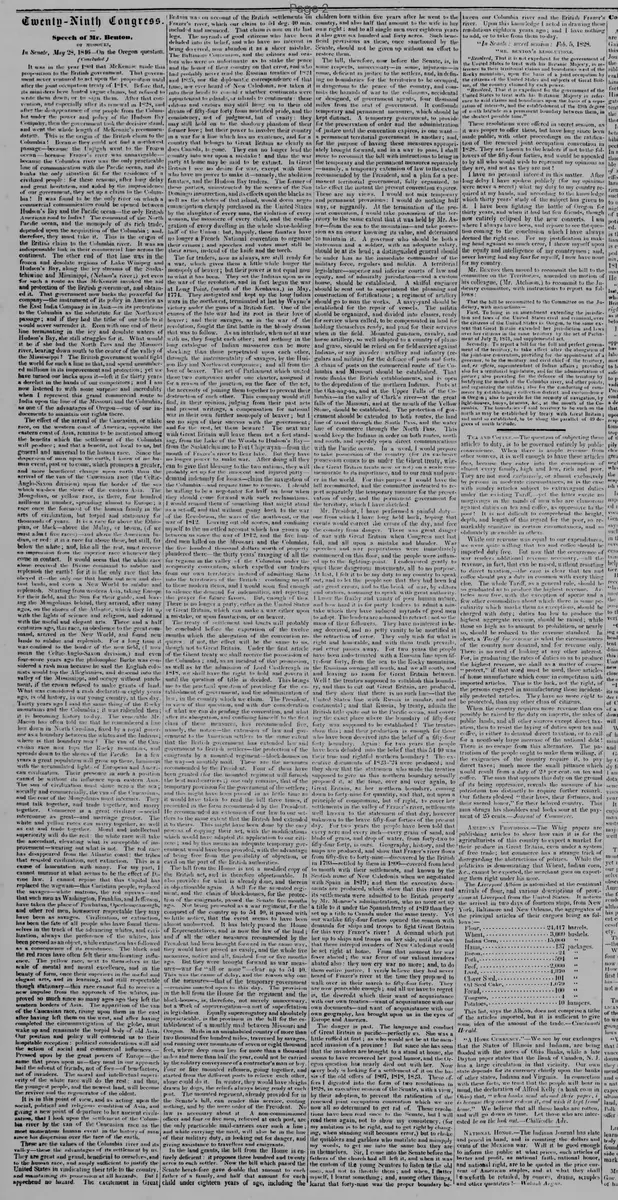
Speech of Mr. Benton,
OF MISSOURI,
In Senate, May 28, 1846—On the Oregon question.
(Concluded.)
It was in the year 1816 that McKenzie made this proposition to the British government. That government never ventured to act upon the proposition until after the joint occupation treaty of 1818. Before that, its ministers here hunted vague claims, but refused to write them down, or to sign them. After that convention, and especially after its renewal in 1827, and after the disappearance of our people from the Columbia under the power and policy of the Hudson Bay Company, then the government took the decisive stand, and went the whole length of McKenzie's recommendation. This is the origin of the British claim to the Columbia! Because they could not find a northwest passage—because the Union went to the Frozen ocean—because Frazer's river was unnavigable—because the Columbia river was the only practicable line of communication with the Pacific ocean, and its banks the only situation fit for the residence of a civilized people: for these reasons, after long delay and great hesitation, and aided by the improvidence of our government, they set up a claim to the Columbia! It was found to be the only river on which a commercial communication could be opened between Hudson's Bay and the Pacific ocean—the only British American road to India! The command of the North Pacific ocean, and the monopoly of its rich trade, depended upon the acquisition of the Columbia; and, therefore, they must take it. This is the origin of the British claim to the Columbia river. It was an indispensable link in their commercial line across the continent. The other end of that line was in the frozen and desolate regions of Lake Winnipeg and Hudson's Bay, along the icy streams of the Saskatchiwine and Missinippi, (Nelson's river;) yet even for such a route as this McKenzie invoked the aid and protection of the British government, and obtained it. That government now backs the powerful fur company—the instrument of its policy in America as the East India Company is in Asia—in its pretensions to the Columbia as the substitute for the Northwest passage; and if they had the tithe of our title to it would never surrender it. Even with one end of their line terminating in the icy and desolate waters of Hudson's Bay, she still struggles for it. What would it be if she had the North Pass and the Missouri river, bearing down south to the center of the valley of the Mississippi? The British government would fight the world for such a line as that, and spend unnumbered millions in its improvement and protection; yet we have turned our backs upon it—left it for thirty years a derelict in the hands of our competitors; and I am now listened to with some surprise and incredulity when I represent this grand commercial route to India upon the line of the Missouri and the Columbia, as one of the advantages of Oregon—one of our inducements to maintain our rights there.
The effect of the arrival of the Caucasian, or white race, on the western coast of America, opposite the eastern coast of Asia, remains to be mentioned among the benefits which the settlement of the Columbia will produce; and that a benefit, not local to us, but general and universal to the human race. Since the dispersion of man upon the earth, I know of no human event, past or to come, which promises a greater, and more beneficent change upon earth than the arrival of the van of the Caucasian race (the Celtic-Anglo-Saxon division) upon the border of the sea which washes the shore of eastern Asia. The Mongolian, or yellow race, is there, four hundred millions in number, spreading almost to Europe; a race once the foremost of the human family in the arts of civilization, but torpid and stationary for thousands of years. It is a race far above the Ethiopian, or black—above the Malay, or brown, (if we must admit five races)—and above the American Indian, or red: it is a race far above these, but still, far below the white; and, like all the rest, must receive an impression from the superior race whenever they come in contact. It would seem that the white race alone received the Divine command to subdue and replenish the earth! for it is the only race that has obeyed it—the only one that hunts out new and distant lands, and even a New World to subdue and replenish. Starting from western Asia, taking Europe for their field, and the Sun for their guide, and leaving the Mongolians behind, they arrived, after many ages, on the shores of the Atlantic, which they lit up, with the lights of science and religion, and adorned with the useful and elegant arts. Three and a half centuries ago, this race, in obedience to the great command, arrived in the New World, and found new lands to subdue and replenish. For a long time it was confined to the border of the new field, (I now mean the Celtic-Anglo-Saxon division.) and even four-score years ago the philosophic Burke was considered a rash man because he said the English colonists would top the Alleghanies, and descend into the valley of the Mississippi, and occupy without parchment, if the crown refused to make grants of land. What was considered a rash declaration eighty years ago, is old history, in our young country, at this day. Thirty years ago I said the same thing of the Rocky mountains and the Columbia; it was ridiculed then; it is becoming history to-day. The venerable Mr. Mason has often told me that he remembered a line low down in North Carolina, fixed by a royal governor as a boundary between the whites and the Indians: where is that boundary now? The van of the Caucasian race now tops the Rocky mountains, and spreads down to the shores of the Pacific. In a few years a great population will grow up there, luminous with the accumulated lights of European and American civilization. Their presence in such a position cannot be without its influence upon eastern Asia. The sun of civilization must shine across the sea; socially and commercially, the van of the Caucasians, and the rear of the Mongolians must intermingle. They must talk together, and trade together, and marry together. Commerce is a great civilizer—social intercourse as great—and marriage greater. The white and yellow races can marry together, as well as eat and trade together. Moral and intellectual superiority will do the rest: the white race will take the ascendant, elevating what is susceptible of improvement—wearing out what is not. The red race has disappeared from the Atlantic coast: the tribes that resisted civilization, met extinction. This is a cause of lamentation with many. For my part, I cannot murmur at what seems to be the effect of Divine law. I cannot repine that thus Capitol has replaced the wigwam—this Christian people, replaced the savages—white matrons, the red squaws—and that such men as Washington, Franklin, and Jefferson, have taken the place of Powhatan, Opechancanough, and other red men, howsoever respectable they may have been as savages. Civilization, or extinction, has been the fate of all people who have found themselves in the track of the advancing whites, and civilization, always the preference of the whites, has been pressed as an object, while extinction has followed as a consequence of its resistance. The black and the red races have often felt their ameliorating influence. The yellow race, next to themselves in the scale of mental and moral excellence, and in the beauty of form, once their superiors in the useful and elegant arts, and in learning, and still respectable though stationary—this race cannot fail to receive a new impulse from the approach of the whites, improved so much since so many ages ago they left the western borders of Asia. The apparition of the van of the Caucasian race, rising upon them in the east after having left them on the west, and after having completed the circumnavigation of the globe, must wake up and reanimate the torpid body of old Asia. Our position and policy will commend us to their hospitable reception: political considerations will aid the action of social and commercial influences.—Pressed upon by the great powers of Europe—the same that press upon us—they must hail the advent of friends, not of foes—of benefactors, not of invaders. The moral and intellectual superiority of the white race will do the rest: and thus, the youngest people, and the newest land, will become the reviver and the regenerator of the oldest.
It is in this point of view, and as acting upon the social, political and religious condition of Asia, and giving a new point of departure to her ancient civilization, that I look upon the settlement of the Columbia river by the van of the Caucasian race as the most momentous human event in the history of man since his dispersion over the face of the earth.
These are the values of the Columbia river and its valley—these the advantages of its settlement by us. They are great and grand, beneficial to ourselves, and to the human race, and amply sufficient to justify the United States in vindicating their title to the country, and maintaining its possession at all hazards. But I apprehend no hazard. The excitement in Great
What sub-type of article is it?
What themes does it cover?
What keywords are associated?
What entities or persons were involved?
Where did it happen?
Story Details
Key Persons
Location
Columbia River, Oregon, Pacific Ocean, Eastern Asia
Event Date
May 28, 1846
Story Details
Senator Benton argues for U.S. rights to Oregon by detailing British claims originating from 1816 proposals, highlighting the Columbia's commercial importance as a route to India, and extolling the civilizational benefits of white settlement influencing Asia through commerce, intermarriage, and moral superiority.