Thank you for visiting SNEWPapers!
Sign up free
The Rhode Island Republican
Newport, Newport County, Rhode Island
What is this article about?
Report on the Tammany Society's 1808 anniversary in Philadelphia, detailing its history inspired by Indian chief Tammany, role in republicanism, and General Leib's speech advocating liberty, democracy, and the embargo against war threats. (248 characters)
Clipping
OCR Quality
Full Text
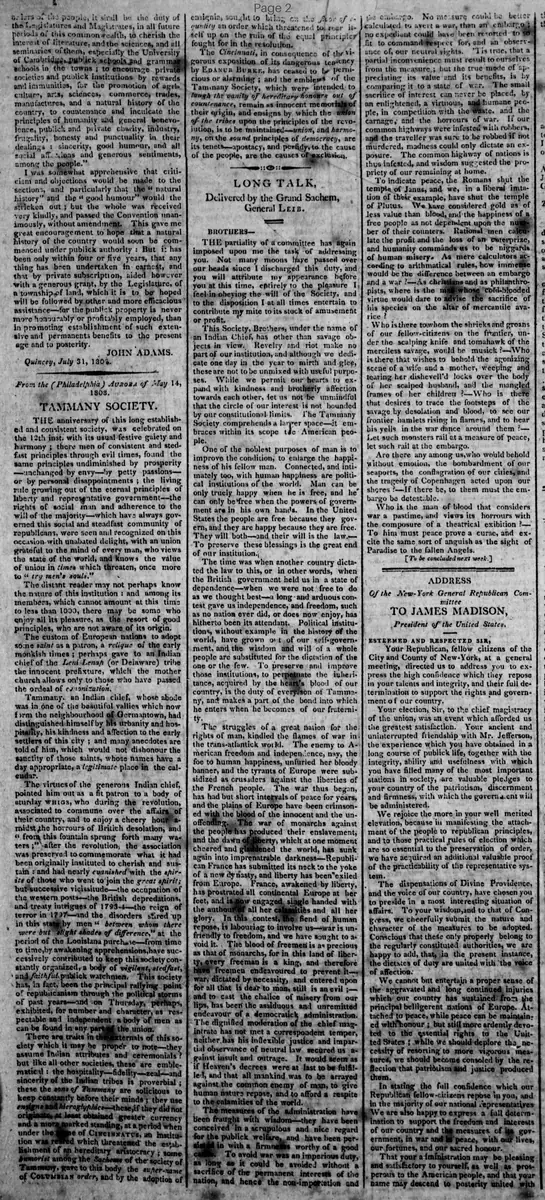
TAMMANY SOCIETY.
THE anniversary of this long established and consistent society, was celebrated on the 12th inst. with its usual festive gaiety and harmony; there men of consistent and steadfast principles through evil times, found the same principles undiminished by prosperity—unchanged by envy—by petty passions—or by personal disappointments; the living rule growing out of the eternal principles of liberty and representative government—the rights of social man and adherence to the will of the majority which has always governed this social and steadfast community of republicans, were seen and recognized on this occasion—with unabated delight, with an union grateful to the mind of every man, who views the state of the world, and knows the value of union in times which threaten, once more to "try men's souls."
The distant reader may not perhaps know the nature of this institution: and among its members, which cannot amount at this time to less than 100, there may be some who enjoy all its pleasure, as the resort of good principles, who are not aware of its origin. The custom of European nations to adopt some saint as a patron, a relique of the early monkish times; perhaps gave to an Indian chief of the Leni Lenape (or Delaware) tribe the innocent prefixture, which the mother church allows only to those who have passed the ordeal of canonization.
Tammany, an Indian chief, whose abode was in one of the beautiful vallies which now form the neighbourhood of Germantown, had distinguished himself by his urbanity and hospitality, his kindness and affection to the early settlers of this city; and many anecdotes are told of him, which would not dishonour the sanctity of those saints, whose names have a day appropriate, a legitimate place in the calendar.
The virtues of the generous Indian chief, pointed him out as a fit patron to a body of sturdy whigs, who during the revolution, associated to commune over the affairs of their country, and to enjoy a cheery hour amidst the horrours of British desolation, and "from this fountain sprung forth many waters;" after the revolution, the association was preserved to commemorate what it had been originally instituted to cherish and sustain: and had nearly vanished with the spirits of those who went to join the great spirit; but successive vicissitude—the occupation of the western posts—the British depredations, and treaty intrigues of 1793-4—the reign of terror in 1797—and the disorders stirred up in this state by men "between whom there were but slight shades of difference," at the period of the Louisiana purchase—from time to time, by awakening apprehensions, have successively contributed to keep this society constantly organized, a body of vigilant, steadfast, and faithful public watchmen. This society has, in fact, been the principal rallying point of republicanism through the political storms of past years and on Thursday, perhaps, exhibited, in number and character, as respectable and independent a body of men as can be found in any part of the union.
There are traits in the externals of this society which it may be proper to note—they assume Indian attributes and ceremonials; but like all other societies, these are emblematical: the hospitality—fidelity—zeal and sincerity of the Indian tribes is proverbial; these the sons of Tammany are solicitous to keep constantly before their minds; they use ensigns and hieroglyphics these, if they did not originate, at least obtained greater currency and a more marked standing, at a period when under the name of Cincinnatus, an institution was reared which threatened the establishment of an hereditary aristocracy; some humorist among the Sachems of the society of Tammany, gave to this body the super-name of Corybantian order, and by the adoption of insignia, sought to bring on the door af equality an order which threatened to rear itself up on the ruin of the equal principles fought for in the revolution.
The Cincinnati, in consequence of the vigorous exposition of its dangerous tendency by Edmund Burke, has ceased to be pernicious or alarming: and the emblems of the Tammany Society, which were intended to laugh the vanity of hereditary honours out of countenance, remain as innocent memorials of their origin, and ensigns by which the union of the tribes upon the principles of the revolution, is to be maintained—union, and harmony, on the sound principles of democracy, are its tenets—apostacy, and perfidy, to the cause of the people, are the causes of exclusion.
LONG TALK,
Delivered by the Grand Sachem,
General LEIB.
BROTHERS—
THE partiality of a committee has again imposed upon me the task of addressing you. Not many moons have passed over our heads since I discharged this duty, and you will attribute my appearance before you at this time, entirely to the pleasure I feel in obeying the will of the Society, and to the disposition I at all times entertain to contribute my mite to its stock of amusement or profit.
This Society, Brothers, under the name of an Indian Chief, has other than savage objects in view. Revelry and riot make no part of our institution, and although we dedicate one day in the year to mirth and glee, these are not to be unmixed with useful purposes. While we permit our hearts to expand with kindness and brotherly affection towards each other, let us not be unmindful that the circle of our interest is not bounded by our constitutional limits. The Tammany Society comprehends a larger space—it embraces within its scope the American people.
One of the noblest purposes of man is to improve the condition, to enlarge the happiness of his fellow man. Connected, and intimately too, with human happiness are political institutions of the world. Man can be only truly happy when he is free, and he can only be free when the powers of government are in his own hands. In the United States the people are free because they govern, and they are happy because they are free. They will both—and their will is the law.
To preserve these blessings is the great end of our institution.
The time was when another country dictated the law to this, or in other words, when the British government held us in a state of dependence—when we were not free to do as we thought best—a long and arduous contest gave us independence, and freedom, such as no nation ever did, or does now enjoy, has hitherto been its attendant. Political institutions, without example in the history of the world, have grown out of our self government, and the wisdom and will of a whole people are substituted for the dictation of the one or the few. To preserve and improve those institutions, to perpetuate the inheritance, acquired by the heart's blood of our country, is the duty of every son of Tammany, and makes a part of the bond into which he enters when he becomes of our fraternity.
The struggles of a great nation for the rights of man, kindled the flames of war in the trans-atlantic world. The enemy to American freedom and independence, now the foe to human happiness, unfurled her bloody banner, and the tyrants of Europe were subsidized as crusaders against the liberties of the French people. The war thus began, has had but short intervals of peace for years, and the plains of Europe have been crimsoned with the blood of the innocent and the unoffending. The war of monarchs against the people has produced their enslavement; and the dawn of liberty, which at one moment cheered and gladdened the world, has sunk again into impenetrable darkness—Republican France has submitted its neck to the yoke of a new dynasty, and liberty has been exiled from Europe. France, awakened by liberty, has prostrated all continental Europe at her feet, and is now engaged single handed with the author of all her calamities and all her glory. In this contest, the fiend of human repose, is labouring to involve us—war is unfriendly to freedom, and we have sought to avoid it. The blood of freemen is as precious as that of monarchs, for in this land of liberty, every freeman is a king, and therefore have freemen endeavoured to prevent it—war; dictated by necessity, and entered upon for all that is dear to man, still is an evil;—and to cast the chalice of misery from our lips, has been the assiduous and unremitted endeavour of a democratick administration.
The dignified moderation of the chief magistrate has not met a correspondent temper, neither has his inflexible justice and impartial observance of neutral law secured us against insult and outrage. It would seem as if Heaven's decrees were at last to be fulfilled, and that all mankind was to be arrayed against the common enemy of man, to give human nature repose, and to afford a respite to the calamities of the world.
The measures of the administration have been fraught with wisdom—they have been conceived in a scrupulous and nice regard for the public welfare, and have been persued in with a firmness worthy of a good cause. To avoid war was an imperious duty, as long as it could be avoided without a sacrifice of the permanent interests of the nation, and hence the non-importation and the embargo. No measure could be better calculated to avert a war, than an embargo; no expedient could have been resorted to so fit to command respect for, and an observance of, our neutral rights. 'Tis true, that a partial inconvenience must result to ourselves from the measure; but the true mode of appreciating its value and its benefits, is by comparing it to a state of war. The small sacrifice of interest can never be placed, by an enlightened, a virtuous, and humane people, in competition with the waste, and the carnage, and the horrours of war. If our common highways were infested with robbers, and the traveller was sure to be robbed if not murdered, madness could only dictate an exposure. The common highway of nations is thus infested, and wisdom suggested the propriety of our remaining at home.
To indicate peace, the Romans shut the temple of Janus, and we, in a liberal imitation of their example, have shut the temple of Plutus. We have considered gold as of less value than blood, and the happiness of a free people as not dependent upon the number of their counters. Rational men calculate the profit and the loss of an enterprize, and humanity commands us to be niggards of human misery. As mere calculators according to arithmetical rules, how immense would be the difference between an embargo and a war?—As christians and as philanthropists, where is the man whose cold-blooded virtue would dare to advise the sacrifice of his species on the altar of mercantile avarice?
Who is there to whom the shrieks and groans of our fellow-citizens on the frontier, under the scalping knife and tomahawk of the merciless savage, would be musick—Who is there that wishes to behold the agonizing scene of a wife and a mother, weeping and tearing her dishevelled locks over the body of her scalped husband, and the mangled remains of her children?—Who is there that desires to trace the footsteps of the savage by desolation and blood, to see our frontier hamlets rising in flames, and to hear his yells in the war canoe around them?
Let such monsters rail at a measure of peace, let such rail at the embargo.
Are there any among us, who would behold without emotion, the bombardment of our seaports, the conflagration of our cities, and the tragedy of Copenhagen acted upon our shores?—If there be, to them must the embargo be detestable.
Who is the man of blood that considers war a pastime, and views its horrours with the composure of a theatrical exhibition? To him must peace prove a curse, and excite the same sort of anguish as the sight of Paradise to the fallen Angels.
[To be concluded next week.]
What sub-type of article is it?
What themes does it cover?
What keywords are associated?
What entities or persons were involved?
Where did it happen?
Story Details
Key Persons
Location
Philadelphia, Neighborhood Of Germantown
Event Date
May 12, 1808
Story Details
The Tammany Society celebrated its anniversary on May 12, 1808, honoring its origins from an Indian chief's virtues and its role as a steadfast republican group through political storms. General Leib delivered a speech emphasizing preservation of American freedom, critique of European wars, and support for the embargo to avoid war.