Thank you for visiting SNEWPapers!
Sign up free
Story
September 16, 1846
Morning Star
Limerick, York County, Maine
What is this article about?
A visitor spends Sabbath, August 9, in Lowell, attending Unitarian and Mechanics Hall meetings where Brother Curtis preaches. Observes the large church's trials, critiques the choir mildly, and praises the city's Sabbath and weekday sobriety compared to Boston, noting orderly behavior among factory workers.
Clipping
OCR Quality
98%
Excellent
Full Text
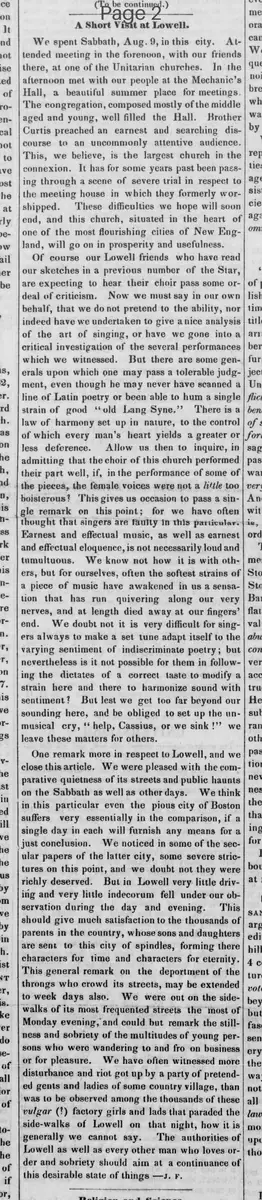
A Short Visit at Lowell.
We spent Sabbath, Aug. 9, in this city. Attended meeting in the forenoon, with our friends there, at one of the Unitarian churches. In the afternoon met with our people at the Mechanic's Hall, a beautiful summer place for meetings. The congregation, composed mostly of the middle aged and young, well filled the Hall. Brother Curtis preached an earnest and searching discourse to an uncommonly attentive audience.
This, we believe, is the largest church in the connexion. It has for some years past been passing through a scene of severe trial in respect to the meeting house in which they formerly worshipped. These difficulties we hope will soon end, and this church, situated in the heart of one of the most flourishing cities of New England, will go on in prosperity and usefulness.
Of course our Lowell friends who have read our sketches in a previous number of the Star, are expecting to hear their choir pass some ordeal of criticism. Now we must say in our own behalf, that we do not pretend to the ability, nor indeed have we undertaken to give a nice analysis of the art of singing, or have we gone into a critical investigation of the several performances which we witnessed. But there are some generals upon which one may pass a tolerable judgment, even though he may never have scanned a line of Latin poetry or been able to hum a single strain of good "old Lang Syne." There is a law of harmony set up in nature, to the control of which every man's heart yields a greater or less deference. Allow us then to inquire, in admitting that the choir of this church performed their part well, if, in the performance of some of the pieces, the female voices were not a little too boisterous? This gives us occasion to pass a single remark on this point; for we have often thought that singers are faulty in this particular. Earnest and effectual music, as well as earnest and effectual eloquence, is not necessarily loud and tumultuous. We know not how it is with others, but for ourselves, often the softest strains of a piece of music have awakened in us a sensation that has run quivering along our very nerves, and at length died away at our fingers end. We doubt not it is very difficult for singers always to make a set tune adapt itself to the varying sentiment of indiscriminate poetry; but nevertheless is it not possible for them in following the dictates of a correct taste to modify a strain here and there to harmonize sound with sentiment? But lest we get too far beyond our sounding here, and be obliged to set up the unmusical cry, "help, Cassius, or we sink!" we leave these matters for others.
One remark more in respect to Lowell, and we close this article. We were pleased with the comparative quietness of its streets and public haunts on the Sabbath as well as other days. We think in this particular even the pious city of Boston suffers very essentially in the comparison, if a single day in each will furnish any means for a just conclusion. We noticed in some of the secular papers of the latter city, some severe strictures on this point, and we doubt not they were richly deserved. But in Lowell very little driving and very little indecorum fell under our observation during the day and evening. This should give much satisfaction to the thousands of parents in the country, whose sons and daughters are sent to this city of spindles, forming there characters for time and characters for eternity.
This general remark on the deportment of the throngs who crowd its streets, may be extended to week days also. We were out on the side-walks of its most frequented streets the most of Monday evening, and could but remark the stillness and sobriety of the multitudes of young persons who were wandering to and fro on business or for pleasure. We have often witnessed more disturbance and riot got up by a party of pretended gents and ladies of some country village, than was to be observed among the thousands of these vulgar (?) factory girls and lads that paraded the side-walks of Lowell on that night, how it is generally we cannot say. The authorities of Lowell as well as every other man who loves order and sobriety should aim at a continuance of this desirable state of things.—J. F.
We spent Sabbath, Aug. 9, in this city. Attended meeting in the forenoon, with our friends there, at one of the Unitarian churches. In the afternoon met with our people at the Mechanic's Hall, a beautiful summer place for meetings. The congregation, composed mostly of the middle aged and young, well filled the Hall. Brother Curtis preached an earnest and searching discourse to an uncommonly attentive audience.
This, we believe, is the largest church in the connexion. It has for some years past been passing through a scene of severe trial in respect to the meeting house in which they formerly worshipped. These difficulties we hope will soon end, and this church, situated in the heart of one of the most flourishing cities of New England, will go on in prosperity and usefulness.
Of course our Lowell friends who have read our sketches in a previous number of the Star, are expecting to hear their choir pass some ordeal of criticism. Now we must say in our own behalf, that we do not pretend to the ability, nor indeed have we undertaken to give a nice analysis of the art of singing, or have we gone into a critical investigation of the several performances which we witnessed. But there are some generals upon which one may pass a tolerable judgment, even though he may never have scanned a line of Latin poetry or been able to hum a single strain of good "old Lang Syne." There is a law of harmony set up in nature, to the control of which every man's heart yields a greater or less deference. Allow us then to inquire, in admitting that the choir of this church performed their part well, if, in the performance of some of the pieces, the female voices were not a little too boisterous? This gives us occasion to pass a single remark on this point; for we have often thought that singers are faulty in this particular. Earnest and effectual music, as well as earnest and effectual eloquence, is not necessarily loud and tumultuous. We know not how it is with others, but for ourselves, often the softest strains of a piece of music have awakened in us a sensation that has run quivering along our very nerves, and at length died away at our fingers end. We doubt not it is very difficult for singers always to make a set tune adapt itself to the varying sentiment of indiscriminate poetry; but nevertheless is it not possible for them in following the dictates of a correct taste to modify a strain here and there to harmonize sound with sentiment? But lest we get too far beyond our sounding here, and be obliged to set up the unmusical cry, "help, Cassius, or we sink!" we leave these matters for others.
One remark more in respect to Lowell, and we close this article. We were pleased with the comparative quietness of its streets and public haunts on the Sabbath as well as other days. We think in this particular even the pious city of Boston suffers very essentially in the comparison, if a single day in each will furnish any means for a just conclusion. We noticed in some of the secular papers of the latter city, some severe strictures on this point, and we doubt not they were richly deserved. But in Lowell very little driving and very little indecorum fell under our observation during the day and evening. This should give much satisfaction to the thousands of parents in the country, whose sons and daughters are sent to this city of spindles, forming there characters for time and characters for eternity.
This general remark on the deportment of the throngs who crowd its streets, may be extended to week days also. We were out on the side-walks of its most frequented streets the most of Monday evening, and could but remark the stillness and sobriety of the multitudes of young persons who were wandering to and fro on business or for pleasure. We have often witnessed more disturbance and riot got up by a party of pretended gents and ladies of some country village, than was to be observed among the thousands of these vulgar (?) factory girls and lads that paraded the side-walks of Lowell on that night, how it is generally we cannot say. The authorities of Lowell as well as every other man who loves order and sobriety should aim at a continuance of this desirable state of things.—J. F.
What sub-type of article is it?
Journey
Biography
Historical Event
What themes does it cover?
Social Manners
Moral Virtue
What keywords are associated?
Lowell Visit
Sabbath Meeting
Church Choir
City Sobriety
Factory Workers
What entities or persons were involved?
Brother Curtis
J. F.
Where did it happen?
Lowell
Story Details
Key Persons
Brother Curtis
J. F.
Location
Lowell
Event Date
Sabbath, Aug. 9
Story Details
Visitors attend religious meetings in Lowell, hear Brother Curtis preach, note church trials and choir performance, and observe the city's orderly Sabbath and weekday behavior among factory workers, contrasting it favorably with Boston.