Thank you for visiting SNEWPapers!
Sign up free
Editorial
February 24, 1858
Weekly North Carolina Standard
Raleigh, Wake County, North Carolina
What is this article about?
Editorial defends the author's consistent Democratic loyalty against attacks by Mr. McRae, who prioritizes public lands over slavery and criticizes the author's 1840 stance. Critiques McRae's opportunism, federal offices, and silence on Kansas-Lecompton issue amid partisan rivalries.
Clipping
OCR Quality
98%
Excellent
Full Text
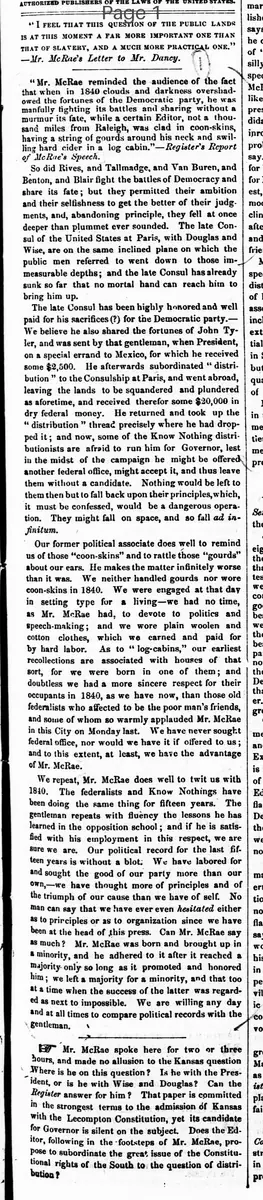
"I FEEL THAT THIS QUESTION OF THE PUBLIC LANDS
IS AT THIS MOMENT A FAR MORE IMPORTANT ONE THAN
THAT OF SLAVERY, AND A MUCH MORE PRACTICAL ONE."
—Mr. McRae's Letter to Mr. Dancy.
"Mr. McRae reminded the audience of the fact
that when in 1840 clouds and darkness overshadowed
the fortunes of the Democratic party, he was
manfully fighting its battles and sharing without a
murmur its fate, while a certain Editor, not a thousand
miles from Raleigh, was clad in coon-skins,
having a string of gourds around his neck and swilling
hard cider in a log cabin."—Register's Report
of McRae's Speech.
So did Rives, and Tallmadge, and Van Buren, and
Benton, and Blair fight the battles of Democracy and
share its fate; but they permitted their ambition
and their selfishness to get the better of their judgment,
and, abandoning principle, they fell at once
deeper than plummet ever sounded. The late Consul
of the United States at Paris, with Douglas and
Wise, are on the same inclined plane on which the
public men referred to went down to those immeasurable
depths; and the late Consul has already
sunk so far that no mortal hand can reach him to
bring him up.
The late Consul has been highly honored and well
paid for his sacrifices (?) for the Democratic party.
We believe he also shared the fortunes of John Tyler:
and was sent by that gentleman, when President,
on a special errand to Mexico, for which he received
some $2,500. He afterwards subordinated "distribution"
to the Consulship at Paris, and went abroad,
leaving the lands to be squandered and plundered
as aforetime, and received therefor some $20,000 in
pure federal money. He returned and took up the
"distribution" thread precisely where he had dropped
it: and now, some of the Know Nothing distributionists
are afraid to run him for Governor, lest
in the midst of the campaign he might be offered
another federal office, might accept it, and thus leave
them without a candidate. Nothing would be left to
them then but to fall back upon their principles, which,
it must be confessed, would be a dangerous operation.
They might fall on space, and so fall ad infinitum.
Our former political associate does well to remind
us of those "coon-skins" and to rattle those "gourds"
about our ears. He makes the matter infinitely worse
than it was. We neither handled gourds nor wore
coon-skins in 1840. We were engaged at that day
in setting type for a living—we had no time,
as Mr. McRae had, to devote to politics and
speech-making: and we wore plain woolen and
cotton clothes, which we earned and paid for
by hard labor. As to "log-cabins," our earliest
recollections are associated with houses of that
sort, for we were born in one of them; and
doubtless we had a more sincere respect for their
occupants in 1840, as we have now, than those old
federalists who affected to be the poor man's friends,
and some of whom so warmly applauded Mr. McRae
in this City on Monday last. We have never sought
federal office, nor would we have it if offered to us;
and to this extent, at least, we have the advantage
of Mr. McRae.
We repeat, Mr. McRae does well to twit us with
1840. The federalists and Know Nothings have
been doing the same thing for fifteen years. The
gentleman repeats with fluency the lessons he has
learned in the opposition school; and if he is satisfied
with his employment in this respect, we are
sure we are. Our political record for the last fifteen
years is without a blot: We have labored for
and sought the good of our party more than our
own,—we have thought more of principles and of
the triumph of our cause than we have of self. No
man can say that we have ever even hesitated either
as to principles or as to organization since we have
been at the head of this press. Can Mr. McRae say
as much? Mr. McRae was born and brought up in
a minority, and he adhered to it after it reached a
majority—only so long as it promoted and honored
him; we left a majority for a minority, and that too
at a time when the success of the latter was regarded
as next to impossible. We are willing any day
and at all times to compare political records with the
gentleman.
Mr. McRae spoke here for two or three
hours, and made no allusion to the Kansas question.
Where is he on this question? Is he with the President,
or is he with Wise and Douglas? Can the
Register answer for him? That paper is committed
in the strongest terms to the admission of Kansas
with the Lecompton Constitution, yet its candidate
for Governor is silent on the subject. Does the Editor,
following in the footsteps of Mr. McRae, propose
to subordinate the great issue of the Constitutional
rights of the South to the question of distribution?
IS AT THIS MOMENT A FAR MORE IMPORTANT ONE THAN
THAT OF SLAVERY, AND A MUCH MORE PRACTICAL ONE."
—Mr. McRae's Letter to Mr. Dancy.
"Mr. McRae reminded the audience of the fact
that when in 1840 clouds and darkness overshadowed
the fortunes of the Democratic party, he was
manfully fighting its battles and sharing without a
murmur its fate, while a certain Editor, not a thousand
miles from Raleigh, was clad in coon-skins,
having a string of gourds around his neck and swilling
hard cider in a log cabin."—Register's Report
of McRae's Speech.
So did Rives, and Tallmadge, and Van Buren, and
Benton, and Blair fight the battles of Democracy and
share its fate; but they permitted their ambition
and their selfishness to get the better of their judgment,
and, abandoning principle, they fell at once
deeper than plummet ever sounded. The late Consul
of the United States at Paris, with Douglas and
Wise, are on the same inclined plane on which the
public men referred to went down to those immeasurable
depths; and the late Consul has already
sunk so far that no mortal hand can reach him to
bring him up.
The late Consul has been highly honored and well
paid for his sacrifices (?) for the Democratic party.
We believe he also shared the fortunes of John Tyler:
and was sent by that gentleman, when President,
on a special errand to Mexico, for which he received
some $2,500. He afterwards subordinated "distribution"
to the Consulship at Paris, and went abroad,
leaving the lands to be squandered and plundered
as aforetime, and received therefor some $20,000 in
pure federal money. He returned and took up the
"distribution" thread precisely where he had dropped
it: and now, some of the Know Nothing distributionists
are afraid to run him for Governor, lest
in the midst of the campaign he might be offered
another federal office, might accept it, and thus leave
them without a candidate. Nothing would be left to
them then but to fall back upon their principles, which,
it must be confessed, would be a dangerous operation.
They might fall on space, and so fall ad infinitum.
Our former political associate does well to remind
us of those "coon-skins" and to rattle those "gourds"
about our ears. He makes the matter infinitely worse
than it was. We neither handled gourds nor wore
coon-skins in 1840. We were engaged at that day
in setting type for a living—we had no time,
as Mr. McRae had, to devote to politics and
speech-making: and we wore plain woolen and
cotton clothes, which we earned and paid for
by hard labor. As to "log-cabins," our earliest
recollections are associated with houses of that
sort, for we were born in one of them; and
doubtless we had a more sincere respect for their
occupants in 1840, as we have now, than those old
federalists who affected to be the poor man's friends,
and some of whom so warmly applauded Mr. McRae
in this City on Monday last. We have never sought
federal office, nor would we have it if offered to us;
and to this extent, at least, we have the advantage
of Mr. McRae.
We repeat, Mr. McRae does well to twit us with
1840. The federalists and Know Nothings have
been doing the same thing for fifteen years. The
gentleman repeats with fluency the lessons he has
learned in the opposition school; and if he is satisfied
with his employment in this respect, we are
sure we are. Our political record for the last fifteen
years is without a blot: We have labored for
and sought the good of our party more than our
own,—we have thought more of principles and of
the triumph of our cause than we have of self. No
man can say that we have ever even hesitated either
as to principles or as to organization since we have
been at the head of this press. Can Mr. McRae say
as much? Mr. McRae was born and brought up in
a minority, and he adhered to it after it reached a
majority—only so long as it promoted and honored
him; we left a majority for a minority, and that too
at a time when the success of the latter was regarded
as next to impossible. We are willing any day
and at all times to compare political records with the
gentleman.
Mr. McRae spoke here for two or three
hours, and made no allusion to the Kansas question.
Where is he on this question? Is he with the President,
or is he with Wise and Douglas? Can the
Register answer for him? That paper is committed
in the strongest terms to the admission of Kansas
with the Lecompton Constitution, yet its candidate
for Governor is silent on the subject. Does the Editor,
following in the footsteps of Mr. McRae, propose
to subordinate the great issue of the Constitutional
rights of the South to the question of distribution?
What sub-type of article is it?
Partisan Politics
Economic Policy
Slavery Abolition
What keywords are associated?
Public Lands
Democratic Party
Mcrae Speech
Kansas Question
Distribution
Know Nothings
Lecompton Constitution
What entities or persons were involved?
Mr. Mcrae
Mr. Dancy
Rives
Tallmadge
Van Buren
Benton
Blair
Douglas
Wise
John Tyler
President
Register's Editor
Know Nothings
Editorial Details
Primary Topic
Critique Of Mr. Mcrae's Political Record And Priorities On Public Lands Versus Slavery
Stance / Tone
Defensive Of Author's Democratic Loyalty And Critical Of Mcrae's Opportunism
Key Figures
Mr. Mcrae
Mr. Dancy
Rives
Tallmadge
Van Buren
Benton
Blair
Douglas
Wise
John Tyler
President
Register's Editor
Know Nothings
Key Arguments
Mcrae Prioritizes Public Lands Over Slavery
Author's Unwavering Democratic Principles Versus Mcrae's Ambition Driven Shifts
Mcrae's History Of Accepting Federal Offices And Payments
Author Did Not Participate In 1840 Whig Symbols But Worked Honestly
Mcrae Silent On Kansas Question Despite Party's Commitment To Lecompton Constitution
Author Willing To Compare Political Records