Thank you for visiting SNEWPapers!
Sign up free
The National Intelligencer And Washington Advertiser
Washington, District Of Columbia
What is this article about?
Commentary on British Orders in Council of November 1807 restricting neutral trade in retaliation to French decrees, highlighting violations of neutral rights; criticizes Mr. Canning's speech denying US irritation; praises US impartial diplomacy and embargo as peaceful response to belligerents' aggressions.
Clipping
OCR Quality
Full Text
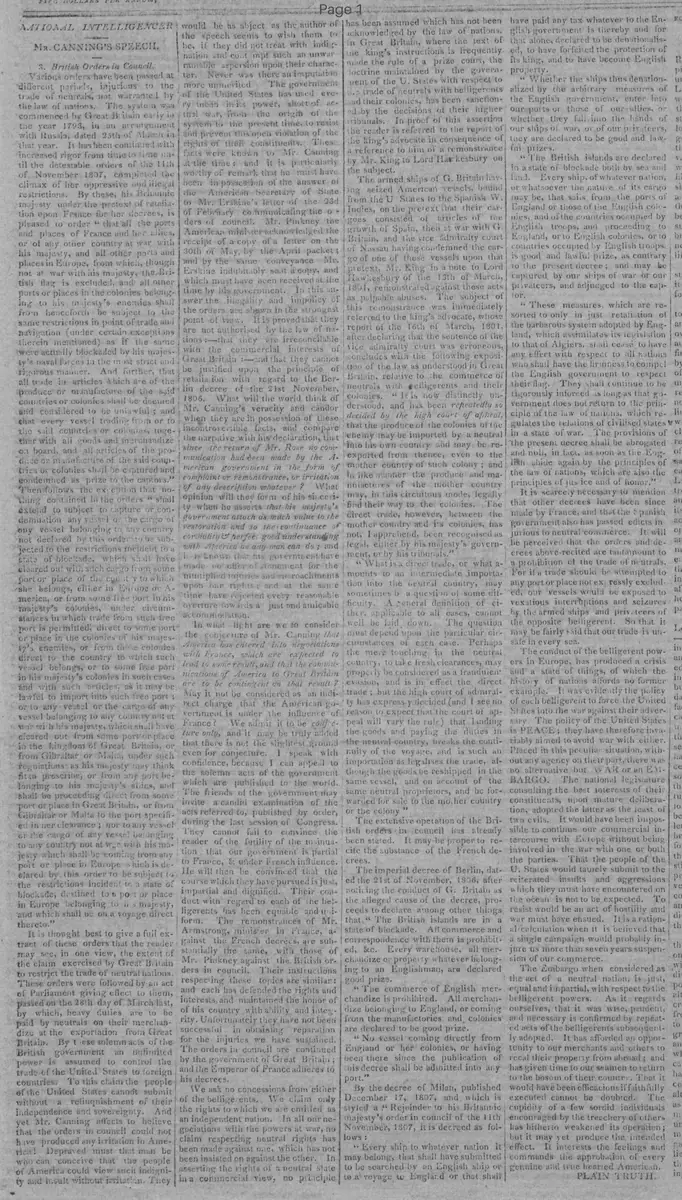
Mr. Canning's Speech,
3. British Orders in Council.
Various orders have been passed at different periods, injurious to the trade of neutrals, not warranted by the law of nations. The system was commenced by Great Britain early in the year 1793, in an arrangement with Russia, dated 25th of March in that year. It has been continued with increased rigor from time to time until the detestable orders of the 11th of November 1807, completed the climax of her oppressive and illegal restrictions. By these, his Britannic majesty under the pretext of retaliation upon France for her decrees, is pleased to order "that all the ports and places of France and her allies, or of any other country at war with his majesty, and all other ports and places in Europe, from which, though not at war with his majesty, the British flag is excluded, and all other ports or places in the colonies belonging to his majesty's enemies shall from henceforth be subject to the same restrictions in point of trade and navigation (under certain exceptions therein mentioned) as if the same were actually blockaded by his majesty's naval forces in the most strict and rigorous manner. And farther, that all trade in articles which are of the produce or manufacture of the said countries or colonies shall be deemed and considered to be unlawful; and that every vessel trading from or to the said countries or colonies, together with all goods and merchandise on board, and all articles of the produce or manufacture of the said countries or colonies shall be captured and condemned as prize to the captors."
Then follows the exception that nothing contained in the orders "shall extend to subject to capture or condemnation any vessel or the cargo of any vessel belonging to any country not declared by this order to be subjected to the restrictions incident to a state of blockade, which shall have cleared out with such cargo from some port or place of the country to which she belongs, either in Europe or America, or from some free port in his majesty's colonies, under circumstances in which trade from such free port is permitted; direct to some port or place in the colonies of his majesty's enemies, or from the colonies direct to the country to which such vessel belongs, or to some free port in his majesty's colonies in such cases and with such articles, as it may be lawful to import into such free port; or to any vessel or the cargo of any vessel belonging to any country not at war with his majesty, which shall have cleared out from some port or place in the Kingdom of Great Britain, or from Gibraltar or Malta, under such regulations as his majesty may think fit to prescribe, or from any port belonging to his majesty's allies, and shall be proceeding direct from some port or place in Great Britain, or from Gibraltar or Malta to the port specified in her clearance; nor to any vessel or the cargo of any vessel belonging to any country not at war with his majesty which shall be coming from any port or place in Europe which is declared by this order to be subject to the restrictions incident to a state of blockade, destined to a port or place in Europe belonging to his majesty, and which shall be on a voyage direct thereto."
It is thought best to give a full extract of these orders that the reader may see, in one view, the extent of the claim exercised by Great Britain to restrict the trade of neutral nations. These orders were followed by an act of Parliament giving effect to them, passed on the 28th day of March last, by which, heavy duties are to be paid by neutrals on their merchandise at the exportation from Great Britain. By these solemn acts of the British government an unlimited power is assumed to control the trade of the United States to foreign countries. To this claim the people of the United States cannot submit without a relinquishment of their independence and sovereignty. And yet Mr. Canning affects to believe that the orders in council could not have produced any irritation in America! Depraved must that man be who can conceive that the people of America could view such indignity and insult without irritation. They would be as abject as the author of the speech seems to wish them to be, if they did not treat with indignation and contempt such an unwarrantable aspersion upon their character. Never was there an imputation more unmerited. The government of the United States has used every means in its power, short of actual war, from the origin of the system to the present time, to resist and prevent this open violation of the rights of their constituents. These facts were known to Mr. Canning at the time: and it is particularly worthy of remark that he must have been in possession of the answer of the American Secretary of State to Mr. Erskine's letter of the 23d of February communicating the orders of council. Mr. Pinkney the American minister acknowledged the receipt of a copy of a letter on the 30th of May, by the April packet; and by the same conveyance Mr. Erskine indubitably sent a copy, and which must have been received at the time by his government. In this answer the illegality and impolicy of the orders are shewn in the strongest point of view. It is proved that they are not authorised by the law of nations:--that they are irreconcilable with the commercial interests of Great Britain:--and that they cannot be justified upon the principle of retaliation with regard to the Berlin decree of the 21st November, 1806. What will the world think of Mr. Canning's veracity and candor when they are in possession of these incontrovertible facts, and compare the narrative with his declaration, that since the return of Mr. Rose no communication had been made by the American government in the form of complaint or remonstrance, or irritation of any description whatever? What opinion will they form of his sincerity when he asserts that his majesty's government attach as much value to the restoration and to the continuance of cordiality between good understanding with America as any man can do; and it is known that his government have made no offer of atonement for the multiplied injuries and encroachments upon our rights; and at the same time have rejected every reasonable overture towards a just and amicable accommodation.
In what light are we to consider the conjecture of Mr. Canning that America has entered into negotiations with France, which are expected to lead to some result, and that the communications of America to Great Britain are to be contingent on that result? May it not be considered as an indirect charge that the American government is under the influence of France? We admit it to be conjecture only, and it may be truly added that there is not the slightest ground even for conjecture. I speak with confidence, because I can appeal to the solemn acts of the government which are published to the world. The friends of the government may invite a candid examination of the acts referred to, published by order, during the last session of Congress. They cannot fail to convince the reader of the futility of the insinuation that our government is partial to France, & under French influence. He will then be convinced that the course which they have pursued is just, impartial and dignified. Their conduct with regard to each of the belligerents has been equable and uniform. The remonstrances of Mr. Armstrong, minister in France, against the French decrees, are substantially the same, with those of Mr. Pinkney against the British orders in council. Their instructions respecting these topics are similar: and each has defended the rights and interests, and maintained the honor of his country with ability and integrity. Unfortunately they have not been successful in obtaining reparation for the injuries we have sustained. The orders in council are continued by the government of Great Britain; and the Emperor of France adheres to his decrees.
We ask no concessions from either of the belligerents. We claim only the rights to which we are entitled as an independent nation. In all our negotiations with the powers at war, no claim respecting neutral rights has been made against one, which has not been insisted on against the other. In asserting the rights of a neutral state in a commercial view, no principle has been assumed which has not been acknowledged by the law of nations. In Great Britain, where the text of the king's instructions is frequently made the rule of a prize court, the doctrine maintained by the government of the U. States with respect to the trade of neutrals with belligerents and their colonies, has been sanctioned by the decisions of their higher tribunals. In proof of this assertion the reader is referred to the report of the king's advocate in consequence of a reference to him of a remonstrance by Mr. King to Lord Hawkesbury on the subject.
The armed ships of G. Britain having seized American vessels, bound from the U States to the Spanish W. Indies, on the pretext that their cargoes consisted of articles of the growth of Spain, then at war with G. Britain, and the vice admiralty court of Nassau having condemned the cargo of one of these vessels upon that pretext, Mr. King in a note to Lord Hawkesbury of the 13th of March, 1801, remonstrated against these acts as palpable abuses. The subject of this remonstrance was immediately referred to the king's advocate, whose report of the 16th of March, 1801, after declaring that the sentence of the vice admiralty court was erroneous, concludes with the following exposition of the law as understood in Great Britain, relative to the commerce of neutrals with belligerents and their colonies. "It is now distinctly understood, and has been repeatedly so decided by the high court of appeal, that the produce of the colonies of the enemy may be imported by a neutral into his own country and may be re-exported from thence, even to the mother country of such colony; and in like manner the produce and manufactures of the mother country may, in this circuitous mode, legally find their way to the colonies. The direct trade, however, between the mother country and its colonies, has not, I apprehend, been recognised as legal, either by his majesty's government, or by his tribunals."
"What is a direct trade, or what amounts to an intermediate importation into the neutral country, may sometimes be a question of some difficulty. A general definition of either, applicable to all cases, cannot well be laid down. The question must depend upon the particular circumstances of each case. Perhaps the mere touching in the neutral country, to take fresh clearances, may properly be considered as a fraudulent evasion, and is in effect the direct trade; but the high court of admiralty has expressly decided (and I see no reason to expect that the court of appeal will vary the rule) that landing the goods and paying the duties in the neutral country, breaks the continuity of the voyage, and is such an importation as legalises the trade, although the goods be reshipped in the same vessel, and on account of the same neutral proprietors, and be forwarded for sale to the mother country or the colony"
The extensive operation of the British orders in council has already been stated. It may be proper to recite the substance of the French decrees.
The imperial decree of Berlin, dated the 21st of November, 1806, after noticing the conduct of G. Britain as the alleged cause of the decree, proceeds to declare among other things that "The British islands are in a state of blockade. All commerce and correspondence with them is prohibited, &c. Every warehouse, all merchandise or property whatever belonging to an Englishman, are declared good prize."
"The commerce of English merchandise is prohibited. All merchandise belonging to England, or coming from the manufactories and colonies are declared to be good prize."
"No vessel coming directly from England or her colonies, or having been there since the publication of this decree shall be admitted into any port."
By the decree of Milan, published December 17, 1807, and which is styled a "Rejoinder to his Britannic majesty's order in council of the 11th November, 1807, it is decreed as follows:
"Every ship to whatever nation it may belong, that shall have submitted to be searched by an English ship or to a voyage to England or that shall have paid any tax whatever to the English government is thereby and for that alone, declared to be denationalised, to have forfeited the protection of its king, and to have become English property."
"Whether the ships thus denationalised by the arbitrary measures of the English government, enter into our ports or those of our allies, or whether they fall into the hands of our ships of war, or of our privateers, they are declared to be good and lawful prizes."
"The British islands are declared in a state of blockade both by sea and land. Every ship, of whatever nation, or whatsoever the nature of its cargo may be, that sails from the ports of England or those of the English colonies, and of the countries occupied by English troops, and proceeding to England, or to English colonies, or to countries occupied by English troops, is good and lawful prize, as contrary to the present decree; and may be captured by our ships of war or our privateers, and adjudged to the captor."
"These measures, which are resorted to only in just retaliation of the barbarous system adopted by England, which assimilates its legislation to that of Algiers, shall all cease to have any effect with respect to all nations who shall have the firmness to compel the English government to respect their flag. They shall continue to be rigorously enforced as long as that government does not return to the principles of the law of nations, which regulates the relations of civilised states in a state of war. The provisions of the present decree shall be abrogated and null, in fact, as soon as the English abide again by the principles of the law of nations, which are also the principles of justice and of honor."
It is scarcely necessary to mention that other decrees have been since made by France, and that the Spanish government also has passed edicts injurious to neutral commerce. It will be perceived that the orders and decrees above-recited are tantamount to a prohibition of the trade of neutrals. For if a trade should be attempted to any port or place not expressly excluded, our vessels would be exposed to vexatious interruptions and seizures by the armed ships and privateers of the opposite belligerent. So that it may be fairly said that our trade is unsafe in every sea.
The conduct of the belligerent powers in Europe, has produced a crisis and a state of things, of which the history of nations affords no former example. It was evidently the policy of each belligerent to force the United States into the war against their adversary. The policy of the United States is PEACE; they have therefore invariably aimed to avoid war with either. Placed in this peculiar situation, without any agency on their part, there was no alternative but WAR or an EMBARGO. The national legislature consulting the best interests of their constituents, upon mature deliberation, adopted the latter as the least of two evils. It would have been impossible to continue our commercial intercourse with Europe without being involved in the war with one or both the parties. That the people of the U. States would tamely submit to the reiterated insults and aggressions which they must have encountered on the ocean is not to be expected. To resist would be an act of hostility and war must have ensued. It is a rational calculation when it is believed that a single campaign would probably injure us more than seven years suspension of our commerce.
The Embargo when considered as the act of a neutral nation, is just, equal and impartial, with respect to the belligerent powers. As it regards ourselves, that it was wise, prudent, and necessary is confirmed by repeated acts of the belligerents subsequently adopted. It has afforded an opportunity to our merchants and others to recall their property from abroad; and has given time to our seamen to return to the bosom of their country. That it would have been efficacious if faithfully executed cannot be doubted. The cupidity of a few sordid individuals encouraged by the treachery of others has hitherto weakened its operation; but it may yet produce the intended effect. It interests the feelings and commands the approbation of every genuine and true hearted American.
What sub-type of article is it?
What keywords are associated?
What entities or persons were involved?
Where did it happen?
Foreign News Details
Primary Location
Great Britain
Event Date
11th Of November 1807
Key Persons
Outcome
british and french decrees prohibit neutral trade, leading to us embargo as alternative to war; no direct casualties mentioned.
Event Details
British Orders in Council of November 1807 impose blockade-like restrictions on trade with France, allies, and excluded European ports, capturing neutral vessels; French Berlin Decree of 1806 and Milan Decree of 1807 retaliate similarly against British trade; US protests violations of neutral rights, maintains impartial diplomacy, and enacts embargo to avoid war while protecting commerce.