Thank you for visiting SNEWPapers!
Sign up free
Virginia Argus
Richmond, Virginia
What is this article about?
Reports from U.S. House of Representatives sessions on November 15, 17, and 18 discuss embargo policies, including resolutions for trade with West Indies, petitions from Massachusetts for repeal, Mr. Macon's proposals on foreign relations, and a failed vote on repeal. Other matters include Capt. Pike's expedition, territorial governments, and various petitions.
Clipping
OCR Quality
Full Text
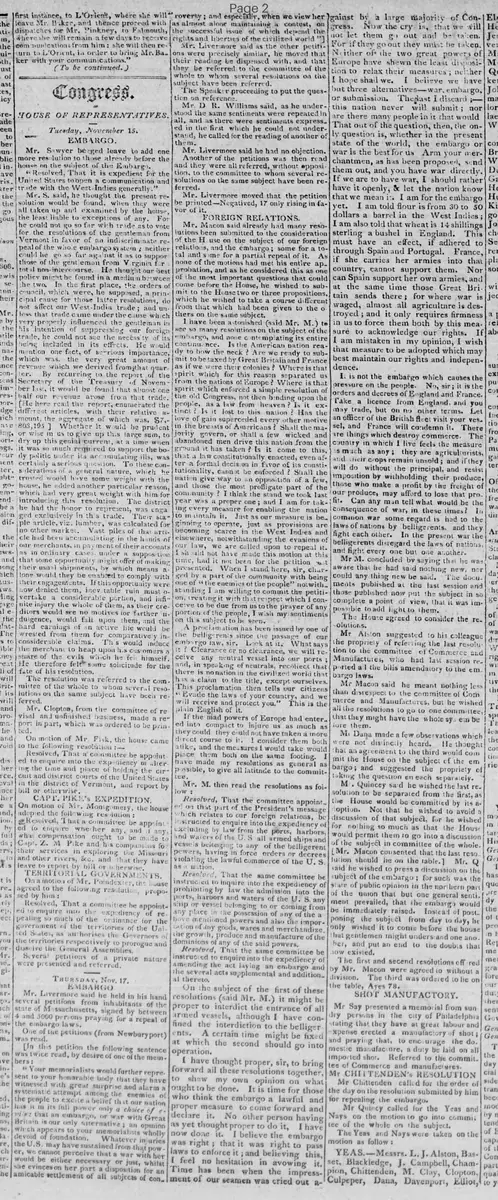
HOUSE OF REPRESENTATIVES.
Tuesday, November 15.
EMBARGO.
Mr. Sawyer begged leave to add one more resolution to those already before the house on the subject of the Embargo.
"Resolved, That it is expedient for the United States to open a Communication and trade with the West Indies generally."
Mr. S. said, he thought the present resolution would be found, when they were all taken up and examined by the house, the least liable to exceptions of any. For he could not go so far with trade as to vote for the resolutions of the gentleman from Vermont in favor of an indiscriminate repeal of the whole embargo system; neither could he go so far against it as to support those of the gentleman from Virginia for total non-intercourse. He thought our best policy might be found in a medium between the two. In the first place, the orders of council, which were, he supposed, a principal cause for those latter resolutions, do not affect our West-India trade; and unless that trade came under the cause which very properly influenced the gentleman in his intention of suppressing our foreign trade, he could not see the necessity of its being included in its effects. He would mention one fact, of serious importance, which was, the very great amount of revenue which we derived from that quarter. By recurring to the report of the Secretary of the Treasury of November last, it would be found that almost one half our revenue arose from that trade. He here read the report, enumerated the different articles, with their relative amount, the aggregate of which was, $7,803,195. Whether it would be prudent or wise in us to give up this large sum, to dry up this genial current, at a time when it was so much required to support the body politic under its accumulating ills, was certainly a serious question. To these considerations of a general nature, which he trusted would have some weight with the house, he added another particular reason, which had very great weight with him for introducing this resolution. The district he had the honor to represent, was engaged exclusively in this trade. Their staple article, viz. lumber, was calculated for no other market. Vast piles of that article had been accumulating in the hands of our merchants, in payment of their accounts as in ordinary cases, under a supposition that some opportunity might offer of making their usual shipments, by which means alone would they be enabled to comply with their engagements. If this opportunity were now denied them, inevitable ruin must overtake a considerable portion, and infinite injury the whole of them, as their creditors would see no motives for farther indulgence, would fall upon them, and the hard earnings of an active life would be wrested from them for comparatively inconsiderable claims. This would induce the merchant to heap upon his customers a share of the evils which he felt himself. He therefore felt some solicitude for the fate of his resolution.
The resolution was referred to the committee of the whole to whom several resolutions on the same subject have been referred.
Mr. Clopton, from the committee of revisal and unfinished business, made a report in part, which was ordered to be printed.
On motion of Mr. Fisk, the house came to the following resolution:--
Resolved, That a committee be appointed to enquire into the expediency of altering the time and place of holding the circuit and district Courts of the United States in the district of Vermont, and report by bill or otherwise.
CAPT. PIKE's EXPEDITION.
On motion of Mr. Montgomery, the house adopted the following resolution:
Resolved, That a Committee be appointed to enquire whether any, and if any, what compensation ought to be made to Capt. Z. M. Pike and his companions for their services in exploring the Missouri and other rivers, &c. and that they have leave to report by bill or otherwise.
TERRITORIAL GOVERNMENTS.
On a motion of Mr. Poindexter, the house agreed to the following resolution, proposed by him:
Resolved, That a committee be appointed to enquire into the expediency of repealing so much of the ordinance for the government of the territories of the United States, as authorises the Governors of the territories respectively to prorogue and dissolve the General Assemblies.
Several petitions of a private nature were presented and referred.
THURSDAY, NOV. 17.
EMBARGO
Mr. Livermore said he held in his hand several petitions from inhabitants of the state of Massachusetts, signed by between 4 and 5000 persons praying for a repeal of the embargo laws.
One of the petitions (from Newburyport) was read.
In this petition the following sentence was twice read, by desire of one of the members:
"Your memorialists would further represent to your honorable body that they have witnessed with great surprise and alarm a systematic attempt among the enemies of the people to excite a belief that our nation has it in its full power only a choice of evils: that an embargo, or war with Great Britain is our only alternative; an opinion which appears to your memorialists wholly devoid of foundation. Whatever injuries the U. S. may have sustained from that power, we cannot perceive that a war with her would be either necessary or just, whilst she evinces on her part a disposition for an amicable settlement of all subjects of controversy; and especially, when we view her as almost alone maintaining a contest, on the successful issue of which depend the rights and liberties of the civilized world."
Mr. Livermore said as the other petitions were precisely similar, he moved that their reading be dispensed with, and that they be referred to the committee of the whole to whom several resolutions on the subject have been referred.
The Speaker proceeding to put the question on reference.
Mr. D. R. Williams said, as he understood the same sentiments were repeated in all, and as there were sentiments expressed in the first which he could not understand, he called for the reading of another of them.
Mr. Livermore said he had no objection.
Another of the petitions was then read and they were all referred, without opposition, to the committee to whom several resolutions on the same subject have been referred.
Mr. Livermore moved that the petition be printed--Negatived, 17 only rising in favor of it.
FOREIGN RELATIONS
Mr. Macon said already had many resolutions been submitted to the consideration of the House on the subject of our foreign relations, and the embargo; some for a total and some for a partial repeal of it. As none of the motions had met his entire approbation, and as he considered this as one of the most important questions that could come before the House, he wished to submit to the House two or three propositions, which he wished to take a course different from that which had been given to the others on the same subject.
"I have been astonished (said Mr. M.) to see so many resolutions on the subject of the embargo, and none contemplating its entire continuance. Is the American nation ready to bow the neck? Are we ready to submit to be taxed by Great Britain and France as if we were their colonies? Where is that spirit which for this reason separated us from the nations of Europe? Where is that spirit which enforced a simple resolution of the old Congress, not then binding upon the people, as a law from heaven? Is it extinct? Is it lost to this nation? Has the love of gain superceded every other motive in the breasts of Americans? Shall the majority govern, or shall a few wicked and abandoned men drive this nation from the ground it has taken? Is it come to this, that a law constitutionally enacted, even after a formal decision in favor of its constitutionality, cannot be enforced? Shall the nation give way to an opposition of a few, and those the most profligate part of the community? I think the stand we took last year was a proper one; and I am for taking every measure for enabling the nation to maintain it. Just as our measure is beginning to operate, just as provisions are becoming scarce in the West Indies and elsewhere, notwithstanding the evasions of our law, we are called upon to repeal it. I should not have made this motion at this time, had it not been for the petition just presented. When I stand here, sir, charged by a part of the community with being one of 'the enemies of the people' notwithstanding I am willing to commit the petition, treating it with that respect which I conceive to be due from us to the prayer of any portion of the people, I wish my sentiments on this subject to be seen."
A proclamation has been issued by one of the belligerents since the passage of our embargo law, sir. Look at it. What says it? Clearance or no clearance, we will receive any neutral vessel into our ports; and, in speaking of neutrals, recollect that there is no nation in the civilized world that has a claim to the title, except ourselves. This proclamation then tells our citizens "Evade the laws of your country, and we will receive and protect you." This is the plain English of it.
If the mad powers of Europe had entered into compact to injure us as much as they could, they could not have taken a more direct course to it. I consider them both alike, and the measures I would take would place them both on the same footing. I have made my resolutions as general as possible, to give all latitude to the Committee.
Mr. M. then read the resolutions as follows:
Resolved, That the committee appointed on that part of the President's message which relates to our foreign relations, be instructed to enquire into the expediency of excluding by law from the ports, harbors, and waters of the U. S. all armed ships and vessels belonging to any of the belligerent powers, having in force orders or decrees violating the lawful commerce of the U. S. as a nation.
Resolved, That the same committee be instructed to inquire into the expediency of prohibiting by law the admission into the ports, harbors and waters of the U. S. any ship or vessel belonging to or coming from any place in the possession of any of the above mentioned powers and also the importation of any goods, wares and merchandize, the growth, produce and manufacture of the dominions of any of the said powers.
Resolved, That the same committee be instructed to enquire into the expediency of amending the act laying an embargo and the several acts supplemental and additional thereto.
On the subject of the first of these resolutions (said Mr. M.) it might be proper to interdict the entrance of all armed vessels, although I have confined the interdiction to the belligerents. A certain time might be fixed at which the second should go into operation.
I have thought proper, sir, to bring forward all these resolutions together, to shew my own opinion on what ought to be done. It is time for those who think the embargo a lawful and proper measure to come forward and declare it. No other person having as yet thought proper to do it, I have now done it. I believe the embargo was right; that it was right to pass laws to enforce it; and believing this, I feel no hesitation in avowing it.
Time has been when the impressment of our seamen was cried out against by a large majority of Congress. Now the cry is, that we will not let them go out and be taken. For if they go out they must be taken. Neither of the two great powers of Europe have shewn the least disposition to relax their measures; neither I hope shall we. I believe we have but three alternatives--war, embargo, or submission. The last I discard; this nation never will submit; nor are there many people in it that would. That out of the question, then, the only question is, whether in the present state of the world, the embargo or war is the best for us. Arm your merchantmen, as has been proposed, send them out, and you have war directly. If we are to have war, I should rather have it openly, & let the nation know that we mean it. I am for the embargo yet. I am told flour is from 30 to 50 dollars a barrel in the West Indies; I am also told that wheat is 14 shillings sterling a bushel in England. This must have an effect, if adhered to through Spain and Portugal. France, if she carries her armies into that country, cannot support them. Nor can Spain support her own armies, and at the same time those Great Britain sends there; for where war is waged, almost all agriculture is destroyed; and it only requires firmness in us to force them both by this measure to acknowledge our rights. If I am mistaken in my opinion, I wish that measure to be adopted which may best maintain our rights and independence.
It is not the embargo which causes the oppression on the people. No, sir; it is the orders and decrees of England and France. Take a licence from England, and you may trade, but on no other terms. Let an officer of the British fleet visit your vessel, and France will condemn it. There are things which destroy commerce. The country in which I live feels the measure as much as any; they are agriculturists, and their crops remain unsold; and if they will do without the principal, and resist imposition by withholding their produce, those who make a profit by the freight of our produce, may afford to lose that profit. Can any man tell what would be the consequence of war, in these times? In common war some regard is had to the laws of nations by belligerents, and they fight each other. In the present war the belligerents disregard the laws of nations, and fight every one but one another.
Mr. M. concluded by saying that he was aware that he had said nothing new, nor could anything new be said. The documents published at the last session and those published now put the subject in so complete a point of view, that it was impossible to add light to them.
The House agreed to consider the resolutions.
Mr. Alston suggested to his colleague the propriety of referring the last resolution to the committee of Commerce and Manufactures, who had last session reported all the bills amendatory to the embargo laws.
Mr. Macon said he meant nothing less than disrespect to the committee of Commerce and Manufactures, but he wished all the resolutions to go to one committee, that they might have the whole system before them.
Mr. Dana made a few observations which were not distinctly heard. He thought that an agreement to the third would commit the House on the subject of the embargo; and suggested the propriety of taking the question on each separately.
Mr. Quincy said he wished the last resolution to be separated from the first, as the House would be committed by its adoption. Not that he wished to avoid a discussion of that subject, for he wished for nothing so much as that the House would permit them to go into a discussion of the subject in committee of the whole.
(Mr. Macon consented that the last resolution should lie on the table.) Mr. Q. said he wished to press a discussion on the subject of the embargo; for such was the state of public opinion in the northern part of the union that but one general sentiment prevailed, that the embargo would be immediately raised. Instead of postponing the subject from day to day, he only wished it to come before the house that gentlemen might understand one another, and put an end to the doubts that now existed.
The first and second resolutions offered by Mr. Macon were agreed to without a division. The third was ordered to lie on the table, Ayes 78.
SHOT MANUFACTORY.
Mr. Say presented a memorial from sundry persons in the city of Philadelphia stating that they have at great labour and expense erected a manufactory of shot; and praying that, to encourage the domestic manufacture, a duty be laid on all imported shot. Referred to the committee of Commerce and manufactures.
Mr. CHITTENDEN's RESOLUTION
Mr. Chittenden called for the order of the day on the resolution submitted by him for repealing the embargo.
Mr. Quincy called for the Yeas and Nays on the motion to go into committee of the whole on the subject.
The Yeas and Nays were taken on the motion as follows:
YEAS.--Messrs. L. J. Alston, Bassett, Blackledge, J. Campbell, Champion, Chittenden, M. Clay, Clopton, Culpeper, Dana, Davenport, Elliot, Ely, Goldsborough, Gray, Harris, Heister, Hoge, Richard S. Jackson, Jenkins, Kelly, Lambert, Lewis, Livermore, Lloyd, Macon, Marion, Masters, Milnor, D. Montgomery, Moseley, Mumford, Newbold, Paken, Quincy, Randolph, M. Richards, Riker, Russell, Sloan, Snell, J. K. Smith, John Smith, S. Smith, Stanford, Stebbins, Sturges, Swart, Taggart, Taylor, Upham, Van Horn, Van Rensselaer, Wilbour, D. R. Williams, N. Wilson--56.
NAYS.--Messrs. W. Alston, Bacon, Barker, Bibb, Blount, Boyd, Brown, Burwell, Cutler, Calhoun, G. W. Campbell, Cutts, Dawson, Desha, Durell, Eppes, Findley, Franklin, Garnett, Gholson, Goodwyn, Green, Helms, Holland, Holmes, Howard, Humphreys, Ilsley, Johnson, Jones, Kirkpatrick, Love, M'Creery, J. Montgomery, N. Moore, Jer. Morrow, John Morrow, Nelson, Newton, Nicholas, Porter, Pugh, Rea, Rhea, Say, Seaver, Shaw, Smilie, Southard, Storrs, Thompson, Trigg, Troup, Verplanck, Wharton, Whitehill, A. Wilson.--58.
So it was decided that the house will not on this day take up the subject.
Several petitions and resolutions of a private nature were presented and referred; and the house adjourned about 1 o'clock.
Friday, Nov. 18.
Mr. Morrow presented the petition of sundry inhabitants of Ohio, praying for an extension of time for the payment of lands purchased from the U. S. Referred to the committee of public lands.
The Speaker laid before the house a communication from the legislature of the Indiana territory, giving notice of the election of Jesse B. Thomas as the delegate from that territory, in the room of Mr. Park, resigned; and also a very long communication from the same legislature against the introduction of slavery into that territory.
Mr. Rhea, from the committee on Post Offices and post roads, reported a bill authorising members to transmit by mail, free of postage, all public documents, which was twice read, and ordered a third reading on Monday.
Mr. Gholson presented the petition of Amy Darden, praying compensation for a stud horse, killed in the service of the U. States. Referred to the committee of claims.
Mr. Poindexter called for the order of the day on the bill concerning the powers of territorial governors, taking from them the right of proroguing and dissolving the general assemblies.
Mr. Bibb was opposed to the principles of the bill. One condition of the cession of that territory by the state of Georgia was, that it should be governed by the ordinance for the government of the North Western Territory. If the house had a right to alter that agreement in one point, without the consent of Georgia, they had it in all. It was therefore, as a representative from Georgia, that he protested against the passage of the bill.
Mr. Poindexter supported, and Mr. Troup opposed the principle of the bill, in speeches of considerable length and spirit.
The committee rose, and were refused leave to sit again, Mr. Troup moved for the indefinite postponement of its farther consideration. On this motion, the question was taken by ayes and noes, and carried--Ayes 57--Noes 52.
What sub-type of article is it?
What keywords are associated?
What entities or persons were involved?
Where did it happen?
Domestic News Details
Primary Location
United States House Of Representatives
Event Date
Tuesday, November 15; Thursday, Nov. 17; Friday, Nov. 18
Key Persons
Outcome
sawyer's resolution on west indies trade referred to committee; massachusetts petitions against embargo referred, printing negatived 17-others; macon's first two resolutions on foreign relations agreed to, third tabled 78 ayes; chittenden's repeal resolution not taken up, 56-58; territorial governors bill indefinitely postponed 57-52; other resolutions and petitions referred to committees.
Event Details
Proceedings in the House of Representatives over three days focused on embargo debates, including resolutions for partial trade openings, petitions for repeal from Massachusetts residents, Macon's speeches and resolutions supporting embargo continuance and restricting belligerent vessels and imports, failed vote on discussing repeal, memorials on shot manufactory, compensation for Capt. Pike, territorial governance changes, land payment extensions, Indiana territory communications on slavery and delegate election, and postal bill.