Thank you for visiting SNEWPapers!
Sign up free
Story
March 28, 1878
The News And Herald
Winnsboro, Fairfield County, South Carolina
What is this article about?
Natural processes involving barnacles and wood-boring worms destroy floating ship wreckage, preventing navigation hazards by sinking and riddling timber with tunnels until it disintegrates.
Clipping
OCR Quality
98%
Excellent
Full Text
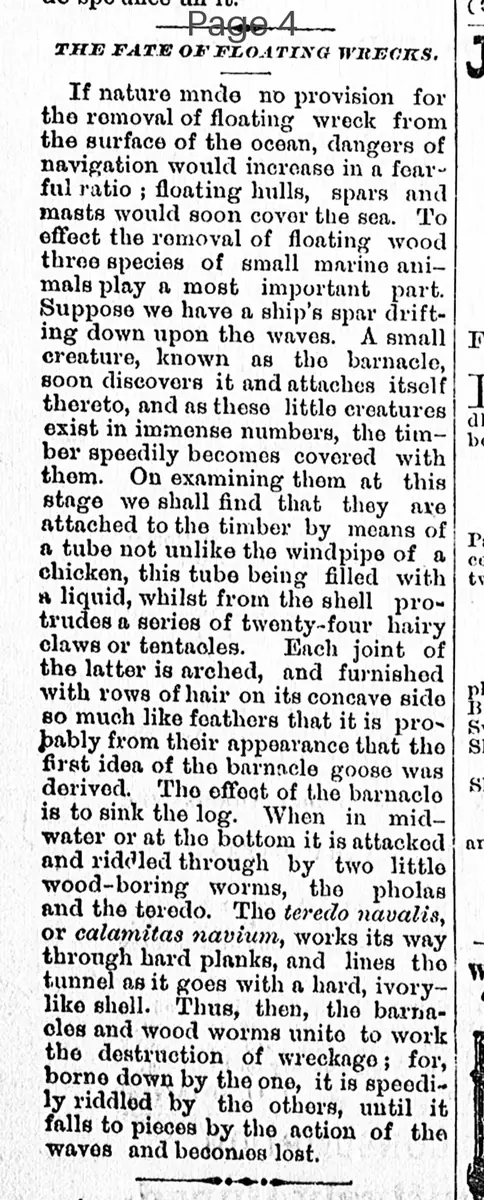
THE FATE OF FLOATING WRECKS.
If nature made no provision for the removal of floating wreck from the surface of the ocean, dangers of navigation would increase in a fearful ratio; floating hulls, spars and masts would soon cover the sea. To effect the removal of floating wood three species of small marine animals play a most important part.
Suppose we have a ship's spar drifting down upon the waves. A small creature, known as the barnacle, soon discovers it and attaches itself thereto, and as these little creatures exist in immense numbers, the timber speedily becomes covered with them. On examining them at this stage we shall find that they are attached to the timber by means of a tube not unlike the windpipe of a chicken, this tube being filled with a liquid, whilst from the shell protrudes a series of twenty-four hairy claws or tentacles. Each joint of the latter is arched, and furnished with rows of hair on its concave side so much like feathers that it is probably from their appearance that the first idea of the barnacle goose was derived. The effect of the barnacle is to sink the log. When in mid-water or at the bottom it is attacked and riddled through by two little wood-boring worms, the pholas and the teredo. The teredo navalis, or calamitas navium, works its way through hard planks, and lines the tunnel as it goes with a hard, ivory-like shell. Thus, then, the barnacles and wood worms unite to work the destruction of wreckage; for, borne down by the one, it is speedily riddled by the others, until it falls to pieces by the action of the waves and becomes lost.
If nature made no provision for the removal of floating wreck from the surface of the ocean, dangers of navigation would increase in a fearful ratio; floating hulls, spars and masts would soon cover the sea. To effect the removal of floating wood three species of small marine animals play a most important part.
Suppose we have a ship's spar drifting down upon the waves. A small creature, known as the barnacle, soon discovers it and attaches itself thereto, and as these little creatures exist in immense numbers, the timber speedily becomes covered with them. On examining them at this stage we shall find that they are attached to the timber by means of a tube not unlike the windpipe of a chicken, this tube being filled with a liquid, whilst from the shell protrudes a series of twenty-four hairy claws or tentacles. Each joint of the latter is arched, and furnished with rows of hair on its concave side so much like feathers that it is probably from their appearance that the first idea of the barnacle goose was derived. The effect of the barnacle is to sink the log. When in mid-water or at the bottom it is attacked and riddled through by two little wood-boring worms, the pholas and the teredo. The teredo navalis, or calamitas navium, works its way through hard planks, and lines the tunnel as it goes with a hard, ivory-like shell. Thus, then, the barnacles and wood worms unite to work the destruction of wreckage; for, borne down by the one, it is speedily riddled by the others, until it falls to pieces by the action of the waves and becomes lost.
What sub-type of article is it?
Curiosity
What themes does it cover?
Nature
What keywords are associated?
Floating Wrecks
Barnacles
Teredo Worms
Wood Boring
Ocean Navigation
Where did it happen?
Ocean
Story Details
Location
Ocean
Story Details
Barnacles attach to and sink floating wreckage, after which wood-boring worms like the teredo riddle it with tunnels, leading to its destruction by waves.