Thank you for visiting SNEWPapers!
Sign up free
The New Hampshire Gazette And General Advertiser
Portsmouth, Exeter, Rockingham County, New Hampshire
What is this article about?
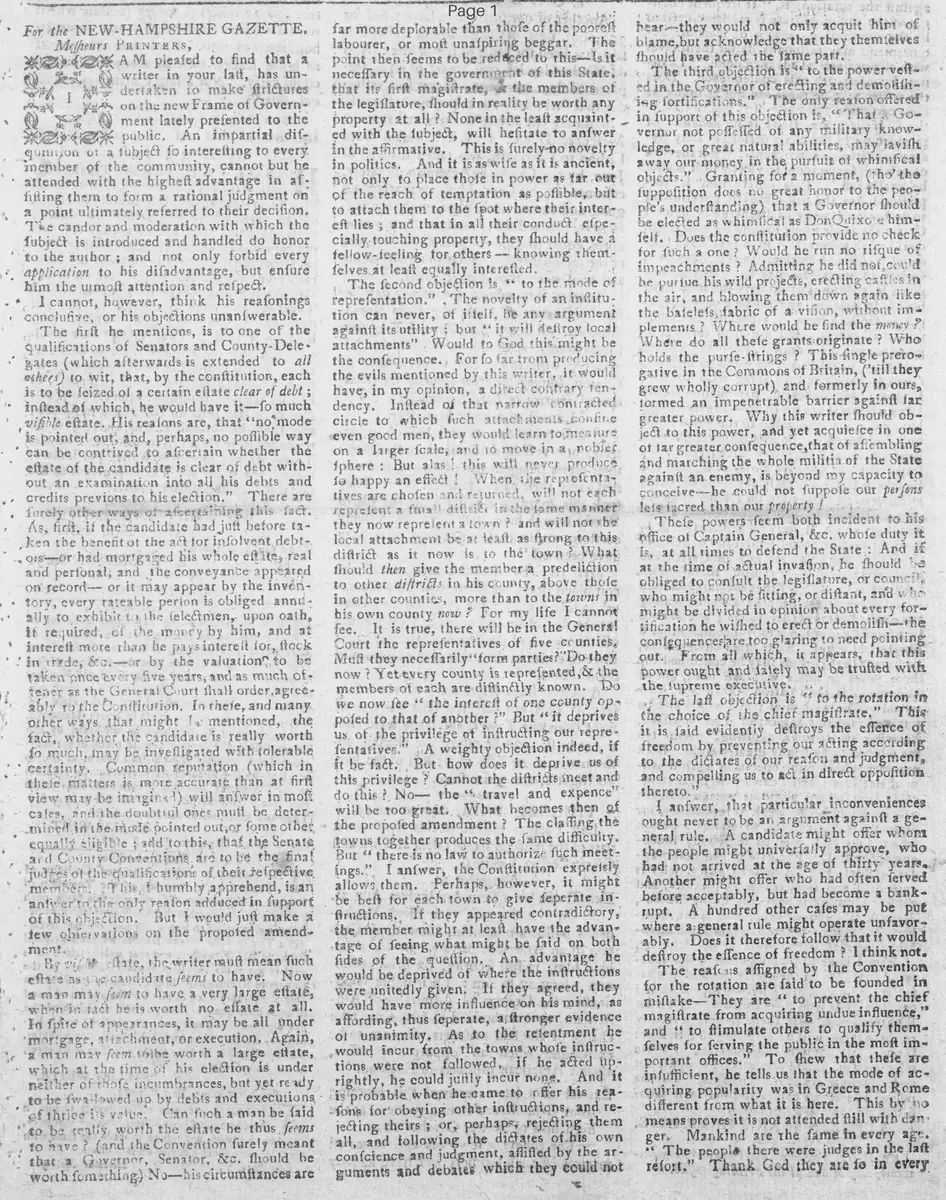
A New Hampshire citizen defends the new state constitution against objections raised by 'A True Republican' in the Gazette, arguing in favor of property qualifications clear of debt, county-based representation, the governor's power over fortifications, and rotation in office for the chief magistrate.
Merged-components note: This is a continuation of the same letter to the editor across pages 1 and 2, as indicated by sequential reading order and flowing text content.
Clippings
1 of 2
OCR Quality
Full Text
Messieurs Printers,
I am pleased to find that a writer in your last. has undertaken to make strictures on the new Frame of Government lately presented to the public. An impartial discussion of a subject so interesting to every member of the community, cannot but be attended with the highest advantage in assisting them to form a rational judgment on a point ultimately referred to their decision.
The candor and moderation with which the subject is introduced and handled do honor to the author; and not only forbid every application to his disadvantage, but ensure him the utmost attention and respect.
I cannot, however, think his reasonings conclusive, or his objections unanswerable. The first he mentions, is to one of the qualifications of Senators and County-Delegates (which afterwards is extended to all others) to wit, that, by the constitution, each is to be seised of a certain estate clear of debt; instead of which, he would have it--so much visible estate. His reasons are, that "no mode is pointed out, and, perhaps, no possible way can be contrived to ascertain whether the estate of the candidate is clear of debt without an examination into all his debts and credits previous to his election." There are surely other ways of ascertaining this fact. As, such, if the candidate had just before taken the benefit of the act for insolvent debtors--or had mortgaged his whole estate real and personal; and the conveyance appeared on record--or it may appear by the inventory, every rateable person is obliged annually to exhibit to the selectmen, upon oath, if required, of the money by him, and at interest more than he pays interest for, stock in trade, &c. or by the valuation? to be taken once every five years, and as much oftener as the General Court shall order, agreeably to the Constitution. In these, and many other ways that might be mentioned, the fact, whether the candidate is really worth so much, may be investigated with tolerable certainty. Common reputation (which in these matters is more accurate than at first view may be imagined) will answer in most cases, and the doubtful ones must be determined in the mode pointed out, or some other equally eligible; add to this, that the Senate and County Conventions are to be the final judges of the qualifications of their respective members. This, I humbly apprehend, is an answer to the only reason adduced in support of this objection. But I would just make a few observations on the proposed amendment.
By visible estate, the writer must mean such estate as the candidate seems to have. Now a man may seem to have a very large estate, when in fact he is worth no estate at all. In spite of appearances, it may be all under mortgage, attachment, or execution. Again, a man may seem to be worth a large estate, which at the time of his election is under neither of those incumbrances, but yet ready to be swallowed up by debts and executions of thrice its value. Can such a man be said to be really worth the estate he thus seems to have? (and the Convention surely meant that a Governor, Senator, &c. should be worth something) No--his circumstances are far more deplorable than those of the poorest labourer, or most unaspiring beggar. The point then seems to be reduced to this--Is it necessary in the government of this State, that its first magistrate, or the members of the legislature, should in reality be worth any property at all? None in the least acquainted with the subject, will hesitate to answer in the affirmative. This is surely no novelty in politics. And it is as wise as it is ancient, not only to place those in power as far out of the reach of temptation as possible, but to attach them to the post where their interest lies: and that in all their conduct especially touching property, they should have a fellow-feeling for others--knowing themselves at least equally interested.
The second objection is "to the mode of representation." The novelty of an institution can never, of itself, be any argument against its utility; but "it will destroy local attachments." Would to God this might be the consequence. For so far from producing the evils mentioned by this writer, it would have, in my opinion, a direct contrary tendency. Instead of that narrow contracted circle to which such attachments confine even good men, they would learn to measure on a larger scale, and to move in a nobler sphere: But alas! this will never produce so happy an effect! When the representatives are chosen and returned, will not each represent a small district, in the same manner they now represent a town? and will not the local attachment be at least as strong to this district as it now is to the town? What should then give the member a predilection to other districts in his county, above those in other counties, more than to the towns in his own county now? For my life I cannot see. It is true, there will be in the General Court the representatives of five counties. Must they necessarily form parties? Do they now? Yet every county is represented, & the members of each are distinctly known. Do we now see "the interest of one county opposed to that of another?" But "it deprives us of the privilege of instructing our representatives." A weighty objection indeed, if it be fact. But how does it deprive us of this privilege? Cannot the districts meet and do this? No--the "travel and expence" will be too great. What becomes then of the proposed amendment? The classing the towns together produces the same difficulty. But "there is no law to authorize such meetings." I answer, the Constitution expressly allows them. Perhaps, however, it might be best for each town to give separate instructions. If they appeared contradictory, the member might at least have the advantage of seeing what might be said on both sides of the question. An advantage he would be deprived of where the instructions were unitedly given. If they agreed, they would have more influence on his mind, as affording, thus separate, a stronger evidence of unanimity. As to the resentment he would incur from the towns whose instructions were not followed, if he acted uprightly, he could justly incur none. And it is probable when he came to offer his reasons for obeying other instructions, and rejecting theirs; or, perhaps, rejecting them all, and following the dictates of his own conscience and judgment, assisted by the arguments and debates which they could not hear--they would not only acquit him of blame, but acknowledge that they themselves should have acted the same part.
The third objection, is to the power vested in the Governor of erecting and demolishing fortifications." The only reason offered in support of this objection is, "That a Governor not possessed of any military knowledge, or great natural abilities, may lavish away our money in the pursuit of whimsical objects." Granting for a moment, (tho' the supposition does no great honor to the people's understanding) that a Governor should be elected as whimsical as Don Quixote himself, Does the constitution provide no check for such a one? Would he run no risque of impeachments? Admitting he did not, could he pursue his wild projects, erecting castles in the air, and blowing them down again like the baseless fabric of a vision, without implements? Where would he find the money? Where do all these grants originate? Who holds the purse-strings? This single prerogative in the Commons of Britain, ('till they grew wholly corrupt), and formerly in ours, formed an impenetrable barrier against far greater power. Why this writer should object to this power, and yet acquiesce in one of far greater consequence, that of assembling and marching the whole militia of the State against an enemy, is beyond my capacity to conceive--he could not suppose our persons less sacred than our property!
These powers seem both incident to his office of Captain General, &c. whose duty it is, at all times to defend the State: And if at the time of actual invasion, he should be obliged to consult the legislature, or council, who might not be sitting, or distant, and v. he might be divided in opinion about every fortification he wished to erect or demolish--the consequences are too glaring to need pointing out. From all which, it appears, that this power ought and safely may be trusted with the supreme executive.
The last objection is "to the rotation in the choice of the chief magistrate." This it is said evidently destroys the essence of freedom by preventing our acting according to the dictates of our reason and judgment, and compelling us to act in direct opposition thereto."
I answer, that particular inconveniences ought never to be an argument against a general rule. A candidate might offer whom the people might universally approve, who had not arrived at the age of thirty years. Another might offer who had often served before acceptably, but had become a bankrupt. A hundred other cases may be put where a general rule might operate unfavorably. Does it therefore follow that it would destroy the essence of freedom? I think not.
The reasons assigned by the Convention for the rotation are said to be founded in mistake--They are "to prevent the chief magistrate from acquiring undue influence," and "to stimulate others to qualify themselves for serving the public in the most important offices." To show that these are insufficient, he tells us that the mode of acquiring popularity was in Greece and Rome different from what it is here. This by no means proves it is not attended still with danger. Mankind are the same in every age. "The people there were judges in the last resort." Thank God they are so in every
Report. The instance of Arnold is rather unfortunate for the writer's argument. Was he not popular long after he deviated from the path of virtue? Lee, I hope, never did. 'Tis said, if a man renders himself popular by his virtues, no danger can arise to the State while he continues virtuous—as soon as he deviates, he ceases to be popular. This I can by no means agree to. If the people could always see the deviation, perhaps the remark might be just: But their generous unsuspicious minds will be so blinded by the high opinion they once justly entertained, that they will not discern it.
Another argument used by the writer, against the rotation, is, "If frequent changes of the first magistrate is rendered certain by the constitution, persons of moderate acquirements may rationally flatter themselves with the prospect of advancement." I cannot, I confess, see this consequence. Does the writer suppose there are not as many as three persons in this State of "superior abilities?" If there are, there is no necessity of introducing to the chair persons of only moderate abilities or acquirements. "But the idea of rewards for eminent services will, it is said, be totally lost." This observation is surprising! Are the first offices in government to be bartered away in discharge of debts? Or are the people singly to consider who is best qualified to govern? A man may have rendered "eminent services" to the State in a variety of ways—he may have lent it, nay given it, vast sums of money—he may have bled in its defence, and yet be a very improper person to govern it, especially in exclusion of all others. But are such services to go unrewarded? I answer, no—they cannot—if they proceeded from virtuous motives, they carry their reward along with them—if that is not sufficient, pay them—amply assess a general tax for them—do every thing but expose the state vessel to the perils of an unskillful steerage. Besides, whoever fills that department, and faithfully discharges all the important and weighty duties of it, will not thereby lessen, but greatly augment the debt, and confer an obligation on (rather than receive) a reward from the people. Notwithstanding which, it may be added, that it is good for men in power sometimes to descend from their high stations and mix with the mass of the people—it reminds them (which they are apt to forget) that they are but men—and prevents the people from entertaining too exalted ideas of their rulers: which ends in a servility of mind totally inconsistent with liberty and virtue. Some other observations, such as "that persons may be continued the three years in office who are unfit, out of tenderness, if the rotation takes place, who would not be without it; and would also be tempted to grow neglectful of public affairs, knowing his term was expiring," seems too far fetched to have any great weight. Both arguments have some operation against annual elections; and I can by no means conceive that where elections are annual, the people would be so weak as repeatedly, for three years successively, to choose a person whom they had found to be wholly inadequate, the first. The case of the commander in chief of the American army, who is appointed and removable at pleasure, and considers himself as held only during the war, does not apply to our case; that of the members of Congress, where the rotation is established, applies, in my opinion, much better.
Thus I have thrown together a few scattered thoughts on the objections and proposed amendments, made by the ingenious and candid author who signs himself "A TRUE REPUBLICAN."—If there is weight in any of them, they will be attended to; if there is none, I do not wish it—unless he, or some other person, should condescend to point out and convince me of my mistakes. To the public I refer the cause, and shall rest satisfied with their determination.
A CITIZEN OF NEW HAMPSHIRE.
What sub-type of article is it?
What themes does it cover?
What keywords are associated?
What entities or persons were involved?
Letter to Editor Details
Author
A Citizen Of New Hampshire
Recipient
Messieurs Printers
Main Argument
the new frame of government for new hampshire is defended against objections regarding property qualifications, mode of representation, governor's powers over fortifications, and rotation in office, emphasizing their necessity for sound governance and public interest.
Notable Details