Thank you for visiting SNEWPapers!
Sign up free
Letter to Editor
February 4, 1825
American Watchman And Delaware Advertiser
Wilmington, New Castle County, Delaware
What is this article about?
A Wilmington citizen criticizes Pennsylvania's inefficient canal projects and envy of New York's successes, attributing issues to wealthy influences in Philadelphia, and urges better policy for mutual benefit with neighbors like Delaware. (214 characters)
Clipping
OCR Quality
85%
Good
Full Text
FOR THE WATCHMAN.
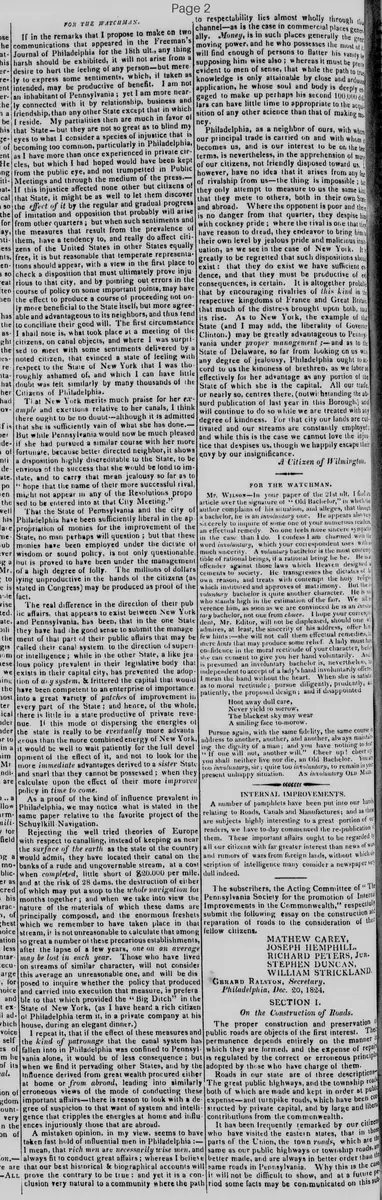
[From the Journal of Philadelphia for the 18th ult., anything but communications that appeared in the Freeman's Journal. If in the remarks that I propose to make on two articles should be exhibited, it will not arise from a desire to hurt the feeling of any person—but merely to express some sentiments, which, if taken as intended, may be productive of benefit. I am not an inhabitant of Pennsylvania; yet I am more nearly connected with it by relationship, business and friendship, than any other State except that in which I reside. My partialities then are much in favor of that State—but they are not so great as to blind my eyes to what I consider a species of injustice that is becoming too common, particularly in Philadelphia, as I have more than once experienced in private circles, but which I had hoped would have been kept from the public eye, and not trumpeted in Public Meetings and through the medium of the press.—
If this injustice affected none other but citizens of that State, it might be as well to let them discover the effect of it by the regular and gradual progress of imitation and opposition that probably will arise from other quarters; but when such sentiments and the measures that result from the prevalence of them, have a tendency to, and really do affect citizens of the United States in other States equally free, it is but reasonable that temperate representations should appear, with a view in the first place to check a disposition that must ultimately prove injurious to that city, and by pointing out errors in the course of policy on some important points, may have the effect to produce a course of proceeding not only more beneficial to the State itself, but more agreeable and advantageous to its neighbors, and thus tend to conciliate their good will. The first circumstance I shall note is, what took place at a meeting of the citizens, on canal objects, and where I was surprised to meet with some sentiments delivered by a noted citizen, that evinced a state of feeling with respect to the State of New York that I was thoroughly ashamed of, and which I can have little doubt was felt similarly by many thousands of the Citizens of Philadelphia.
That New York merits much praise for her example and exertions relative to her canals, I think there ought to be no doubt—although it is admitted that she is sufficiently vain of what she has done.—But little Pennsylvania would now be much pleased if she had pursued a similar course with her more fortunate, because better directed neighbor, it shows a disposition highly discreditable to the State, to be envious of the success that she would be fond to imitate, and to carry that mean jealousy so far as to "hope that the name of their more successful rival, might not appear in any of the Resolutions proposed to be entered into at that City Meeting."
That the State of Pennsylvania and the city of Philadelphia have been sufficiently liberal in the appropriation of monies for the improvement of the State, no man perhaps will question; but that these monies have been employed under the dictate of wisdom or sound policy, is not only questionable, but is proved to have been under the management of a high degree of folly. The millions of dollars lying unproductive in the hands of the citizens (as stated in Congress) may be produced as proof of the fact.
The real difference in the direction of their public affairs, that appears to exist between New York and Pennsylvania, has been, that in the one State they have had the good sense to submit the management of that part of their public affairs that may be called their canal system, to the direction of superior intelligence; while in the other State, a like jealous policy prevalent in their legislative body that exists in their capital city, has prevented the adoption of any system, & frittered the capital that would have been competent to an enterprise of importance, into a great variety of patches of improvement in every part of the State; and hence, of the whole, there is little in a state productive of private revenue. If this mode of dispersing the energies of the state is really to be eventually more advantageous than the more combined energy of New York, it would be well to wait patiently for the full development of the effect of it, and not to look for the more immediate advantages derived to a sister State and snarl that they cannot be possessed; when they calculate upon the effect of their more improved policy in time to come.
As a proof of the kind of influence prevalent in Philadelphia, we may notice what is stated in the same paper relative to the favorite project of the Schuylkill Navigation.
Rejecting the well tried theories of Europe with respect to canalling, instead of keeping as near the surface of the earth as the state of the country would admit, they have located their canal on the banks of a rude and ungovernable stream, at a cost when completed, little short of $20,000 per mile, and at the risk of 28 dams, the destruction of either of which may put a stop to the whole navigation for months together; and when we take into view the nature of the materials of which these dams are principally composed, and the enormous freshets which we remember to have taken place in that stream, it is not unreasonable to calculate that among so great a number of these precarious establishments, after the lapse of a few years, one on an average may be lost in each year. Those who have lived on streams of similar character, will not consider this average an unreasonable one, and will be disposed to inquire whether the policy that produced and carried into execution that measure, is preferable to that which provided the "Big Ditch" in the State of New York, (as I have heard a rich citizen of Philadelphia term it, in a private company at his house, during an elegant dinner.)
I repeat it, that if the effect of these measures and the kind of patronage that the canal system has fallen into in Philadelphia was confined to Pennsylvania alone, it would be of less consequence; but when we find it pervading other States, and by the influence derived from great wealth procured either at home or from abroad, leading into similarly erroneous views of the mode of conducting these important affairs—there is reason to look with a degree of suspicion to that want of system and intelligence that cripples the energies at home and influences injuriously those that are abroad.
A mistaken opinion, in my view, seems to have taken fast hold of influential men in Philadelphia:—I mean, that rich men are necessarily wise men, and always fit to conduct great affairs; whereas I believe that our best historical & biographical accounts will prove the contrary to be true: and yet it is a conclusion very natural to a community where the path to respectability lies almost wholly through that channel—as is the case in commercial places generally. Money, is in such places generally the great moving power and he who possesses the most of it will find enough of persons to flatter his vanity supposing him wise also; whereas it must be evident to men of sense, that while the path to true knowledge is only attainable by close and arduous application he whose soul and body is deeply engaged to make up perhaps his second 100,000 dollars can have little time to appropriate to the acquisition of any other science than that of making money.
Philadelphia, as a neighbor of ours, with whom our principal trade is carried on and with whom it becomes us, and is our interest to be on the best terms, is nevertheless, in the apprehension of many of our citizens, not friendly disposed toward us. I however, have no idea that it arises from any fear of rivalship from us—the thing is impossible; but they only attempt to measure to us the same kind that they mete to others, both in their own State and abroad. Where the opponent is poor and there is no danger from that quarter, they despise him with cockney pride; where the rival is one that they have reason to dread, they endeavor to bring him to their own level by jealous pride and malicious insinuation, as we see in the case of New York. It is greatly to be regretted that such dispositions should exist: that they do exist we have sufficient evidence, and that they must be productive of evil consequences, is certain. It is altogether probable that by encouraging rivalries of this kind in the respective kingdoms of France and Great Britain that much of the distress brought upon both, took its rise. As to New York, the example of that State (and I may add, the liberality of Governor Clinton) may be greatly advantageous to Pennsylvania under proper management;—and as to the State of Delaware, so far from looking on us with any degree of jealousy, Philadelphia ought to accord to us the kindness of brethren, as we labor as effectively for her advantage as any portion of the State of which she is the capital. All our trade, or nearly so, centres there, (notwithstanding the absurd publication of last year in this Borough.) and will continue to do so while we are treated with any degree of kindness. For that city our lands are cultivated and our streams are constantly employed: and while this is the case we cannot love the injustice that despises us, though we happily escape their envy by our insignificance.
A Citizen of Wilmington
[From the Journal of Philadelphia for the 18th ult., anything but communications that appeared in the Freeman's Journal. If in the remarks that I propose to make on two articles should be exhibited, it will not arise from a desire to hurt the feeling of any person—but merely to express some sentiments, which, if taken as intended, may be productive of benefit. I am not an inhabitant of Pennsylvania; yet I am more nearly connected with it by relationship, business and friendship, than any other State except that in which I reside. My partialities then are much in favor of that State—but they are not so great as to blind my eyes to what I consider a species of injustice that is becoming too common, particularly in Philadelphia, as I have more than once experienced in private circles, but which I had hoped would have been kept from the public eye, and not trumpeted in Public Meetings and through the medium of the press.—
If this injustice affected none other but citizens of that State, it might be as well to let them discover the effect of it by the regular and gradual progress of imitation and opposition that probably will arise from other quarters; but when such sentiments and the measures that result from the prevalence of them, have a tendency to, and really do affect citizens of the United States in other States equally free, it is but reasonable that temperate representations should appear, with a view in the first place to check a disposition that must ultimately prove injurious to that city, and by pointing out errors in the course of policy on some important points, may have the effect to produce a course of proceeding not only more beneficial to the State itself, but more agreeable and advantageous to its neighbors, and thus tend to conciliate their good will. The first circumstance I shall note is, what took place at a meeting of the citizens, on canal objects, and where I was surprised to meet with some sentiments delivered by a noted citizen, that evinced a state of feeling with respect to the State of New York that I was thoroughly ashamed of, and which I can have little doubt was felt similarly by many thousands of the Citizens of Philadelphia.
That New York merits much praise for her example and exertions relative to her canals, I think there ought to be no doubt—although it is admitted that she is sufficiently vain of what she has done.—But little Pennsylvania would now be much pleased if she had pursued a similar course with her more fortunate, because better directed neighbor, it shows a disposition highly discreditable to the State, to be envious of the success that she would be fond to imitate, and to carry that mean jealousy so far as to "hope that the name of their more successful rival, might not appear in any of the Resolutions proposed to be entered into at that City Meeting."
That the State of Pennsylvania and the city of Philadelphia have been sufficiently liberal in the appropriation of monies for the improvement of the State, no man perhaps will question; but that these monies have been employed under the dictate of wisdom or sound policy, is not only questionable, but is proved to have been under the management of a high degree of folly. The millions of dollars lying unproductive in the hands of the citizens (as stated in Congress) may be produced as proof of the fact.
The real difference in the direction of their public affairs, that appears to exist between New York and Pennsylvania, has been, that in the one State they have had the good sense to submit the management of that part of their public affairs that may be called their canal system, to the direction of superior intelligence; while in the other State, a like jealous policy prevalent in their legislative body that exists in their capital city, has prevented the adoption of any system, & frittered the capital that would have been competent to an enterprise of importance, into a great variety of patches of improvement in every part of the State; and hence, of the whole, there is little in a state productive of private revenue. If this mode of dispersing the energies of the state is really to be eventually more advantageous than the more combined energy of New York, it would be well to wait patiently for the full development of the effect of it, and not to look for the more immediate advantages derived to a sister State and snarl that they cannot be possessed; when they calculate upon the effect of their more improved policy in time to come.
As a proof of the kind of influence prevalent in Philadelphia, we may notice what is stated in the same paper relative to the favorite project of the Schuylkill Navigation.
Rejecting the well tried theories of Europe with respect to canalling, instead of keeping as near the surface of the earth as the state of the country would admit, they have located their canal on the banks of a rude and ungovernable stream, at a cost when completed, little short of $20,000 per mile, and at the risk of 28 dams, the destruction of either of which may put a stop to the whole navigation for months together; and when we take into view the nature of the materials of which these dams are principally composed, and the enormous freshets which we remember to have taken place in that stream, it is not unreasonable to calculate that among so great a number of these precarious establishments, after the lapse of a few years, one on an average may be lost in each year. Those who have lived on streams of similar character, will not consider this average an unreasonable one, and will be disposed to inquire whether the policy that produced and carried into execution that measure, is preferable to that which provided the "Big Ditch" in the State of New York, (as I have heard a rich citizen of Philadelphia term it, in a private company at his house, during an elegant dinner.)
I repeat it, that if the effect of these measures and the kind of patronage that the canal system has fallen into in Philadelphia was confined to Pennsylvania alone, it would be of less consequence; but when we find it pervading other States, and by the influence derived from great wealth procured either at home or from abroad, leading into similarly erroneous views of the mode of conducting these important affairs—there is reason to look with a degree of suspicion to that want of system and intelligence that cripples the energies at home and influences injuriously those that are abroad.
A mistaken opinion, in my view, seems to have taken fast hold of influential men in Philadelphia:—I mean, that rich men are necessarily wise men, and always fit to conduct great affairs; whereas I believe that our best historical & biographical accounts will prove the contrary to be true: and yet it is a conclusion very natural to a community where the path to respectability lies almost wholly through that channel—as is the case in commercial places generally. Money, is in such places generally the great moving power and he who possesses the most of it will find enough of persons to flatter his vanity supposing him wise also; whereas it must be evident to men of sense, that while the path to true knowledge is only attainable by close and arduous application he whose soul and body is deeply engaged to make up perhaps his second 100,000 dollars can have little time to appropriate to the acquisition of any other science than that of making money.
Philadelphia, as a neighbor of ours, with whom our principal trade is carried on and with whom it becomes us, and is our interest to be on the best terms, is nevertheless, in the apprehension of many of our citizens, not friendly disposed toward us. I however, have no idea that it arises from any fear of rivalship from us—the thing is impossible; but they only attempt to measure to us the same kind that they mete to others, both in their own State and abroad. Where the opponent is poor and there is no danger from that quarter, they despise him with cockney pride; where the rival is one that they have reason to dread, they endeavor to bring him to their own level by jealous pride and malicious insinuation, as we see in the case of New York. It is greatly to be regretted that such dispositions should exist: that they do exist we have sufficient evidence, and that they must be productive of evil consequences, is certain. It is altogether probable that by encouraging rivalries of this kind in the respective kingdoms of France and Great Britain that much of the distress brought upon both, took its rise. As to New York, the example of that State (and I may add, the liberality of Governor Clinton) may be greatly advantageous to Pennsylvania under proper management;—and as to the State of Delaware, so far from looking on us with any degree of jealousy, Philadelphia ought to accord to us the kindness of brethren, as we labor as effectively for her advantage as any portion of the State of which she is the capital. All our trade, or nearly so, centres there, (notwithstanding the absurd publication of last year in this Borough.) and will continue to do so while we are treated with any degree of kindness. For that city our lands are cultivated and our streams are constantly employed: and while this is the case we cannot love the injustice that despises us, though we happily escape their envy by our insignificance.
A Citizen of Wilmington
What sub-type of article is it?
Persuasive
Political
Informative
What themes does it cover?
Infrastructure
Politics
Economic Policy
What keywords are associated?
Canal Policy
Pennsylvania Rivalry
Schuylkill Navigation
New York Canals
Philadelphia Influence
Delaware Trade
Public Funds Management
What entities or persons were involved?
A Citizen Of Wilmington
For The Watchman
Letter to Editor Details
Author
A Citizen Of Wilmington
Recipient
For The Watchman
Main Argument
pennsylvania's canal policies, marked by jealousy toward new york's success and poor management influenced by wealthy interests, are misguided and harmful to the state and its neighbors like delaware; the state should adopt a more systematic approach like new york's to benefit all.
Notable Details
Critique Of Schuylkill Navigation's Costly And Risky Design With 28 Dams
Reference To New York's 'Big Ditch' (Erie Canal)
Mention Of Governor Clinton's Liberality
Contrast In Policy: Pennsylvania's Dispersed Improvements Vs. New York's Combined Efforts