Thank you for visiting SNEWPapers!
Sign up free
Alexandria Daily Gazette, Commercial & Political
Alexandria, Virginia
What is this article about?
Detailed account from Lisbon (Feb 1811) of the Peninsular War in Portugal: After Bussaco, Wellington retreated to impregnable Torres Vedras lines. Massena, facing supply issues, masterfully retreated to fortified Santarem on Nov 15, avoiding major battle with British forces under Crawford. Armies remain positioned along Tagus River.
Clipping
OCR Quality
Full Text
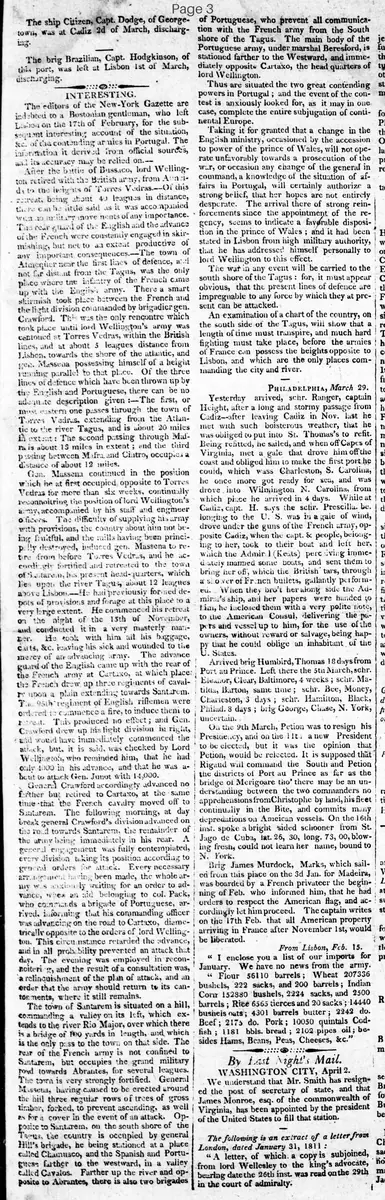
The editors of the New-York Gazette are indebted to a Bostonian gentleman, who left Lisbon on the 17th of February, for the subsequent interesting account of the situation, &c. of the contending armies in Portugal. The information is derived from official sources, and its accuracy may be relied on.
After the battle of Bussaco, Lord Wellington retired with the British army, from Almeida to the heights of Torres Vedras. Of this retreat, being about 40 leagues in distance, there can be little said as it was accompanied with no military movements of any importance. The rear guard of the English and the advance of the French were constantly engaged in skirmishing, but not to any extent productive of any important consequences. The town of Alcobaca, near the first lines of defence, and not far distant from the Tagus, was the only place where the infantry of the French came up with the English army. There a smart skirmish took place between the French and the light division commanded by Brigadier General Crawford. This was the only rencontre which took place until Lord Wellington's army was cantoned at Torres Vedras, within the British lines, and at about 5 leagues distance from Lisbon, towards the shore of the Atlantic, and Gen. Massena possessing himself of a height running parallel to that place. Of the three lines of defence which have been thrown up by the English and Portuguese, there can be no adequate description given. The first, or most eastern one passes through the town of Torres Vedras, extending from the Atlantic to the river Tagus, and is about 20 miles in extent. The second passing through Mafra about 15 miles in extent; and the third passing between Mafra and Cintra, occupies a distance of about 12 miles.
Gen. Massena continued in the position which he at first occupied, opposite to Torres Vedras for more than six weeks, continually reconnoitring the position of Lord Wellington's army, accompanied by his staff and engineer officers. The difficulty of supplying his army with provisions, the country about him not being fruitful, and the mills having been principally destroyed, induced Gen. Massena to retreat from before Torres Vedras, and he accordingly fortified and retreated to the town of Santarem, his present head-quarters, which lies upon the river Tagus, about 12 leagues above Lisbon. He had previously formed depots of provisions and forage at this place to a very large extent. He commenced his retreat on the night of the 15th of November, and conducted it in a very masterly manner. He took with him all his baggage carts, &c. leaving his sick and wounded to the mercy of an advancing army. The advance guard of the English came up with the rear of the French army at Cartaxo, at which place the French drew up three regiments of cavalry upon a plain extending towards Santarem. The 95th regiment of English riflemen were ordered to commence a fire, to induce them to retreat. This produced no effect; and Gen. Crawford drew up his light division in sight, and would have immediately commenced the attack, but, it is said, was checked by Lord Wellington, who reminded him, that he had only 4000 in his advance, and that he was about to attack Gen. Junot with 14,000.
General Crawford accordingly advanced no further but retired to Cartaxo, at the same time that the French cavalry moved off to Santarem. The following morning, at day break general Crawford's division advanced on the road towards Santarem, the remainder of the army being immediately in his rear. A general engagement was fully contemplated, every division taking its position according to general orders for attack. Every necessary arrangement having been made, the whole army was anxiously waiting for an order to advance, when an aid belonging to Col. Pack, who commands a brigade of Portuguese, arrived, informing that his commanding officer was advancing on the road to Cartaxo, diametrically opposite to the orders of Lord Wellington. This circumstance retarded the advance, and in all probability prevented an attack that day. The evening was employed in reconnoitring, and the result of a consultation was, a relinquishment of the plan of attack, and an order that the army should return to its cantonments, where it still remains.
The town of Santarem is situated on a hill, commanding a valley on its left, which extends to the river Rio Major, over which there is a bridge of 100 yards in length, and which is the only pass to the town on that side. The rear of the French army is not confined to Santarem, but occupies the grand military road towards Abrantes, for several leagues. The town is very strongly fortified. General Massena, having caused to be erected around the hill three regular rows of trees of gross timber, forked, to prevent ascending, as well as for a cover in the event of an attack. Opposite to Santarem, on the south shore of the Tagus, the country is occupied by General Hill's brigade, he being stationed at a place called Chamusco, and the Spanish and Portuguese further to the westward, in a valley called Cavalos. Farther up the river and opposite to Abrantes, there is also two brigades of Portuguese, who prevent all communication with the French army from the South shore of the Tagus. The main body of the Portuguese army, under Marshal Beresford, is stationed farther to the Westward, and immediately opposite Cartaxo, the head quarters of Lord Wellington.
Thus are situated the two great contending powers in Portugal; and the event of the contest is anxiously looked for, as it may in one case, complete the entire subjugation of continental Europe. Taking it for granted that a change in the English ministry, occasioned by the accession to power of the prince of Wales, will not operate unfavorably towards a prosecution of the war, or occasion any change of the general in command, a knowledge of the situation of affairs in Portugal, will certainly authorize a strong belief, that her hopes are not entirely desperate. The arrival there of strong reinforcements since the appointment of the regency, seems to indicate a favorable disposition in the prince of Wales; and it had been stated in Lisbon from high military authority, that he has addressed himself personally to Lord Wellington to this effect.
The war in any event will be carried to the south shore of the Tagus: for, it must appear obvious, that the present lines of defence are impregnable to any force by which they at present can be attacked. An examination of a chart of the country, on the south side of the Tagus, will show that a length of time must transpire, and much hard fighting must take place, before the armies of France can possess the heights opposite to Lisbon, and which are the only places commanding the city and river.
What sub-type of article is it?
What keywords are associated?
What entities or persons were involved?
Where did it happen?
Foreign News Details
Primary Location
Portugal
Event Date
15th Of November
Key Persons
Outcome
french retreated to santarem leaving sick and wounded; no general engagement occurred; armies remain in positions along tagus
Event Details
After Bussaco, Wellington retreated to Torres Vedras lines. Massena, short on supplies, retreated masterfully to fortified Santarem on Nov 15. Skirmishes at Alcobaca and Cartaxo; planned attack aborted due to Portuguese brigade error. British/Portuguese hold lines; French occupy Santarem and road to Abrantes. War likely to shift south of Tagus.