Thank you for visiting SNEWPapers!
Sign up free
Domestic News
June 9, 1802
The National Intelligencer And Washington Advertiser
Washington, District Of Columbia
What is this article about?
Governor Caleb Strong delivers his address to the Massachusetts Senate and House of Representatives in Boston on June 1, emphasizing government duties, national union, perils of party spirit, and updates on Kennebec land disputes, Passamaquoddy boundaries, and military stores valuation.
Clipping
OCR Quality
95%
Excellent
Full Text
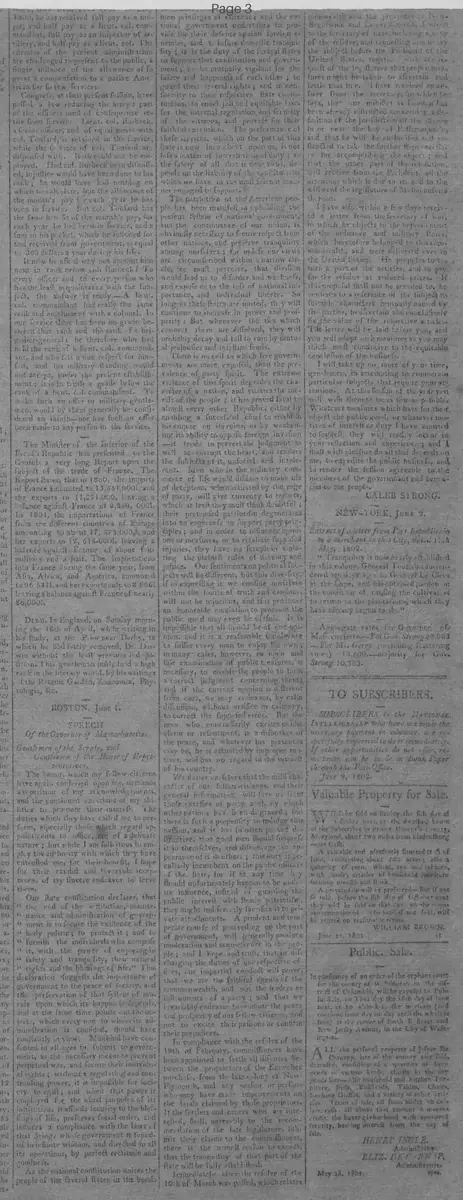
BOSTON, June 1.
SPEECH
Of the Governor of Massachusetts.
Gentlemen of the Senate, and Gentlemen of the House of Representatives,
The honor, which my fellow-citizens have again conferred upon me, demands a repetition of my acknowledgements, and the continued exertions of my abilities to promote their interest. The duties which they have called me to perform, especially those which regard appointments to office, are of a delicate nature: but while I am solicitous to employ the authority with which they have entrusted me, for their benefit, I hope for their candid and favorable acceptance, of my sincere endeavor to serve them.
Our state constitution declares, that "the end of the institution, maintenance and administration of government is to secure the existence of the body politic; to protect it; and to furnish the individuals who compose it, with the power of enjoying in safety and tranquility, their natural rights and the blessings of life." This declaration suggests the importance of government to the peace of society, and the preservation of that system of morals upon which its happiness depends, and at the same time points out the object, which every one to whom its administration is confided, should have constantly in view. Mankind have consented in all ages to submit to government, as the necessary means to prevent perpetual war, and secure their individual rights; without a regulating and controuling power, it is impossible for society to exist; and when that power is employed for the usual purposes of its institution, it affords security to the blessings of life, preserves social order, and induces a compliance with the laws from that Being, whose government is founded in infinite wisdom, and directed in all its operations, by perfect rectitude and goodness.
As the national constitution unites the people of the several states in the bonds of common privileges of citizens; and the national government undertakes to provide for their defence against foreign enemies, and to insure domestic tranquility; it is the duty of the several states to support that constitution and government; to be mutually vigilant for the safety and happiness of each other; to guard their several rights; and in conformity to their respective state constitutions, to enact just and equitable laws for the internal regulation and security of the citizens, and provide for their faithful execution. The performance of these services, which on the part of this state is now incumbent upon you, is not less a matter of interest than of duty; as the safety of all that is dear to us, depends on the stability of the institutions which we have in the most solemn manner engaged to support.
The patriotism of the American people has been manifest in establishing the present system of national government, and the continuance of our union, is obviously necessary to secure respect from other nations, and preserve tranquility among ourselves; for unless our views are circumscribed within a narrow circle, we must perceive, that division would lead us to disorder and weakness, and expose us to the loss of national importance, and individual liberty. So long as these states are united, they will continue to increase in power and prosperity: But wherever the ties which connect them are dissolved, they will probably decay and fall to ruin by mutual jealousies and intestine feuds.
There is no evil to which free governments are more exposed, than the prevalence of party spirit. The extreme violence of this spirit degrades the character of a nation, and vitiates the morals of the people; it has proved fatal to almost every other Republic, either by enabling a successful chief to establish his empire on its ruins, or by weakening its ability to oppose foreign invasion--it tends to pervert the judgment as well as corrupt the heart, and renders the subjects of it, unsocial and intolerant. Men who in the ordinary commerce of life would disdain to make use of deception, when actuated by the rage of party, will give currency to reports, which at least they must think doubtful; their pretended patriotism degenerates into an eagerness to support party principles; and in order to influence opinions or measures, or to retaliate supposed injuries, they have no scruples in violating the plainest rules of decency and justice. Our sentiments on political subjects will be different, but this diversity, if in expressing it we confine ourselves within the limits of truth and candour, will not be injurious, and if it produces an honorable emulation to promote the public good may even be useful. It is impossible that all should be of one opinion. and it is a reasonable indulgence to suffer every man to enjoy his own; in many cases, however, an open and fair examination of public measures, is necessary, to enable the people to form a correct judgment concerning them; and if the current opinion is different from ours, we may endeavor, by calm discussion, without artifice or calumny, to correct the supposed error. But the man who unnecessarily excites public alarm or resentment, is a disturber of the peace, and whatever his pretences may be, he is actuated by improper motives. and has no regard to the interest of his country.
We flatter ourselves that the mild character of our fellow-citizens, and their general information. will save us from those excesses of party zeal, by which other nations have been disgraced; but there is such a propensity to indulge this passion, and it has so often proved destructive, that good men should suppress it in themselves, and discourage the appearance of it in others; this duty is peculiarly incumbent on the public officers of the state, for if at any time they should unfortunately happen to be under its influence, instead of guarding the public interest with steady patriotism, they might indirectly sacrifice it to private attachments. A prudent and temperate course of proceeding on the part of government, will generally produce moderation and acquiescence in the people; and I hope and trust, that in discharging the duties of our respective offices, our impartial conduct will prove, that we are the faithful agents of the commonwealth, and not the leaders or instruments of a party; and that we invariably endeavor to promote the peace and prosperity of our fellow-citizens, and not to excite their passions or confirm their prejudices.
In compliance with the resolve of the 19th of February, commissioners have been appointed to settle all disputes between the proprietors of the Kennebec purchase, from the late colony of New Plymouth, and any person or persons who may have made improvements on the lands claimed by those proprietors. If the settlers and others who are interested, shall, agreeably to the recommendation of the late legislature, submit their claims to the commissioners. there is the strongest reason to expect, that the tranquility of that part of the state will be fully established.
Immediately after the resolve of the 10th of March was passed, which relates to the commonwealth and the proprietors of New-Brunswick and Lower Canada, I wrote to the secretary of state, enclosing a copy of the resolve, and requesting him to lay the subject before the President of the United States, together with the request of the legislature that proper measures might be taken to ascertain and settle that line. I have received an answer from the secretary. in which he says, that our minister at London has been already instructed concerning a definition of the jurisdiction of the islands in or near the bay of Passamaquoddy, and that he will be authorized and instructed to take the further steps necessary for accomplishing the object; and that the other part of the resolution will receive from the President. all the attention which is due to it. and to the wishes of the legislature of Massachusetts thereon.
I have also within a few days received a letter from the secretary of war, in which he objects to the original estimates of the ordnance and military stores, which heretofore belonged to this commonwealth, and were delivered over to the United States. He proposes to return a part of the articles, and to pay for the residue at reduced prices. If this proposal shall not be acceded to, he consents to a reference of the subject to suitable characters mutually named by the parties, to ascertain and conclusively fix the value of the respective articles. The letter will be laid before you, and you will adopt such measures as you may think most conducive to the equitable conclusion of the business.
I will take up no more of your time, gentlemen. in attempting to enumerate particular subjects that require your attention. At this season of the year you will wish them to be as few as possible. Whatever measures which have for their object the public good, or whatever motives of interest or duty I have omitted to suggest, they will readily occur to your reflection and experience; and I shall with pleasure do all that depends on me, to expedite the public business, and to render the session agreeable to the members of the government and beneficial to the people.
CALEB STRONG.
SPEECH
Of the Governor of Massachusetts.
Gentlemen of the Senate, and Gentlemen of the House of Representatives,
The honor, which my fellow-citizens have again conferred upon me, demands a repetition of my acknowledgements, and the continued exertions of my abilities to promote their interest. The duties which they have called me to perform, especially those which regard appointments to office, are of a delicate nature: but while I am solicitous to employ the authority with which they have entrusted me, for their benefit, I hope for their candid and favorable acceptance, of my sincere endeavor to serve them.
Our state constitution declares, that "the end of the institution, maintenance and administration of government is to secure the existence of the body politic; to protect it; and to furnish the individuals who compose it, with the power of enjoying in safety and tranquility, their natural rights and the blessings of life." This declaration suggests the importance of government to the peace of society, and the preservation of that system of morals upon which its happiness depends, and at the same time points out the object, which every one to whom its administration is confided, should have constantly in view. Mankind have consented in all ages to submit to government, as the necessary means to prevent perpetual war, and secure their individual rights; without a regulating and controuling power, it is impossible for society to exist; and when that power is employed for the usual purposes of its institution, it affords security to the blessings of life, preserves social order, and induces a compliance with the laws from that Being, whose government is founded in infinite wisdom, and directed in all its operations, by perfect rectitude and goodness.
As the national constitution unites the people of the several states in the bonds of common privileges of citizens; and the national government undertakes to provide for their defence against foreign enemies, and to insure domestic tranquility; it is the duty of the several states to support that constitution and government; to be mutually vigilant for the safety and happiness of each other; to guard their several rights; and in conformity to their respective state constitutions, to enact just and equitable laws for the internal regulation and security of the citizens, and provide for their faithful execution. The performance of these services, which on the part of this state is now incumbent upon you, is not less a matter of interest than of duty; as the safety of all that is dear to us, depends on the stability of the institutions which we have in the most solemn manner engaged to support.
The patriotism of the American people has been manifest in establishing the present system of national government, and the continuance of our union, is obviously necessary to secure respect from other nations, and preserve tranquility among ourselves; for unless our views are circumscribed within a narrow circle, we must perceive, that division would lead us to disorder and weakness, and expose us to the loss of national importance, and individual liberty. So long as these states are united, they will continue to increase in power and prosperity: But wherever the ties which connect them are dissolved, they will probably decay and fall to ruin by mutual jealousies and intestine feuds.
There is no evil to which free governments are more exposed, than the prevalence of party spirit. The extreme violence of this spirit degrades the character of a nation, and vitiates the morals of the people; it has proved fatal to almost every other Republic, either by enabling a successful chief to establish his empire on its ruins, or by weakening its ability to oppose foreign invasion--it tends to pervert the judgment as well as corrupt the heart, and renders the subjects of it, unsocial and intolerant. Men who in the ordinary commerce of life would disdain to make use of deception, when actuated by the rage of party, will give currency to reports, which at least they must think doubtful; their pretended patriotism degenerates into an eagerness to support party principles; and in order to influence opinions or measures, or to retaliate supposed injuries, they have no scruples in violating the plainest rules of decency and justice. Our sentiments on political subjects will be different, but this diversity, if in expressing it we confine ourselves within the limits of truth and candour, will not be injurious, and if it produces an honorable emulation to promote the public good may even be useful. It is impossible that all should be of one opinion. and it is a reasonable indulgence to suffer every man to enjoy his own; in many cases, however, an open and fair examination of public measures, is necessary, to enable the people to form a correct judgment concerning them; and if the current opinion is different from ours, we may endeavor, by calm discussion, without artifice or calumny, to correct the supposed error. But the man who unnecessarily excites public alarm or resentment, is a disturber of the peace, and whatever his pretences may be, he is actuated by improper motives. and has no regard to the interest of his country.
We flatter ourselves that the mild character of our fellow-citizens, and their general information. will save us from those excesses of party zeal, by which other nations have been disgraced; but there is such a propensity to indulge this passion, and it has so often proved destructive, that good men should suppress it in themselves, and discourage the appearance of it in others; this duty is peculiarly incumbent on the public officers of the state, for if at any time they should unfortunately happen to be under its influence, instead of guarding the public interest with steady patriotism, they might indirectly sacrifice it to private attachments. A prudent and temperate course of proceeding on the part of government, will generally produce moderation and acquiescence in the people; and I hope and trust, that in discharging the duties of our respective offices, our impartial conduct will prove, that we are the faithful agents of the commonwealth, and not the leaders or instruments of a party; and that we invariably endeavor to promote the peace and prosperity of our fellow-citizens, and not to excite their passions or confirm their prejudices.
In compliance with the resolve of the 19th of February, commissioners have been appointed to settle all disputes between the proprietors of the Kennebec purchase, from the late colony of New Plymouth, and any person or persons who may have made improvements on the lands claimed by those proprietors. If the settlers and others who are interested, shall, agreeably to the recommendation of the late legislature, submit their claims to the commissioners. there is the strongest reason to expect, that the tranquility of that part of the state will be fully established.
Immediately after the resolve of the 10th of March was passed, which relates to the commonwealth and the proprietors of New-Brunswick and Lower Canada, I wrote to the secretary of state, enclosing a copy of the resolve, and requesting him to lay the subject before the President of the United States, together with the request of the legislature that proper measures might be taken to ascertain and settle that line. I have received an answer from the secretary. in which he says, that our minister at London has been already instructed concerning a definition of the jurisdiction of the islands in or near the bay of Passamaquoddy, and that he will be authorized and instructed to take the further steps necessary for accomplishing the object; and that the other part of the resolution will receive from the President. all the attention which is due to it. and to the wishes of the legislature of Massachusetts thereon.
I have also within a few days received a letter from the secretary of war, in which he objects to the original estimates of the ordnance and military stores, which heretofore belonged to this commonwealth, and were delivered over to the United States. He proposes to return a part of the articles, and to pay for the residue at reduced prices. If this proposal shall not be acceded to, he consents to a reference of the subject to suitable characters mutually named by the parties, to ascertain and conclusively fix the value of the respective articles. The letter will be laid before you, and you will adopt such measures as you may think most conducive to the equitable conclusion of the business.
I will take up no more of your time, gentlemen. in attempting to enumerate particular subjects that require your attention. At this season of the year you will wish them to be as few as possible. Whatever measures which have for their object the public good, or whatever motives of interest or duty I have omitted to suggest, they will readily occur to your reflection and experience; and I shall with pleasure do all that depends on me, to expedite the public business, and to render the session agreeable to the members of the government and beneficial to the people.
CALEB STRONG.
What sub-type of article is it?
Politics
What keywords are associated?
Governor Speech
Massachusetts Legislature
National Union
Party Spirit
Kennebec Purchase
Passamaquoddy Boundary
Military Stores
What entities or persons were involved?
Caleb Strong
Where did it happen?
Boston
Domestic News Details
Primary Location
Boston
Event Date
June 1.
Key Persons
Caleb Strong
Event Details
Governor Caleb Strong addresses the Senate and House of Representatives on government duties, national union, party spirit dangers, Kennebec land dispute commissioners, Passamaquoddy boundary resolution with federal government, and military stores valuation dispute.