Thank you for visiting SNEWPapers!
Sign up free
The Daily Herald
New Haven, New Haven County, Connecticut
What is this article about?
The steamer Great Western arrived in New York from Bristol on March 23 (23 days voyage), bringing London papers reporting a likely resignation of the British Ministry after defeats in Parliament on Irish affairs, and updates on the pacific U.S.-Britain relations regarding the Maine boundary dispute, with commentary from various journals emphasizing avoidance of war.
Merged-components note: Merged sequential components in the same column that continue coverage of news from the Great Western steamer regarding the boundary question and British politics.
Clipping
OCR Quality
Full Text
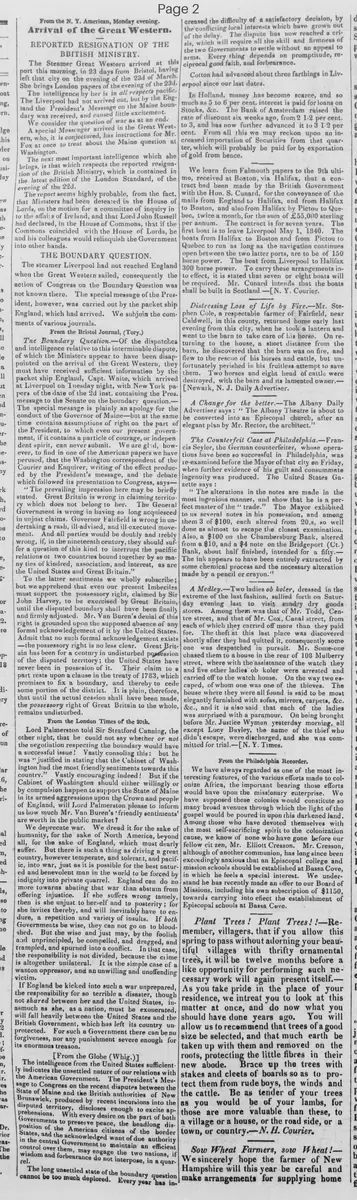
Arrival of the Great Western.
REPORTED RESIGNATION OF THE
BRITISH MINISTRY.
The Steamer Great Western arrived at this port this morning, in 23 days from Bristol, having left that city on the evening of the 23d of March. She brings London papers of the evening of the 23d. The Liverpool had not arrived out, but by the England, who, it is conjectured, has instructions for Mr. Fox at once to treat about the Maine question at Washington. The intelligence by her is in all respects pacific. The President's Message on the Maine boundary was received, and caused little excitement. We consider the question of war as at an end. A special Messenger arrived in the Great Western. The next most important intelligence which she brings, is that which respects the reported resignation of the British Ministry, which is contained in the latest edition of the London Standard, of the evening of the 22d. The report seems highly probable, from the fact that Ministers had been defeated in the House of Lords, on the motion for a committee of inquiry into the affairs of Ireland, and that Lord John Russell had declared, in the House of Commons, that if the Commons coincided with the House of Lords, he and his colleagues would relinquish the Government into other hands.
THE BOUNDARY QUESTION.
The steamer Liverpool had not reached England when the Great Western sailed, consequently the action of Congress on the Boundary Question was not known there. The special message of the President, however, was carried out by the packet ship England, which had arrived. We subjoin the comments of various journals.
From the Bristol Journal, (Tory.)
The Boundary Question.-Of the dispatches and intelligence relative to this interminable dispute, of which the Ministers appear to have been disappointed on the arrival of the Great Western, they must have received sufficient information by the packet ship England, Capt. Waite, which arrived at Liverpool on Tuesday night, with New York papers of the date of the 2d inst. containing the Pres. message to the Senate on the boundary question.—The special message is plainly an apology for the conduct of the Governor of Maine—but at the same time contains assumptions of right on the part of the President, to which even our present government, if it contains a particle of courage, or independent spirit, can never submit. We are glad, however, to find in one of the American papers we have perused, that the Washington correspondent of the Courier and Enquirer, writing of the effect produced by the President's message, and the debate which followed its presentation to Congress, says— "The prevailing impression here may be briefly stated. Great Britain is wrong in claiming territory which does not belong to her. The General Government is wrong in having so long acquiesced in unjust claims. Governor Fairfield is wrong in undertaking a rash, ill-advised, and ill-executed movement. And all parties would be doubly and trebly wrong, if, in the nineteenth century, they should suffer a question of this kind to interrupt the pacific relations of two countries bound together by so many ties of kindred, association, and interest, as are the United States and Great Britain." To the latter sentiments we wholly subscribe; but we apprehend that even our present Imbeciles must support the possessory right, claimed by Sir John Harvey, to be exercised by Great Britain, until the disputed boundary shall have been finally and firmly adjusted. Mr. Van Buren's denial of this right is grounded upon the supposed absence of any formal acknowledgement of it by the United States. Admit that no such formal acknowledgement exists—the possessory right is no less clear. Great Britain has been for a century in undisturbed possession of the disputed territory; the United States have never been in possession of it. Their claim to a part rests upon a clause in the treaty of 1783, which promises to fix a boundary, and thereby to cede some portion of the district. It is plain, therefore, that until the actual cession shall have been made, the possessory right of Great Britain to the whole, remains undisturbed.
From the London Times of the 20th,
Lord Palmerston told Sir Stratford Canning, the other night, that he could not say whether or not the negotiation respecting the boundary would have a successful issue! Vastly consoling this: but he was "justified in stating that the Cabinet of Washington had the most friendly sentiments towards this country." Vastly encouraging indeed! But if the Cabinet of Washington should either willingly or by compulsion happen to support the State of Maine in its armed aggressions upon the Crown and people of England, will Lord Palmerston please to inform us how much Mr. Van Buren's 'friendly sentiments are worth in the public market? We deprecate war. We dread it for the sake of humanity, for the sake of North America, beyond all, for the sake of England, which must dearly suffer. But there is such a thing as driving a great country, however temperate, and tolerant, and pacific, into war, just as it is possible for the best natured and benevolent man in the world to be forced by indignity into private quarrel. England can do no more towards abating that war than abstain from offering injustice. If she suffers wrong tamely, then is she unjust to herself and to posterity; for she invites thereby, and will inevitably have to endure, a repetition and variety of insults. If both Governments be wise, they can not go on to bloodshed. But the wise and just may, by the foolish and unprincipled, be compelled, and dragged, and trampled, and spurned into a conflict. In that case, the responsibility is not divided, because the crime is altogether unilateral. It is the simple case of a wanton oppressor, and an unwilling and unoffending victim. If England be kicked into such a war unprepared, the responsibility for so terrible a disaster, though not shared between her and the United States, inasmuch as she, as a nation, must be exonerated, will fall heavily between the United States and the British Government, which has left its country unprotected. For such a Government there can be no forgiveness, nor any punishment severe enough for its enormous treason.
[From the Globe (Whig.)]
The intelligence from the United States sufficiently indicates the unsettled nature of our relations with the American Government. The President's Message to Congress on the recent disputes between the State of Maine and the British authorities of New Brunswick, produced by recent incursions into the disputed territory, discloses enough to excite apprehensions. With every desire on the part of both Governments to preserve peace, the headlong disposition of the American citizens of the border States, and the acknowledged want of due authority in the central Government to maintain an efficient control over them, may engage the two nations, if wisdom and forbearance do not interpose, in a quarrel. The long unsettled state of the boundary question cannot be too much deplored. Every year has increased the difficulty of a satisfactory decision, by the conflicting local interests which have grown out of the delay. The dispute has now reached a crisis, which will require all the skill and firmness of the two Governments to settle without an appeal to arms. Every thing depends on promptitude, reciprocal good faith, and forbearance.
What sub-type of article is it?
What keywords are associated?
What entities or persons were involved?
Where did it happen?
Foreign News Details
Primary Location
London
Event Date
Evening Of The 23d Of March
Key Persons
Outcome
reported probable resignation of british ministry after defeats in house of lords on irish inquiry and potential in commons; pacific intelligence on maine boundary question with no war excitement and calls for peaceful resolution
Event Details
Steamer Great Western arrived from Bristol with London papers reporting British Ministry's defeat in House of Lords on Ireland inquiry motion and Lord John Russell's statement on potential resignation if Commons agrees; updates on Maine boundary dispute via President's message, viewed as pacific with journal commentaries emphasizing avoidance of war and Britain's possessory rights