Thank you for visiting SNEWPapers!
Sign up free
The Kentucky Gazette
Lexington, Fayette County, Kentucky
What is this article about?
An anonymous letter to Senator Humphrey Marshall criticizes his defense of proscribed Tories and justification of concessions in Jay's Treaty, arguing it delays and compromises U.S. rights to western posts already secured in 1783, while questioning British compliance and treaty equity.
Merged-components note: These two components form a single continued letter to Humphrey Marshall criticizing the treaty, spanning pages 1 and 2 with sequential reading orders.
Clippings
1 of 2
OCR Quality
Full Text
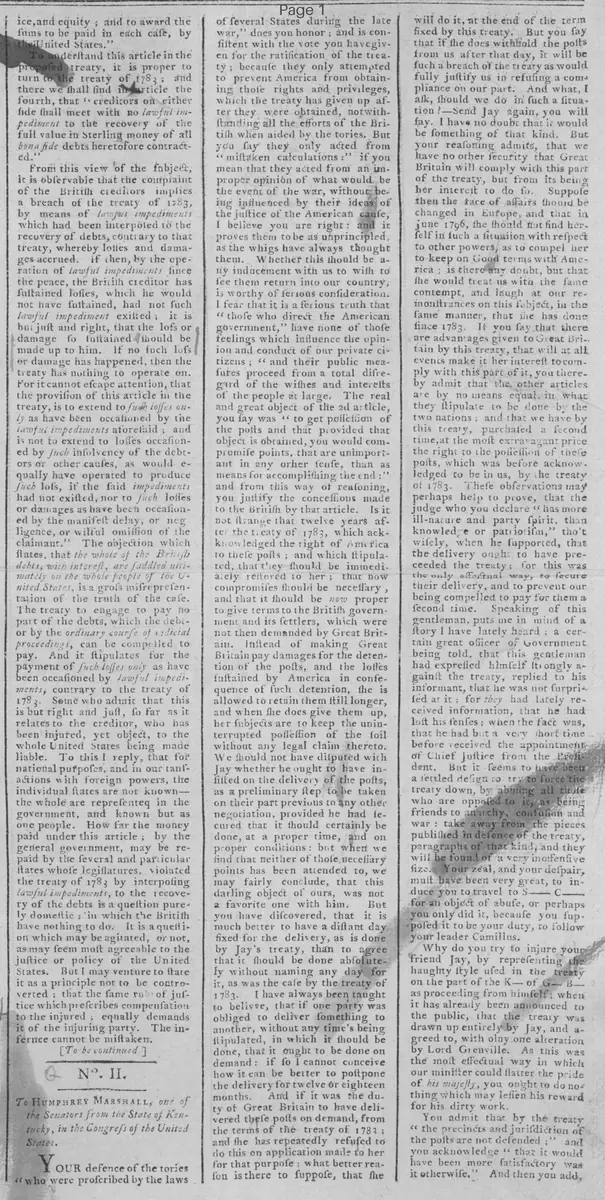
To HUMPHREY MARSHALL, one of the Senators from the State of Kentucky, in the Congress of the United States.
Your defence of the tories "who were proscribed by the laws of several States during the late war," does you honor; and is consistent with the vote you have given for the ratification of the treaty; because they only attempted to prevent America from obtaining those rights and privileges, which the treaty has given up after they were obtained, notwithstanding all the efforts of the British when aided by the tories. But you say they only acted from "mistaken calculations:" if you mean that they acted from an improper opinion of what would be the event of the war, without being influenced by their ideas of the justice of the American cause, I believe you are right: and it proves them to be as unprincipled, as the whigs have always thought them. Whether this should be any inducement with us to wish to see them return into our country, is worthy of serious consideration. I fear that it is a serious truth that "those who direct the American government," have none of those feelings which influence the opinion and conduct of our private citizens; "and their public measures proceed from a total disregard of the wishes and interests of the people at large. The real and great object of this 2d article, you say was 'to get possession of the posts and that provided that object is obtained, you would compromise points, that are unimportant in any other sense, than as means for accomplishing the end:' and from this way of reasoning, you justify the concessions made to the British by that article. Is it not strange that twelve years after the treaty of 1783, which acknowledged the right of America to these posts; and which stipulated, that they should be immediately restored to her; that now compromises should be necessary, and that it should be now proper to give terms to the British government and its settlers, which were not then demanded by Great Britain. Instead of making Great Britain pay damages for the detention of the posts, and the losses sustained by America in consequence of such detention, she is allowed to retain them still longer, and when she does give them up, her subjects are to keep the uninterrupted possession of the soil without any legal claim thereto. We should not have disputed with Jay whether he ought to have insisted on the delivery of the posts, as a preliminary step to be taken on their part previous to any other negotiation, provided he had secured that it should certainly be done, at a proper time, and on proper conditions: but when we find that neither of those necessary points has been attended to, we may fairly conclude, that this darling object of ours, was not a favorite one with him. But you have discovered, that it is much better to have a distant day fixed for the delivery, as is done by Jay's treaty, than to agree that it should be done absolutely without naming any day for it, as was the case by the treaty of 1783. I have always been taught to believe, that if one party was obliged to deliver something to another, without any time's being stipulated, in which it should be done, that it ought to be done on demand: if so I cannot conceive how it can be better to postpone the delivery for twelve or eighteen months. And if it was the duty of Great Britain to have delivered these posts on demand, from the terms of the treaty of 1783; and she has repeatedly refused to do this on application made to her for that purpose; what better reason is there to suppose, that she will do it at the end of the term fixed by this treaty. But you say that if she does withhold the posts from us after that day, it will be such a breach of the treaty as would fully justify us in refusing a compliance on our part. And what, I ask, should we do in such a situation?—Send Jay again, you will say. I have no doubt that it would be something of that kind. But your reasoning admits, that we have no other security that Great Britain will comply with this part of the treaty, but from its being her interest to do so. Suppose then the face of affairs should be changed in Europe, and that in June 1796, she should not find herself in such a situation with respect to other powers, as to compel her to keep on good terms with America; is there any doubt, but that she would treat us with the same contempt, and laugh at our remonstrances on this subject, in the same manner, that she has done since 1783. If you say that there are advantages given to Great Britain by this treaty, that will at all events make it her interest to comply with this part of it, you thereby admit that the other articles are by no means equal, in what they stipulate to be done by the two nations; and that we have by this treaty, purchased a second time, at the most extravagant price the right to the possession of these posts, which was before acknowledged to be in us, by the treaty of 1783. These observations may perhaps help to prove, that the judge who you declare "has more ill-nature and party spirit, than knowledge or patriotism," thought wisely, when he supported, that the delivery ought to have preceded the treaty; for this was the only effectual way, to secure their delivery, and to prevent our being compelled to pay for them a second time. Speaking of this gentleman, puts me in mind of a story I have lately heard; a certain great officer of Government being told, that this gentleman had expressed himself strongly against the treaty, replied to his informant, that he was not surprised at it; for they had lately received information, that he had lost his senses; when the fact was, that he had but a very short time before received the appointment of Chief Justice from the President. But it seems to have been a settled design to try to force the treaty down, by abusing all those who are opposed to it, as being friends to anarchy, confusion and war: take away from the pieces published in defence of the treaty, paragraphs of that kind, and they will be found of a very inoffensive size. Your zeal, and your despair, must have been very great, to induce you to travel to S--C-- for an object of abuse, or perhaps you only did it, because you supposed it to be your duty, to follow your leader Camillus. Why do you try to injure your friend Jay, by representing the haughty style used in the treaty on the part of the K-- of G-- B: as proceeding from himself; when it has already been announced to the public, that the treaty was drawn up entirely by Jay, and agreed to, with only one alteration by Lord Grenville. As this was the most effectual way in which our minister could flatter the pride of his majesty, you ought to do nothing which may lessen his reward for his dirty work. You admit that by the treaty "the precincts and jurisdiction of the posts are not defined;" and you acknowledge "that it would have been more satisfactory was it otherwise." And then you add,
Yet I flatter myself that this objection will be thought to yield to arguments which may be offered. Certainly like other actors you intended to have said this aside; and could never have meant, however consistent it may be with truth, to tell us that you were arguing against your own conviction; and that although you did not believe what you said, you thought that "the well disposed people of Kentucky" are such fools as to suppose every part of it to be as true as holy writ. I would advise you to be more cautious hereafter, as to the persons to whom you confide your real sentiments. But you say the words precinct and jurisdiction, mean the same thing, and are sufficiently certain as to the extent of ground they include. If they do mean the same thing, why the difference which we find in the wording of this part of the clause, by which it is declared, that the U. S. may extend their settlements to any part within the said boundary line except within the said precinct and jurisdiction of any of the said posts: all settlers and traders within the precincts or jurisdiction of the said posts, shall continue &c. From this I should suppose, that they must have been intended to convey different ideas, and that the precinct may mean the country immediately round the posts; and the jurisdiction, include all the country subject to orders to be given at those posts. But how can the meaning of the term "precinct," be precise and certain, when you declare, that in common acceptation both in England and America it means a small district of about ten or twelve miles in extent; and when you also declare that in military language it means, that ground which the cannon of a post can command, and to which it can extend its protection. Your own inconsistencies must prove, that these terms convey no fixed or certain idea. and therefore that it will be in the power of the British, to put such a meaning on them, as will serve to prevent us from erecting a post in any part of that country. But you say we shall get these posts by the treaty, as soon as we could make the necessary arrangements to receive them. Would it take from November 1794 to June 1796, to march our troops from the most advanced American posts to those to be delivered to us? For shame, do not attempt to impose such ridiculous assertions, for reasons.
[To be continued.]
What sub-type of article is it?
What themes does it cover?
What keywords are associated?
What entities or persons were involved?
Letter to Editor Details
Recipient
Humphrey Marshall, One Of The Senators From The State Of Kentucky, In The Congress Of The United States
Main Argument
criticizes marshall's defense of tories and support for jay's treaty, arguing it unjustly concedes american rights to western posts already secured in 1783, delays delivery without guarantees, and favors british interests over u.s. sovereignty.
Notable Details