Thank you for visiting SNEWPapers!
Sign up free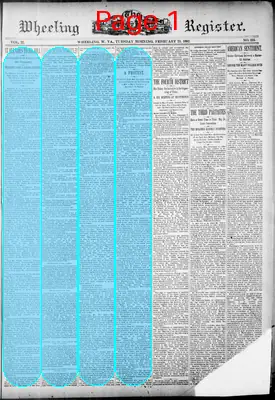
Wheeling Register
Wheeling, Ohio County, West Virginia
What is this article about?
The 1892 New York Democratic State Convention in Albany endorses David B. Hill for president, adopts a platform on finance and tariff reform, and instructs delegates to vote unanimously for him at the national convention. Anti-Hill faction protests and plans a rival meeting. (214 characters)
Merged-components note: These components form a continuous article on the Albany Democratic Convention, split across columns on page 1 due to initial parsing; sequential reading orders (3-6) and text flow confirm they belong to the same logical story unit.
Clipping
OCR Quality
Full Text
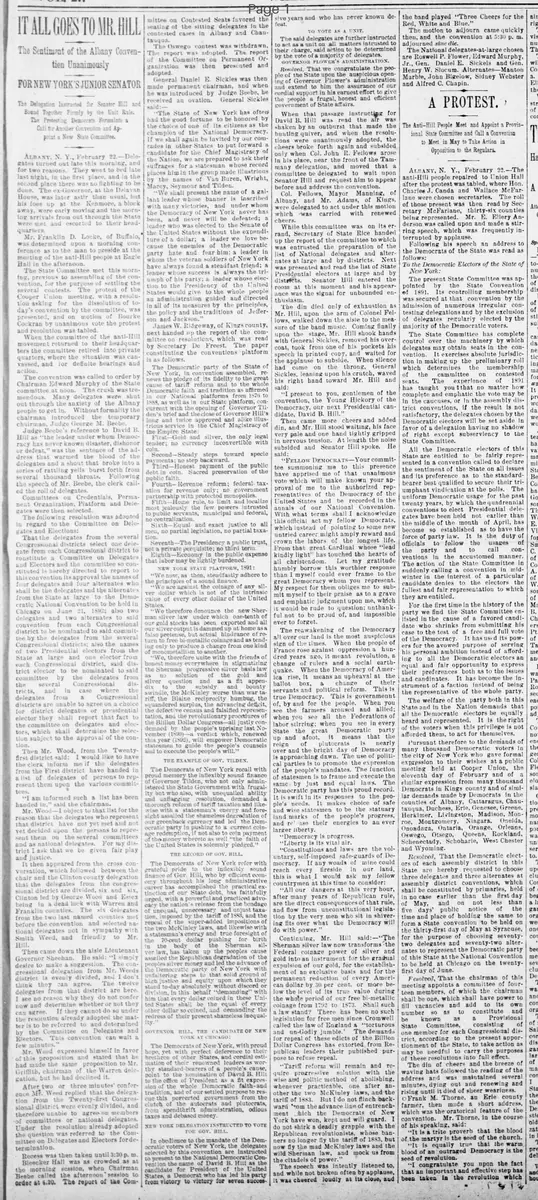
The Service of the Albany Convention Unanimously
FOR NEW YORK'S JUNIOR SENATOR.
The Delegation Instructed for Senator Hill and
Bound Together Firmly by the Unit Rule.
The Protesting Democrats Formulate a
Call for Another Convention and Ap-
point a New State Committee.
ALBANY, N. Y., February 23.—Delegates turned out late this morning, and
for two reasons. They went to bed late
last night, in the first place, and in the
second place there was no fighting to be
done. The ex-Governor, at the Delavan
House, was later astir than usual, but
his foes up at the Kenmore, a block
away, were early moving and the morn-
ing arrivals from out through the State
were met and escorted to their head-
quarters.
Mr. Franklin D. Locke, of Buffalo,
was determined upon a morning con-
ference as to the man to preside at the
meeting of the anti-Hill people at Eagle
Hall in the afternoon.
The State Committee met this morn-
ing, previous to assembling of the con-
vention, for the purpose of settling the
several contests. The protest of the
Cooper Union meeting, with a resolu-
tion asking for the dissolution of to-
day's convention by the committee, was
presented, and on motion of Bourke
Cockran by unanimous vote the protest
and resolution was tabled.
When the committee of the anti-Hill
movement returned to their headquar-
ters the committee retired into private
quarters, where the situation was can-
vassed, and for definite hearings and
action,
The convention was called to order by
Chairman Edward Murphy of the State
committee at noon. The crush was tre-
mendous. Many delegates were shut
out through the anxiety of the Albany
people to get in. Without formality the
chairman introduced the temporary
chairman, Judge George M. Beebe.
Judge Beebe's reference to David B.
Hill as "the leader under whom Democ-
racy has never known disaster, dishonor
or defeat," was the sentence of the ad-
dress that warmed the blood of the
delgates and a shout that broke into a
series of rattling yells burst forth from
several thousand throats. Following
the speech of Mr. Beebe, the clerk call-
ed the roll of delegates.
Committees on Credentials, Perma-
neat Organization, Platform and Dele-
gates were then selected.
The following resolution was adopted
in regard to the Committee on Dele
gates and Elections:
That the delegates from the several
Congressional districts select one dele-
gate from each Congressional district to
constitute a Committee on Delegates
and Electors and the committee so con-
stituted is hereby directed to report to
this convention its approval the names of
four delegates and four alternates who
shall be the delegates and the alternates
from the State at large to the Demo-
cratic National Convention to be held in
Chicago on June 21, 1892; also two
delgates and two alternates to said
convention from each Congressional
district to be nominated to said commit-
tee by the delegates from the several
Congressional districts; also the names
of two Presidential electors from the
State at large and one elector from
each Congressional district, said dis-
triet elector to be nominated to said
committee by
the delegates from
the
several
Congressional
dis-
triets,
and in case
where
the
delgates from
a
Congressional
districts are unable to agree on a choice
for district delegates or presidential
elector they shall report that fact to
the committee on delegates and elec-
tors, which shall determine the selec-
tion subject to the approval of the con-
tion.
Then Mr. Wood, from the Twenty-
first district said: I would like to have
the clerk inform me if the delegates
from the First district have handed in
a list of delegates of persons to rep-
resent them upon the various commit-
tees.
I am informed such a list has been
handed in," said the chairman.
Mr. Wood—I object to that list for the
reason that the delegates who represent
that district have not yet met and not
yet decided upon the persons to repre-
sent them on the several committees
and as national delegates. For my dis-
triet I ask that we be given fair play
and justice.
It then appeared from the cross con-
versation, which followed between the
chair and the Clinton county delegation
that the delegates from the congres-
sional district are divided, six and six,
Clinton led by George Wood and Essex
being in a dead lock with Warren and
Franklin counties. The six delegates
from the two last named counties met
before the convention and selected na-
tional delegates not in sympathy with
Smith Weed, and
friendly
to Mr.
Hill.
Then came down the aisle Lieutenant
Governor Sheehan. He said: "I simply
desire to make a suggestion. The con-
gressional delegation from Mr. Weed's
district is evenly divided, and I don't
think they can agree. The twelve
delgates from that district are here.
I see no reason why they do not confer
now and determine whether or not they
can agree. If they cannot do so under
the resolution already adopted the mat-
ter is to be referred to and determined
by the Committee on Delegates and
Electors. This convention can wait a
few minutes."
Mr. Wood expressed himself in favor
of this proposition and stated that he
had made the same proposition to Mr.
Griffith, chairman of the Warren dele-
gation, but he had declined it.
After two or three minutes' confer-
ence Mr. Weed replied that the delega-
tion from the Twenty-first Congres-
sional district were evenly divided, and
therefore unable to agree on members
of committees or national delegates.
Under the resolution already adopted
the question was referred to the Com-
mittee on Delegates and Electors for de-
termination.
Recess was then taken until 3:30 p. m.
Bleecker Hall was as crowded as at
the morning session, when Chairman
Beebe called the afternoon session to
order at 4:20. The report of the Com-
mittee on Contested Seats favored the
seating of the sitting delegates in the
contested cases in Albany and Chau-
tauqua.
The Oswego contest was withdrawn.
The report was adopted. The report
of the Committee on Permanent Or-
ganization was then presented and
adopted.
General Daniel E. Sickles was then
made permanent chairman, and when
he was introduced by Judge Beebe, he
received an ovation. General Sickles
said:-
"The State of New York has often
had the good fortune to be honored by
the choice of one of its citizens as the
champion of the National Democracy.
If we shall again be invited by our com-
rades in other States to put forward a
candidate for the Chief Magistracy of
the Nation, we are prepared to ask their
suffrages for a statesman whose record
places him in the group made illustrious
by the names of Van Buren, Wright,
Marcy, Seymour and Tilden.
"We shall present the name of a gal-
lant leader whose banner is inscribed
with many victories, and under whom
the Democracy of New York never has
been, and never will be defeated; a
leader who was elected to the Senate of
the United States without the expendi-
ture of a dollar; a leader we love be-
cause the enemies of the Democratic
party hate and fear him; a leader in
whom the veteran soldiers of New York
have always found a steadfast friend; a
leader whose success is always the tri-
umph of his party; a leader whose elec-
tion to the Presidency of the United
States would give to the whole people
an administration guided and directed
in all of its measures by the principles,
the policy and the traditions of Jefferson
and Jackson."
James W. Ridgeway, of Kings county,
next handed up the report of the com-
mittee on resolutions, which was read
by Secretary De Freest. The paper
constituting the convention's platform
is as follows.
The Democratic party of the State of
New York, in convention assembled, re-
news the pledge of its fidelity to the great
cause of tariff reform and to the whole
Democratic faith and tradition as affirmed
in our National platforms from 1870 to
1888, as well as in our State platform, con-
current with the opening of Governor Til-
den's brief and the close of Governor Hill's
long and twice approved and alike illus-
trious service in the Chief Magistracy of
the Empire State:
First—Gold and silver, the only legal
tender: no currency inconvertible with
coin.
Second—Steady steps toward
specie
payments: no step backward.
Third—Honest payment of the public
debt in coin. Sacred preservation of the
public faith.
Fourth—Revenue reform; federal. tax-
ation for revenue only: no government
partnership with protected monopolies.
Fifth—Home rule, to limit and localize
most jealously the few powers intrusted
to public servants, municipal and federal,
no centralization.
Sixth—Equal and exact justice to all
men, no partial legislation, no partial taxa-
tion.
Seventh—The Presidency a public trust,
not a private perquisite: no third term.
Eighth—Economy in the public expense
that labor may be lightly burdened.
NEW YORK STATE PLATFORM, 1891:
"We now, as then, steadfastly adhere to
the principles of a sound finance.
We are against the coinage of any sil-
ver dollar which is not of the intrinsic
value of every other dollar of the United
States.
"We therefore denounce the new Sher-
man silver law under which one-tenth of
our gold stocks has been exported and all
our silver output is dammed up at home as a
false pretense, but actual hindrance of re-
turn to free bi-metallic coinage and as tend-
ing only to produce a change from one kind
of monometallism to another.
"We, therefore unite with the friends of
honest money everywhere in stigmatizing
the Sherman progressive silver basis law
as no solution of the gold and
silver question and as a fit appendix to the subsidy and bounty
swindle, the McKinley worse than war ta-
riff, the Blaine reciprocity humbug, the
squandered surplus, the advancing deficit,
the defective census and falsified represen-
tation, and the revolutionary procedures of
the Billion Dollar Congress—all justly con-
demned by the people's uprising last No-
vember (1890)—a verdict which, renewed
this year (1892), will empower Democratic
statesmen to guide the people's counsels
and to execute the people's will."
THE EXAMPLE OF GOV. TILDEN.
The Democrats of New York recall with
proud memory the inflexibly sound finance
of Governor Tilden, who not only admin-
istered the State Government with frugal-
ity but who also, with unequalled ability
and unfagging resolution, demanded a
thorough reform of tariff taxation and like-
wise with a statesman's energy and fore-
sight assailed the shameless degradation of
our greenback currency and led the Dem-
ocratic party in pushing to a current coin-
age redemption, if not also to coin payment
of the money whereto as well "the faith of
the United States is solemnly pledged."
THE RECORD OF GOV. HILL.
The Democrats of New York refer with
grateful pride to the inflexibly sound
finance of Gov. Hill, who by efficient econ-
omy throughout his long administrative
career has accomplished the practical ex-
tinction of our State debt, has faithfully
urged, with a powerful and practiced advo-
cacy the nation's release from the bondage
of unequal, unnecessary and unjust taxa-
tion, imposed by the tariff of 1890, and the
repeal of the super-added impositions of
the two McKinley laws, and likewise with
a statesman's energy and true foresight of
the 70-cent dollar pushing for birth
in the body of the Sherman sil-
ver law, has taken up the people's cause
asseiled the Republican degradation of the
people's silver money and led the advance of
the Democratic party of New York with
unfaltering steps to that solid ground of
high justice and equity upon which they
stand to-day absolutely without discord or
division, in this behalf "demanding" with
him that every dollar coined in these Uni-
ted States shall be the equal of every
other dollar so coined, and demanding the
redress of their present shameless inequal-
ity."
GOVERNOR
HILL THE CANDIDATE OF NEW
YORK AT CHICAGO:
The Democrats of New York, with proud
hope, yet with perfect deference to their
brethren of other States, and cordial esti-
mation of their renowned leaders as wor-
thy standard-bearers of a people's cause,
point to the nomination of David B. Hill
to the office of President as a fit expres-
sion of the whole Democratic faith and
tradition, and of our settled purpose to res-
cue this perverted government from the
clutch of the autocrats and plutocrats,
from spendthrift administration, odious
taxes and debased money.
NEW YORK DELEGATION INSTRUCTED TO VOTE
FOR GOV. HILL.
In obedience to the mandate of the Dem-
ocratic voters of New York, the delegates
selected by this convention are instructed
to present to the National Democratic Con-
vention the name of David B. Hill as the
candidate for President of the United
States, a Democrat who has led his party
from victory to victory for seven succes-
sive years and who has never known de
feat.
TO VOTE AS A UNIT.
The said delegates are further instructed
to act as a unit on all matters intrusted to
their charge, said action to be determined
by the vote of a majority of delegates.
GOVERNOR FLOWER'S ADMINISTRATION.
Resolved, That we congratulate the peo-
ple of the State upon the auspicious open-
ing of Governor Flower's administration
and extend to him the assurance of our
cordial support in his earnest effort to give
the people a frugal, honest and efficient
government of State affairs.
When that passage instructing for
David B. Hill was read the air was
shaken by an outburst that made the
bunting quiver, and when the resolu-
tions were unanimously adopted, the
cheers broke forth again and subsided
only when Col. John R. Fellows arose
in his place, near the front of the Tam-
many delegation, and moved that a
committee be delegated to wait upon
Senator Hill and request him to appear
before and address the convention.
Col. Fellows, Mayor Manning, of
Albany, and Mr. Adams, of Kings,
were delegated to act under this motion
which was carried
with renewed
cheers.
While this committee was on its er-
rand, Secretary of State Rice handed
up the report of the committee to which
was entrusted the preparation of the
list of National delegates and alter-
nates at large and by districts. Next
was presented and read the list of State
Presidential electors at large and by
districts. Senator Hill entered the
room at this moment and his appear-
ance was the signal for unbounded en-
thusiasm.
The din died only of exhaustion as
Mr. Hill, upon the arm of Colonel Fel-
lows, walked down the aisle to the mea-
sure of the band music. Coming finally
upon the stage, Mr. Hill shook hands
with General Sickles, removed his over-
coat, took from one of his pockets his
speech in printed copy, and waited for
the applause to subside. When silence
had come on the throng, General
Sickles, leaning upon his crutch, waved
his right hand toward Mr. Hill and
said:
"I present to you, gentlemen of the
convention, the Young Hickory of the
Democracy, our next Presidential can-
didate, David B. Hill."
Then came more cheers and added
din, and Mr. Hill stood waiting, his face
very pale and one hand tightly gripped
in nervous tension. At length the noise
subsided and Senator Hill spoke. He
said:
"Fellow Democrats—Your commit-
tee summoning me to this presence
have apprised me of that unanimous
vote which will make known your ap-
proval of me to the authorized rep-
resentatives of the Democracy of the
United States and be recorded in the
annals of our National Convention.
With what terms shall I acknowledge
this official act my fellow Democrats,
which instead of pointing to some new
untried career might amply reward and
crown the labors of the longest life.
From that great Cardinal whose "lead
kindly light" has touched the hearts of
all Christendom. Let my gratitude
humbly borrow this worthier response
than I myself could ever frame to the
great Democracy whom you represent.
My respect for them obliges me to sub-
mit myself to their praise as to a grave
and emphatic judgment upon me, which
it would be rude to question; unthank-
ful not to be proud of, and impossible
ever to forget.
The reawakening of the Democracy
all over our land is the most auspicious
sign of the times. When the people of
France rose against oppression a hun-
dred years ago, it meant revolution, a
change of rulers and a social earth-
quake. When the Democracy of Amer-
ica rise, it means an upheaval at the
ballot
box,
a
change of their
servants and political reform. This is
true Democracy. This is government
of, by and for the people. When you
see the farmers aroused and allied;
when you see all the Federations of
labor stirring; when you see in every
State the great Democratic party
up and afoot, it means that the
reign
of
plutocrats
is
nearly
over and the bright day of Democracy
is approaching dawn. The use of politi-
cal parties is to promote the expression
of the people's mandates. The function
of statesmen is to frame and execute the
same by just and equal laws. The
Democratic party has this proud record.
It is swift in its responses to the peo-
ple's needs. It makes choice of safe
and wise statesmen to be the statuary
land marks of the people's progress.
and release their energies to an ever
larger liberty.
"Democracy is progress.
"Liberty is its vital air.
"Constitutions and laws are the vol-
untary, self-imposed safe-guards of De-
mocracy. If any words of mine could
reach every fireside in our land,
this is what I would ask my fellow
countrymen at this time to consider:
"All our dangers at this very hour,
after many years of Republican rule,
are the direct consequences of that rule.
and flow from unconstitutional legisla-
tion by the very men who sit in shiver-
ing fits over what the Democracy will
do with power."
Continuing, Mr. Hill said:—"The
Sherman silver law now transforms the
Federal coinage power of silver and
gold into an instrument for the gradual
expulsion of our gold, for the establish-
ment of an exclusive basis and for the
permanent reduction of every Ameri-
can dollar by 30 per cent. or more be-
low the level of its true value during
the whole period of our free bi-metallic
coinage from 1792 to 1873. Shall such
a law stand? There has been no such
legislation for free men since Cromwell
called the law of England a "torturous
and un-Godly jumble." The demands
for repeal of these edicts of the Billion
Dollar Congress has extorted from Re-
publican leaders their published pur-
pose to refuse repeal.
Tariff reform will remain and re-
quire progressive solution with the
wise and politic method of abolishing,
whenever practicable, one after an-
other the two McKinley laws, and the
tariff of 1890. But I do not flinch back-
ward from the advance line of entrench-
ment which the Democrats of New
York have won, kept and will guard. I
do not shirk a deadly grapple with the
Republican revolutionists, whose ban-
ners no longer fly the tariff of 1890, but
now fly the mad McKinley laws and the
wild Sherman law, and mock us from
the citadels of power."
The speech was intently listened to,
and while not broken often by applause,
it was cheered loudly at its close, and
the band played "Three Cheers for the
Red, White and Blue."
The motion to adjourn came quickly
then, and the convention at 5:30 p. m.
adjourned sine die.
The National delegates-at-large chosen
are Roswell P. Flower, Edward Murphy,
Jr., Gen. Daniel E. Sickles and Gen.
Henry W. Slocum. Alternates—Manton
Marble, John Bigelow, Sidney Webster
and Alfred C. Chapin.
A PROTEST.
The Anti-Hill People Meet and Appoint a Provis-
ional State Committee and Call a Convention
to Meet in May to Take Action in
Opposition to the Regulars.
ALBANY, N. Y., February 22.—The
anti-Hill people repaired to Union Hall
after the protest was tabled, where Hon.
Charles J. Canda and Wallace McFar-
lane were chosen secretaries. The roll
of those present was then read by Sec-
retary McFarlane, thirty-six counties
being represented. Mr. E. Ellery An-
derson was called upon and made a stir-
ring speech, which was frequently in-
terrupted by applause.
Following his speech an address to
the Democrats of the State was read as
follows:
To the Democratic Electors of the State of
New York:
The present State Committee was ap-
pointed by the State Convention
of 1891. Its controlling membership
was secured at that convention by the
admission of numerous irregular con-
testing delegations and by the exclusion
of delegates regularly elected by the
majority of the Democratic voters.
The State Committee has complete
control over the machinery by which
delgates may obtain seats in the con-
vention. It exercises absolute jurisdiction in making up the preliminary roll
which determines the membership
of the
committee on contested
seats.
The
experience of 1891
has taught you that no matter how
complete and emphatic the vote may be
in the caucuses, or in the assembly dis-
trict conventions, if the result is not
satisfactory, the delegates chosen by the
Democratic electors will be set aside in
favor of a delegation having no shadow
of right except subserviency to the
State Committee.
All the Democratic electors of this
State are entitled to be fairly repre-
sented in a convention called to declare
the sentiment of the State on all issues
and its preference as to the standard
bearer best qualified to secure their tri-
umphant vindication at the polls. The
uniform Democratic usage for the past
twenty years, by which the quadrennial
conventions to elect Presidential dele-
gates have been held not earlier than
the middle of the month of April, has
become so established as to have the
force of party law. It is the duty of
officials to follow the usages
of
the party and
to
call
con
ventions in the accustomed manner.
The action of the State Committee in
suddenly calling a convention in mid-
winter in the interest of a particular
candidate denies to the electors the
fullest and fair representation to which
they are entitled.
For the first time in the history of the
party we find the State Committee en-
listed in the cause of a favored candi-
date who shrinks from submitting his
case to the test of a free and full vote
of the Democracy. It has used its power
for the avowed purpose of serving
his personal ambition instead of afford-
ing to all the Democratic electors an
equal and fair opportunity to express
their preferences both as to the issues
and candidates. It has become the in-
strument of a faction instead of being
the representative of the whole party.
The welfare of the party both in this
State and in the Nation demands that
all the Democratic electors be equally
heard and represented. It is the right
of the voters when this privilege is not
afforded them, to act for themselves.
Pursuant therefore to the demands of
many thousand Democratic voters in
the city of New York who gave formal
expression to their wishes at a public
meeting held at Cooper Union, the
eleventh day of February and of a
similar expression from many thousand
Democrats in Kings county and of similar demands made by Democrats in the
counties of Albany, Cattaraugus, Chau-
tauqua, Duchess, Erie, Genesee, Greene,
Herkimer, Livingston, Madison, Monroe, Montgomery, Niagara, Oneida,
Onondaga, Ontario, Orange, Orleans,
Oswego, Otsego, Queens, Rockland,
Schenectady, Schoharie, Westchester
and Wyoming.
Resolved, That the Democratic elect-
ors of each assembly district in this
State are hereby requested to choose
three delegates and three alternates at
assembly district conventions, which
shall be constituted by primaries, held
in no case earlier than the first day
of May, and on not less than
five days' public notice of the
time and place of holding the same to
form a State convention to be held on
the thirty-first day of May at Syracuse,
for the purpose of choosing seventy-
two delegates and seventy-two alter-
nates to represent the Democratic party
of this State at the National Convention
to be held at Chicago on the twenty-
first day of June.
Resolved, That the chairman of this
meeting appoints a committee of four-
teen members, of which the chairman
shall be one, which shall have power to
fill vacancies and add to its own
number so as
to
constitute and
be
known
as
a
Provisional
State
Committee,
consisting
of
one member for each Congressional dis-
trict, according to the present apportionment of the State, to take action as
may be needful to carry the purposes
of these resolutions into full effect.
The din of cheers and the breeze of
waving hats followed the reading of the
address and was maintained several
minutes, dying out and renewing and
rising until it died of sheer weariness.
Frank M. Thorne, an Erie county
farmer, then made a short address,
which was the oratorical feature of the
convention. Mr. Thorne, in the course
of his speaking, said:
"It is a trite proverb that the blood
of the martyr is the seed of the church.
"It is equally true that the warm
blood of an outraged Democracy is the
seed of revolution.
"I congratulate you upon the fact
that an important and effective step has
been taken in the revolution which
What sub-type of article is it?
What themes does it cover?
What keywords are associated?
What entities or persons were involved?
Where did it happen?
Story Details
Key Persons
Location
Albany, N. Y.
Event Date
February 23, 1892
Story Details
The Democratic State Convention in Albany unanimously endorses Senator David B. Hill for President, adopts a platform on tariff reform, sound finance, and opposition to the Sherman silver law, instructs the delegation to vote as a unit at the national convention in Chicago, and celebrates Hill's leadership. Anti-Hill Democrats protest the convention's legitimacy, appoint a provisional committee, and call for a rival convention in May.