Thank you for visiting SNEWPapers!
Sign up free
The Daily Advertiser
New York, New York County, New York
What is this article about?
In the New York ratifying convention, a heated debate occurred on June 28 over a clause on congressional powers, with Mr. Lansing accusing Mr. Hamilton of inconsistent views on state governments. Hamilton defended himself, leading to disorder. On June 30, Judge Yates testified supporting Hamilton's consistent advocacy for preserving state governments.
Clipping
OCR Quality
Full Text
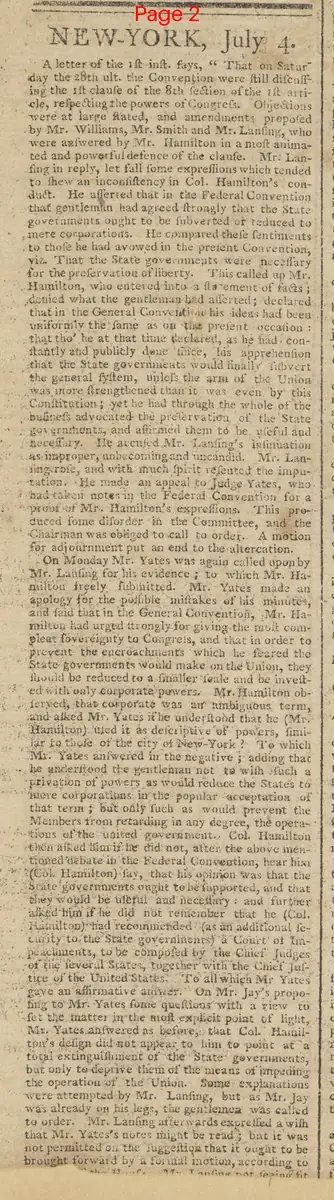
A letter of the 1st inst. says, "That on Saturday the 28th ult. the Convention were still discussing the 1st clause of the 8th section of the 1st article, respecting the powers of Congress. Objections were at large stated, and amendments proposed by Mr. Williams, Mr. Smith and Mr. Lansing, who were answered by Mr. Hamilton in a most animated and powerful defence of the clause. Mr. Lansing in reply, let fall some expressions which tended to show an inconsistency in Col. Hamilton's conduct. He asserted that in the Federal Convention that gentleman had agreed strongly that the State governments ought to be subverted or reduced to mere corporations. He compared these sentiments to those he had avowed in the present Convention, viz. That the State governments were necessary for the preservation of liberty. This called up Mr. Hamilton, who entered into a statement of facts; denied what the gentleman had asserted; declared that in the General Convention his ideas had been uniformly the same as on this present occasion: that tho' he at that time declared, as he had constantly and publicly done since, his apprehension that the State governments would finally subvert the general system, unless the arm of the Union was more strengthened than it was even by this Constitution; yet he had through the whole of the business advocated the preservation of the State governments, and affirmed them to be useful and necessary. He accused Mr. Lansing's insinuation as improper, unbecoming and uncandid. Mr. Lansing rose, and with much spirit resented the imputation. He made an appeal to Judge Yates, who had taken notes in the Federal Convention for a proof of Mr. Hamilton's expressions. This produced some disorder in the Committee, and the Chairman was obliged to call to order. A motion for adjournment put an end to the altercation.
On Monday Mr. Yates was again called upon by Mr. Lansing for his evidence; to which Mr. Hamilton freely submitted. Mr. Yates made an apology for the possible mistakes of his minutes, and said that in the General Convention, Mr. Hamilton had urged strongly for giving the most complete sovereignty to Congress, and that in order to prevent the encroachments which he feared the State governments would make on the Union, they should be reduced to a smaller scale and be invested with only corporate powers. Mr. Hamilton observed, that corporate was an ambiguous term, and asked Mr. Yates if he understood that he (Mr. Hamilton) used it as descriptive of powers, similar to those of the city of New-York? To which Mr. Yates answered in the negative; adding that he understood the gentleman not to wish such a privation of powers as would reduce the States to mere corporations in the popular acceptation of that term; but only such as would prevent the Members from retarding in any degree, the operations of the united government. Col. Hamilton then asked him if he did not, after the above mentioned debate in the Federal Convention, hear him (Col. Hamilton) say, that his opinion was that the State governments ought to be supported, and that they would be useful and necessary: and further asked him if he did not remember that he (Col. Hamilton) had recommended (as an additional security to the State governments) a Court of Impeachments, to be composed by the Chief Judges of the several States, together with the Chief Justice of the United States. To all which Mr. Yates gave an affirmative answer. On Mr. Jay's proposing to Mr. Yates some questions with a view to set the matter in the most explicit point of light, Mr. Yates answered as before, that Col. Hamilton's design did not appear to him to point at a total extinguishment of the State governments, but only to deprive them of the means of impeding the operation of the Union. Some explanations were attempted by Mr. Lansing, but as Mr. Jay was already on his legs, the gentleman was called to order. Mr. Lansing afterwards expressed a wish that Mr. Yates's notes might be read; but it was not permitted on the suggestion that it ought to be brought forward by a formal motion, according to the rules of the house. Lansing out sepinofit."
What sub-type of article is it?
What keywords are associated?
What entities or persons were involved?
Where did it happen?
Domestic News Details
Primary Location
New York
Event Date
Saturday The 28th Ult. And Monday
Key Persons
Outcome
altercation ended with adjournment; mr. yates's testimony supported mr. hamilton's consistent views on preserving state governments.
Event Details
Debate in the convention on powers of Congress; objections and amendments by Williams, Smith, Lansing; Hamilton defended clause; Lansing accused Hamilton of inconsistency on state governments; Hamilton denied and accused Lansing of uncandid insinuation; disorder ensued, chairman called order, adjourned. On Monday, Yates testified on Hamilton's Federal Convention statements, clarifying no intent to subvert states but to strengthen Union; affirmed Hamilton's support for states.