Thank you for visiting SNEWPapers!
Sign up free
New York Tribune
New York, New York County, New York
What is this article about?
Report of M. Gannal's discovery: injecting chloride of aluminum into animals preserves flesh indefinitely without taste change, enabling fresh meat export and improving sea voyages. Demonstrated at French Academy with preserved meats.
Clipping
OCR Quality
Full Text
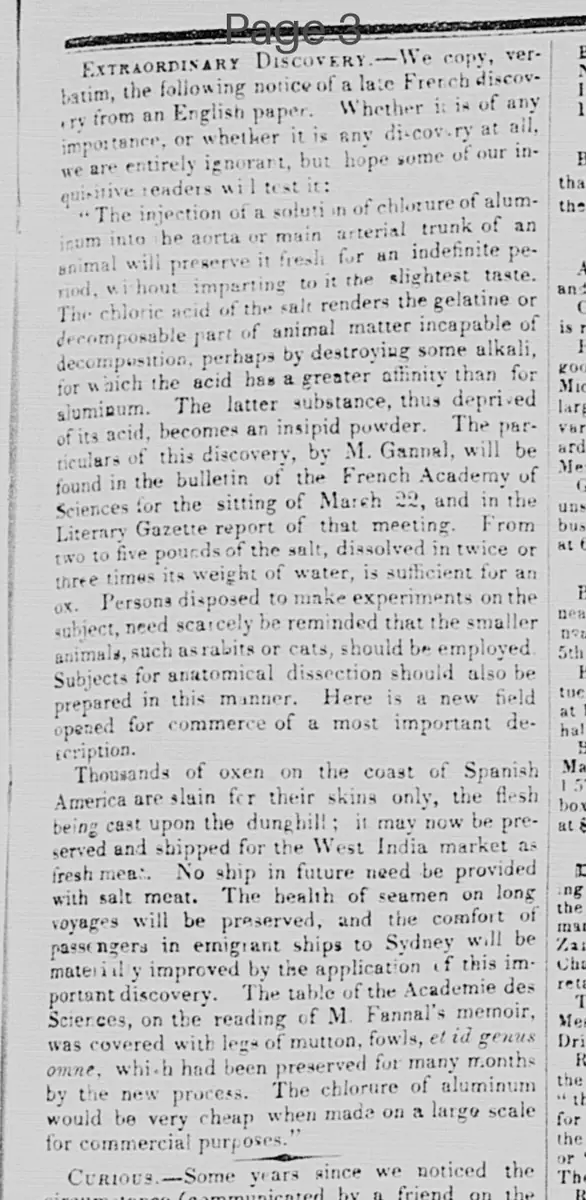
"The injection of a solution of chloride of aluminum into the aorta or main arterial trunk of an animal will preserve it fresh for an indefinite period, without imparting to it the slightest taste. The chloric acid of the salt renders the gelatine or decomposable part of animal matter incapable of decomposition, perhaps by destroying some alkali, for which the acid has a greater affinity than for aluminum. The latter substance, thus deprived of its acid, becomes an insipid powder. The particulars of this discovery, by M. Gannal, will be found in the bulletin of the French Academy of Sciences for the sitting of March 22, and in the Literary Gazette report of that meeting. From two to five pounds of the salt, dissolved in twice or three times its weight of water, is sufficient for an ox. Persons disposed to make experiments on the subject, need scarcely be reminded that the smaller animals, such as rabbits or cats, should be employed. Subjects for anatomical dissection should also be prepared in this manner. Here is a new field opened for commerce of a most important description. Thousands of oxen on the coast of Spanish America are slain for their skins only, the flesh being cast upon the dunghill: it may now be preserved and shipped for the West India market as fresh meat. No ship in future need be provided with salt meat. The health of seamen on long voyages will be preserved, and the comfort of passengers in emigrant ships to Sydney will be materially improved by the application of this important discovery. The table of the Academie des Sciences, on the reading of M. Gannal's memoir, was covered with legs of mutton, fowls, et id genus omne, which had been preserved for many months by the new process. The chlorure of aluminum would be very cheap when made on a large scale for commercial purposes."
What sub-type of article is it?
What themes does it cover?
What keywords are associated?
What entities or persons were involved?
Where did it happen?
Story Details
Key Persons
Location
French Academy Of Sciences
Event Date
March 22
Story Details
M. Gannal discovers that injecting a solution of chloride of aluminum into an animal's main artery preserves its flesh fresh indefinitely without altering taste, by preventing decomposition. Details reported in French Academy bulletin and Literary Gazette. Suitable for oxen (2-5 lbs salt in water), smaller animals like rabbits or cats for testing, and anatomical subjects. Opens commerce: preserve meat from Spanish America for West Indies, eliminate salt meat on ships, improve seamen and passenger health. Demonstration featured preserved mutton legs and fowls.